Corpse bride
Chinese superstition fuels latest horror novel from Winnipeg author

Advertisement
Read this article for free:
or
Already have an account? Log in here »
To continue reading, please subscribe:

Digital Subscription
One year of digital access for only $205*
- Enjoy unlimited reading on winnipegfreepress.com
- Read the E-Edition, our digital replica newspaper
- Access News Break, our award-winning app
- Play interactive puzzles
*First annual payment billed as $205.00 + GST for one year. This annual subscription will automatically renew at $233.00 + GST every 52 weeks (10% off the regular annual price of $259.35). Offer available to new and qualified returning subscribers only. Cancel any time.
To continue reading, please subscribe:
Add Free Press access to your Brandon Sun subscription for only an additional
$1 for the first 4 weeks*
- Enjoy unlimited reading on winnipegfreepress.com
- Read the E-Edition, our digital replica newspaper
- Access News Break, our award-winning app
- Play interactive puzzles
*Your next Brandon Sun subscription payment will increase by $1.00 and you will be charged $17.95 plus GST for four weeks. After four weeks, your payment will increase to $24.95 plus GST every four weeks.
Read unlimited articles for free today:
or
Already have an account? Log in here »
Hey there, time traveller!
This article was published 23/01/2026 (255 days ago), so information in it may no longer be current.
When she was growing up, Lindsay Wong was often warned of the ominous fate that could befall a woman who dies unmarried.
“There’s this Chinese superstition called corpse marriage, or míng hūn, where if you don’t get married, you’re gonna end up in a coffin with a corpse, someone you don’t know — and that was always told to me,” says the Vancouver-born, Winnipeg-based author.
Wong thought that, with her luck, not only would this happen to her, but things would go horribly wrong and she would wake up somehow and the corpse beside her would start yapping. For eternity.

SUPPLIED
Winnipeg-based author Lindsay Wong’s debut horror novel for adults is both harrowing and hilarious.
“And what if that person’s soooo boring?” she laughs.
Corpse marriage is at the heart of Villain Hitting for Vicious Little Nobodies, Wong’s harrowing and hilarious debut horror novel for adults which came out earlier this month by Penguin Canada and will be celebrated with a local book launch on Tuesday at McNally Robinson Grant Park.
Our protagonist is Locinda Lo, an acerbic MFA dropout living in Vancouver with six roommates, zero prospects, one powerful witch of a grandmother and a reanimated corpse of a kid sister who relies on drops of Locinda’s blood to remain among the living.
Locinda’s in crushing debt and, to avoid ruin — and save her family who she does, in fact, love, maggots and all — she signs herself away to Joyful Coffin & Co. Matchmaking Services, which will auction her off as a corpse bride.
Wong, 38, has a true gift for the grotesque, as displayed in her 2023 short-story horror collection Tell Me Pleasant Things about Immortality, and capturing complicated family dynamics, as she explored via her own in her acclaimed 2018 memoir The Woo-Woo: How I Survived Ice Hockey, Drug Raids, Demons, and My Crazy Chinese Family. Here, she brings together elements of both.
“I call this book my Frankenstein’s monster because it is a little bit of everything that I’m obsessed with and also kind of scared of,” Wong says.
That includes corpse brides, but also the villain hitting of the title. Locinda’s story becomes entwined with that of Baozhai, her made-from-tough-stuff grandmother who was a very skilled and much-feared Villain Hitter, a woman who will curse your enemies by using shoes to strike paper effigies of the person (or villain) being cursed.
“I call this book my Frankenstein’s monster because it is a little bit of everything that I’m obsessed with and also kind of scared of.”
Wong was fascinated by this ancient ritual and, in 2023, went on a research trip to Hong Kong to meet some actual Villain Hitters.
“They are these really old aunties and anyone can ask them to curse someone they don’t like. And it’s really inexpensive. I found out $50 Hong Kong is only $9 Canadian, so imagine you could just go and be like, ‘Here are 30 people that I really hate.’” (Wong didn’t have anyone to curse, for the record.)
The novel explores fears both ancient and modern, particularly around “choices” — who gets to make them, who gets more of them and what happens when a choice, such as Locinda’s choice to become a corpse bride to get out of poverty, doesn’t seem like much of a choice at all.
And while Baozhai’s story, which is intertwined with Locinda’s, is one of scrappy survival, she is also presented with a very narrow range of choices (and what is villain hitting if not an ancient gig economy?). There’s a devastating passage after she is kidnapped by Japanese soldiers during the Battle of Hong Kong in which she realizes that her body will never be her own.
“I was really just thinking about the cost of living. Who gets to survive, who gets to make art, and what our worth is based on. Especially for women, we’re often told it’s our bodies, it’s our physical beauty. We’re told that we’re worth what we do for a living. Locinda’s really struggling with that as well, and it doesn’t help that she comes from this family that has suffered so much intergenerational trauma,” Wong says.
“I was really just thinking about the cost of living. Who gets to survive, who gets to make art, and what our worth is based on.”
Placing Locinda in the MFA/writing world was also a site to explore ideas about who gets to be “somebodies” (usually via a specific alchemy of privilege, race, class and looks) and who are consigned to being “nobodies,” as well as what success looks like when you’re barely scraping by.
There’s an excellent detail about one of Locinda’s roommates, who is a revered theatre director with numerous accolades but doesn’t own a bedframe.
It’s an observation plucked from Wong’s own experience living with six roommates in Vancouver. Unlike Locinda, Wong had finished her MFA from Columbia University and had published The Woo-Woo. To the outside world, she appeared successful, but paying $800 a month to sleep on a mattress on the floor with six roommates didn’t feel much like success.
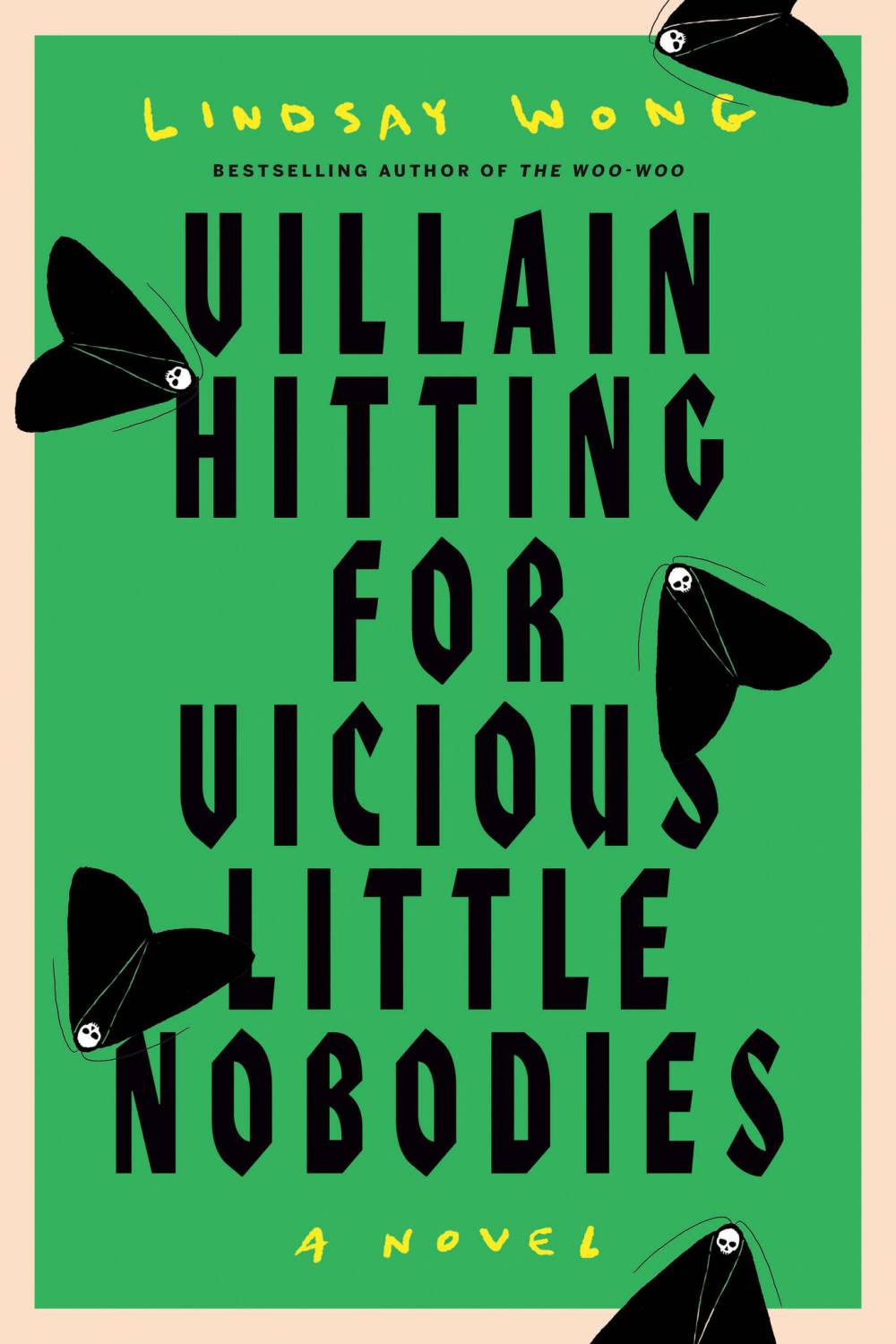
SUPPLIED
Wong calls her latest work her ‘Frankenstein’s monster because it is a little bit of everything that I’m obsessed with and also kind of scared of.’
“What people see on the surface is all this shiny success, but you yourself are really struggling in poverty, right? I think living with six roommates in Vancouver is the modern-day version of what a starving artist goes through,” Wong says.
“And then thinking about the Villain Hitters in Hong Kong, and they still exist today. They’re all really old ladies, and they seem like they have no place to go. They’re just sitting there with a shoe being like, give me your rage, this is what I can do for you.
“So (the book) is really about the whole idea of, what do you do as a marginalized female?”
Family and ancestry — and all that is bound up in that — is also explored through the relationship between Locinda and her entitled sister Samantha, who has been brought back from the dead and relies on Locinda for her survival.
Possibly the only thing worse than a bratty baby sister is a constantly rotting bratty baby sister.
“I was always thinking about siblings as a kind of resource, in a way — especially in ancient China,” Wong says, pointing out that people often had lots of children to help run a farm, say, or were confronted with the cruel fact of a high mortality rate. Children themselves were resources, but they also had to compete for resources.
“Samantha is kind of like a parasite, but then, at the same time, they really do need each other, and they don’t know that. One depends on the other for blood. Samantha really wants to be Locinda, and Locinda really wants to be Samantha. It’s that very complicated thing of wanting something but also not wanting something. Again, it’s that choicelessness. And having no choice but to depend on the people that you’ve been given.”
As in all her work, Wong writes against stereotypes of Asian women.
“The grandmother is such a survivor. She’s resilient, right? And she’s not some passive, meek person who just takes her fate and quietly suffers.”

To that end, grief and rage are important themes in the book, Wong says, as well as animating forces for her characters: none of the women here take their fates lying down, not even Locinda in her coffin.
But despite the dark subject matter, Villain Hitting for Vicious Little Nobodies is frequently laugh-out-loud funny, with humour popping up in places where a reader might not expect to encounter it.
“I think the whole book is rooted in discomfort. I’m always writing from a place of being uncomfortable; there’s no story when someone is comfortable. It’s the idea of feeling like you don’t belong in your own skin, and that’s sort of the effect that I was trying to go for in terms of writing,” she says.
“And I think when something’s really heavy, adding a little joke or a moment can really just make the reader take a deep breath and reflect on what they just read. Because if it was all really dark and terrible, I think the reader would probably give up.”
winnipegfreepress.com/jenzoratti
Jen Zoratti is a columnist and feature writer working in the Arts & Life department, as well as the author of the weekly newsletter NEXT. A National Newspaper Award finalist for arts and entertainment writing, Jen is a graduate of the Creative Communications program at RRC Polytech and was a music writer before joining the Free Press in 2013. Read more about Jen.
Every piece of reporting Jen produces is reviewed by an editing team before it is posted online or published in print – part of the Free Press‘s tradition, since 1872, of producing reliable independent journalism. Read more about Free Press’s history and mandate, and learn how our newsroom operates.
Our newsroom depends on a growing audience of readers to power our journalism. If you are not a paid reader, please consider becoming a subscriber.
Our newsroom depends on its audience of readers to power our journalism. Thank you for your support.
Book launch preview
Villain Hitting for Vicious Little Nobodies, by Lindsay Wong
Tuesday, 7 p.m.
McNally Robinson Grant Park
Q&A hosted by Jenny Heijun Wills
Will be available as a YouTube stream
Jen Zoratti is a columnist and feature writer working in the Arts & Life department, as well as the author of the weekly newsletter NEXT. A National Newspaper Award finalist for arts and entertainment writing, Jen is a graduate of the Creative Communications program at RRC Polytech and was a music writer before joining the Free Press in 2013. Read more about Jen.
Every piece of reporting Jen produces is reviewed by an editing team before it is posted online or published in print – part of the Free Press‘s tradition, since 1872, of producing reliable independent journalism. Read more about Free Press’s history and mandate, and learn how our newsroom operates.
Our newsroom depends on a growing audience of readers to power our journalism. If you are not a paid reader, please consider becoming a subscriber.
Our newsroom depends on its audience of readers to power our journalism. Thank you for your support.
Advertisement Advertise With Us
Advertisement Advertise With Us