Lighter motifs
Singer exploring portrayals of Indigenous women in opera stresses need for joy, humour

Advertisement
Read this article for free:
or
Already have an account? Log in here »
To continue reading, please subscribe:

Digital Subscription
One year of digital access for only $205*
- Enjoy unlimited reading on winnipegfreepress.com
- Read the E-Edition, our digital replica newspaper
- Access News Break, our award-winning app
- Play interactive puzzles
*First annual payment billed as $205.00 + GST for one year. This annual subscription will automatically renew at $233.00 + GST every 52 weeks (10% off the regular annual price of $259.35). Offer available to new and qualified returning subscribers only. Cancel any time.
To continue reading, please subscribe:
Add Free Press access to your Brandon Sun subscription for only an additional
$1 for the first 4 weeks*
- Enjoy unlimited reading on winnipegfreepress.com
- Read the E-Edition, our digital replica newspaper
- Access News Break, our award-winning app
- Play interactive puzzles
*Your next Brandon Sun subscription payment will increase by $1.00 and you will be charged $17.95 plus GST for four weeks. After four weeks, your payment will increase to $24.95 plus GST every four weeks.
Read unlimited articles for free today:
or
Already have an account? Log in here »
Hey there, time traveller!
This article was published 26/01/2026 (217 days ago), so information in it may no longer be current.
While historically opera has been divided into comedies and tragedies, buffa and seria, Camryn Dewar believes Canada’s recent operas have tended to be overly solemn when tackling certain difficult subjects.
The Métis-Canadian soprano is thinking, in particular, about the representation of Indigenous issues — a lightning rod for both government funding and critical scrutiny in Canadian culture.
“Lots of (operas) tackle the struggle and the loss, but not many of them feature Indigenous joy and humour,” she says. “And that’s something that’s really necessary because it helps with normalization, showing us as normal people.”
MIKE DEAL / FREE PRESS
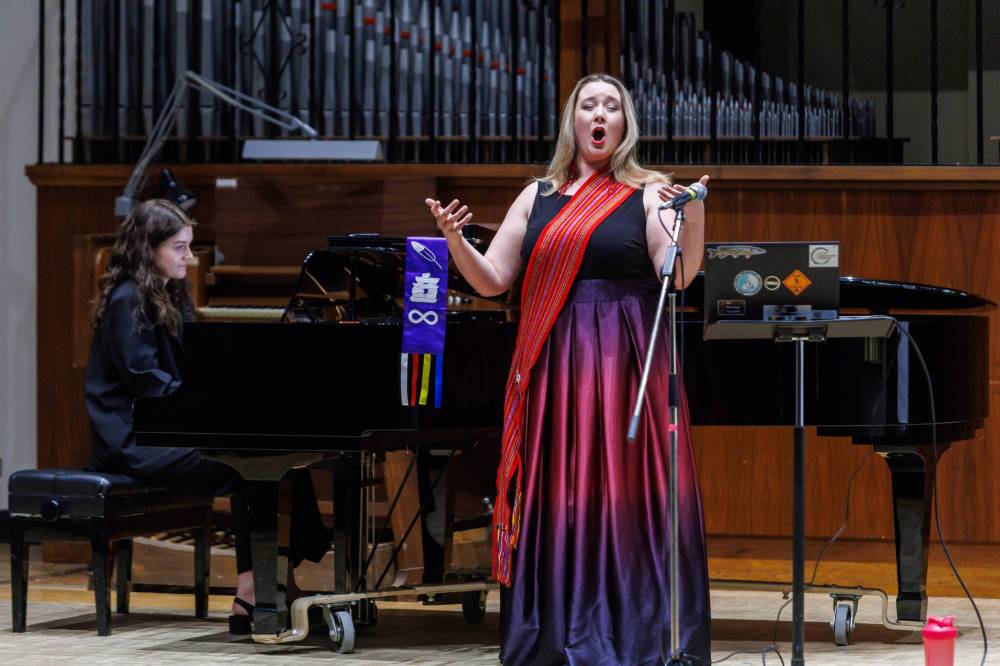
Camryn Dewar, Red River Métis Nation Citizen and Fulbright Scholar, launches her national lecture‑recital tour on Jan. 16 at the University of Manitoba.
Dewar, a Fulbright Scholar with a newly minted master of music in vocal performance from Montclair State University, is on a Canadian tour showcasing Indigenous Female Representation in Opera, 1879–Present. Part lecture, part singing performance, the presentation had its first Winnipeg stop last week at the University of Manitoba and returns to the Canadian Mennonite University at 11:30 a.m., March 12, in the Laudamus Auditorium.
“Looking at example from 1879, Indigenous women are sexualized, minimized,” she says. “Instead of very simple caricatures … now we are seeing real people — Indigenous women are being shown as whole people with complex character development.”
Her presentation draws on an impressive CV: she hasn’t just done a ton of scholarly research, she’s also played some of the parts she’s describing. Dewar appeared in Li Keur: Riel’s Heart of the North with Manitoba Opera and the Winnipeg Symphony Orchestra, and has sung on some of the world’s most prestigious stages, including Carnegie Hall and the Lincoln Center in New York.
One of her favourite roles is Mimi in Indians on Vacation, which she performed at the Banff Centre in 2024.
“Mimi is a real person — she’s hilarious, she’s relatable and she’s honest almost to a fault,” she says. “Indians on Vacation, as a work, is the best representation of Indigenous people in opera that we have.”
Indians on Vacation was supposed to figure centrally into her presentation, but a recent revelation set her on a new course. The opera, whose composer Ian Cusson is Indigenous, is based on a book by prominent Canadian writer and scholar Thomas King, widely known for his work on Indigenous issues.
In November, the 82-year-old wrote an article for The Globe and Mail revealing that genealogical research showed he was not, as he’d long publicly claimed, Indigenous.
King insisted the revelation came as a shock to him, believing for the better part of a century what his family had always told him: that he was of Cherokee ancestry.

MIKE DEAL / FREE PRESS
Camryn Dewar’s national presentation tour — part lecture, part performance — will return March 12 to Winnipeg at Canadian Mennonite University.
“I spent the majority of my Fulbright Scholarship researching Indians on Vacation,” says Dewar. “It was heartbreaking and such a loss to find out about Thomas King’s heritage.”
This importance is also comparative, she says, given how weak and stereotypical the representation of Indigenous women and communities have historically been in Canadian literature and opera.
Indigenous Female Representation in Opera, 1879–Present begins with an almost forgotten work called Canada’s Welcome, a masque with music performed for visiting royalty in 1879.
Much of Canadian literature and culture at the time has been considered “provincial” — anxious about its own identity, while unevenly echoing European archetypes.
As Dewar sees it, this sends Canada’s Welcome pulling in slightly different directions: sometimes exoticizing its Indigenous characters, as Romantic-era opera often did non-European people, while also maligning them in a way that might impress the colonialist outlook of its royal audience.
“There’s two ends of the spectrum: the absolute ‘savagery’ of these people and how they’re danger and violent or … the ‘noble savage’ and romanticization,” she says.
Dewar also analyzes more recent operas, including Louis Riel (1967) — composed by Harry Somers for the 1967 Canadian Centennial and one of the most significant operas to date — Missing (2017), Shanawdithit (2019) and Li Keur (2023).

While she’s proud to see how far Indigenous representation in opera has come, she thinks it’s time Canadian opera rediscovers an Indigenous sense of humour and levity. Opera buffa and seria need not be mutually exclusive.
MIKE DEAL / FREE PRESS
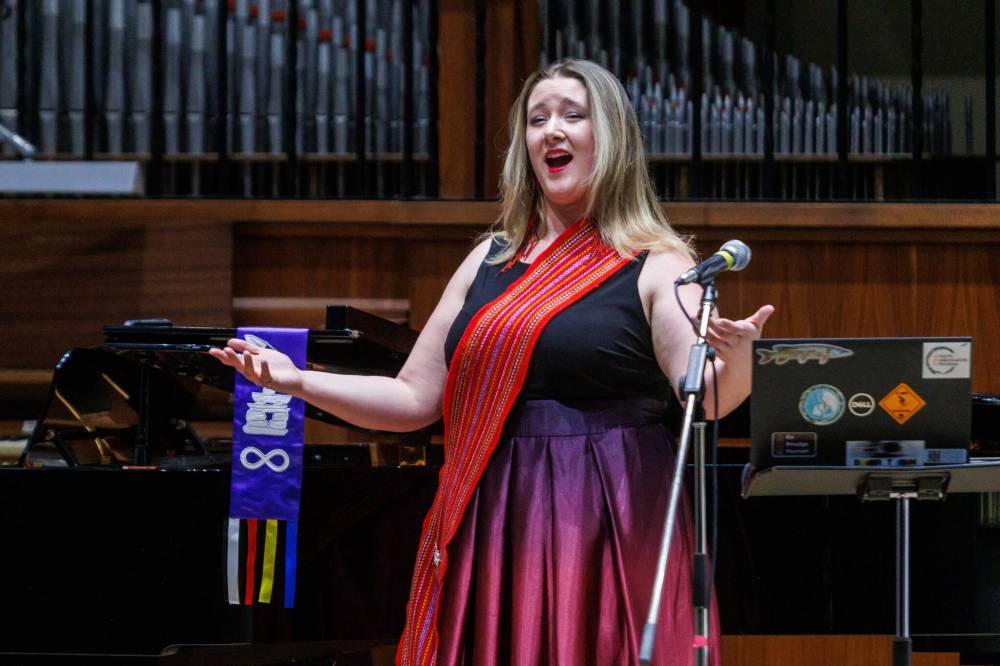
In addition to her research, Dewar has played some of the parts she analyzes in her presentation.
“I want characters filled with strength and joy and humour and relatability,” she says.
As for how the tradition is supposed to move forward, at a time of relative precarity for Canada’s traditional arts sector, Dewar projects optimism.
“There are lots of composers and librettists that are passionate about it,” she says. “Because of precedent, I do feel confident that there are creators that are wanting to do this work, that are wanting to put in this effort.”
winnipegfreepress.com/conradsweatman
Conrad Sweatman is an arts reporter and feature writer. Before joining the Free Press full-time in 2024, he worked in the U.K. and Canadian cultural sectors, freelanced for outlets including The Walrus, VICE and Prairie Fire. Read more about Conrad.
Our newsroom depends on a growing audience of readers to power our journalism. If you are not a paid reader, please consider becoming a subscriber.
Our newsroom depends on its audience of readers to power our journalism. Thank you for your support.
Event preview
Indigenous Female Representation in Opera, 1879-Present
By Camryn Dewar
● March 12
● Laudamus Auditorium, Canadian Mennonite University, 11:30 a.m.
● Free
Conrad Sweatman is an arts reporter and feature writer. Before joining the Free Press full-time in 2024, he worked in the U.K. and Canadian cultural sectors, freelanced for outlets including The Walrus, VICE and Prairie Fire. Read more about Conrad.
Our newsroom depends on a growing audience of readers to power our journalism. If you are not a paid reader, please consider becoming a subscriber.
Our newsroom depends on its audience of readers to power our journalism. Thank you for your support.
Advertisement Advertise With Us
Advertisement Advertise With Us