New Music Festival faces diminuendo-ing audiences

Advertisement
Read this article for free:
or
Already have an account? Log in here »
To continue reading, please subscribe:

Digital Subscription
One year of digital access for only $205*
- Enjoy unlimited reading on winnipegfreepress.com
- Read the E-Edition, our digital replica newspaper
- Access News Break, our award-winning app
- Play interactive puzzles
*First annual payment billed as $205.00 + GST for one year. This annual subscription will automatically renew at $233.00 + GST every 52 weeks (10% off the regular annual price of $259.35). Offer available to new and qualified returning subscribers only. Cancel any time.
To continue reading, please subscribe:
Add Free Press access to your Brandon Sun subscription for only an additional
$1 for the first 4 weeks*
- Enjoy unlimited reading on winnipegfreepress.com
- Read the E-Edition, our digital replica newspaper
- Access News Break, our award-winning app
- Play interactive puzzles
*Your next Brandon Sun subscription payment will increase by $1.00 and you will be charged $17.95 plus GST for four weeks. After four weeks, your payment will increase to $24.95 plus GST every four weeks.
Read unlimited articles for free today:
or
Already have an account? Log in here »
Hey there, time traveller!
This article was published 12/02/2026 (215 days ago), so information in it may no longer be current.
The question of Canadian orchestral music’s future may not keep a lot of people up at night. But perhaps that indifference itself hints at a future that can’t be taken for granted.
When the Winnipeg New Music Festival — one of Canada’s premier platforms for emerging and established Canadian composers, which ran this year from Jan. 21 to 29 — shows signs of struggling, perhaps more Winnipeggers should be kept awake at night.
The past 18 years of Free Press reviews suggests a gradual decline in attendance to the flagship festival presented by the Winnipeg Symphony Orchestra. In 2008, attendance at individual concerts at the Centennial Concert Hall was 1,500 and 1,310; 2017 saw those numbers drop to 1,000 and 1,133. In 2023, the single show reviewed had a head count of 639. This year, the two reviewed concerts at the concert hall drew audiences of 454 and 474, less than a quarter of the venue’s 2,300-seat capacity.
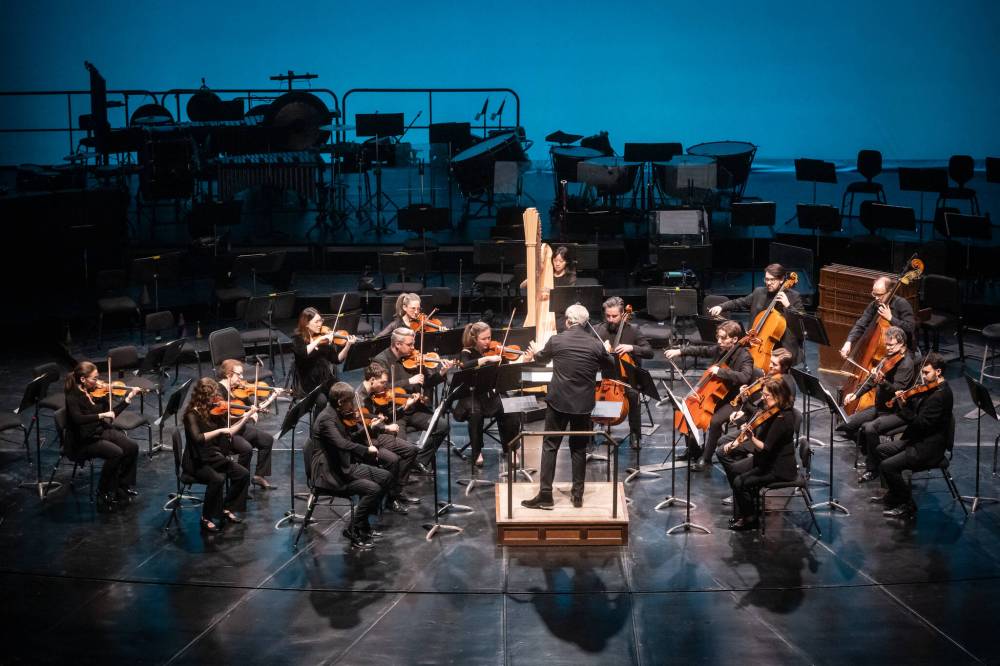
Matt Duboff photo
Audiences at the New Music Festival have been getting smaller and smaller over the years.
Angela Birdsell, the WSO’s executive director, is nothing if not candid about the hurdles contemporary Canadian music faces today, even though she’s very proud of the festival.
“Seeing 600 or 700 people in a hall for a new music concert is still pretty damn good. We do (the festival) even when we can’t really afford to because we believe it’s important,” she says.
It’s been a bustling few weeks for the WSO.
Last week the Centennial Concert Hall was filled to the rafters with cheering fans for Brawl at the Hall. As local Winnipeg Professional Wrestling stars Chad Daniels, Jody Threat and others swapped piledrivers and chokeholds, the orchestra bellowed classical megahits.
“It’s probably one of the best events we’ve ever done. The orchestra wasn’t the star, the wrestlers weren’t the star, the crowd was the star. The crowd was chanting, ‘Tuba, tuba, tuba!’” says Birdsell.
On Saturday, a full house of Winnipeggers revelled in the WSO’s Murdoch Mysteries in Concert, a live experience of the Canadian detective TV show featuring composer Rob Carli’s score.
Successes like these show there’s an appetite here not just for classical music, but for Canadian-centric creations, on the concert hall’s stage.
So why does the Winnipeg New Music Festival struggle, comparatively, to fill the hall?
Birdsell points out that almost every year still has its blockbuster concerts with famous guest artists attracting fuller audiences, and that attendance is also limited by seating, with the WSO often opting in recent years for smaller venues. (This year’s fest included several sold-out shows at the Desaultels Concert Hall, which seats about 400.)
She suggests there are other challenges, too.
“One aspect of the festival from the past, that we haven’t reintegrated since the pandemic, are partnerships with the visual arts community,” she says. “It’s difficult to say how much that drove ticket sales, but it would have definitely contributed to getting the word out.”
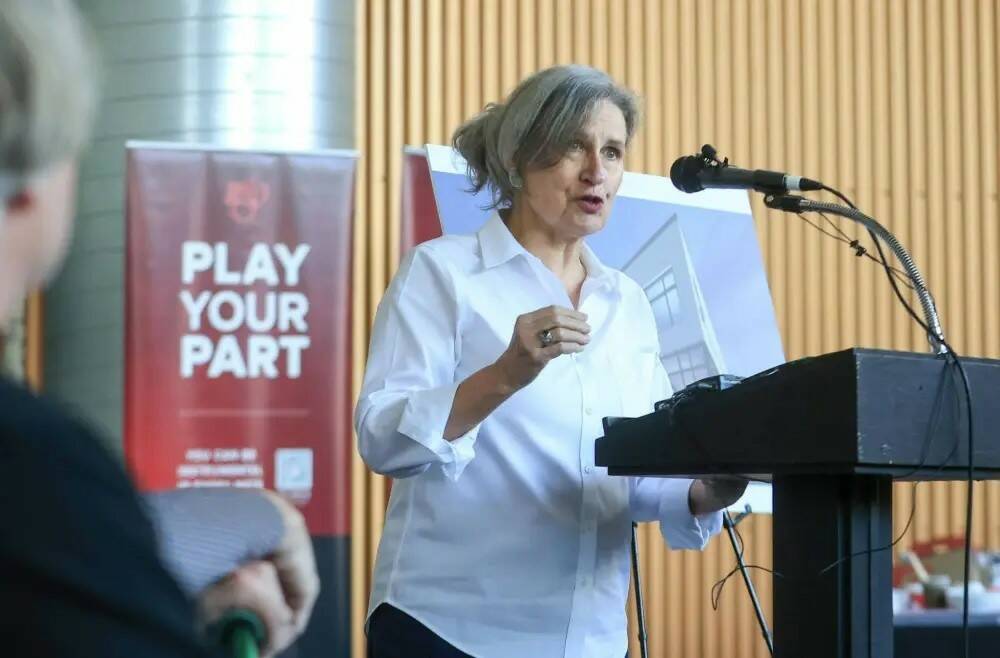
RUTH BONNEVILLE / WINNIPEG FREE PRESS files
Winnipeg Symphony Orchestra executive director Angela Birdsell believes the festival is important, even if it doesn’t fill seats the way it used to.
She goes on to highlight that in the festival’s early years it enjoyed a large-scale corporate sponsorship with DuMaurier. Festivals of this size need sizable marketing funds and this sponsorship supported that.
“Today we market through print, radio, TV, web and many social media platforms. As we know, it is more difficult to ensure comprehensive market penetration, despite the increased cost and workload related to reaching a multi-channel universe,” she says.
A common complaint about modern and contemporary classical music, often invoked to explain its struggles to attract audiences, is that it’s too dissonant or atonal.
Looking back on the past decade of festivals co-curated by WSO’s composer-in-residence Harry Stafylakis (who is completing his final season with the WSO), known for mixing rock sounds and orchestra, it would be difficult to describe the offerings as inaccessible.
Birdsell is heartened to see more young composers today open to influences from world and popular music, a trend reflected in this year’s programming with pieces such as Lisa Pegher’s pulsing electronic Fate Amenable to Grace and Christopher Theofanidis’s neo-romantic Rainbow Body.
“The joyful composers I see among young people are the ones that are trying all kinds of different stuff,” Birdsell says.
But Birdsell suggests that while new media have opened contemporary composers to a brave new world of sound and images, this comes with a price.
The dizzying experience that this freedom creates, where new content comes at us overwhelming rate is and quickly tossed away, may rob us of patience, seriousness or an openness to depth.
“Are we getting to the point where people simply aren’t able to shut down the other sensory parts of themselves and just listen? If we orchestras jump on the 15-second (TikTok song) bandwagon, are we just perpetuating the problem?” she asks.
In this light, composers for television, film and video games may have a professional advantage over composers for live orchestra. For better or worse, they’re enmeshed in the mediums of pop culture.

Matt Duboff photo
Percussionist Lisa Pegher performs at the 2026 fest.
Yet whether it’s in giving young composers a chance to cut their teeth before venturing into these more commercial fields, or in celebrating Canadian music for its own sake, there’s still nothing quite like the new music fest, which remains one of North America’s only festivals of new orchestral music.
“It’s still very risky thing, but I think we need it … (however), we’d like to have more of a festival vibe,” Birdsell says.

She adds that for future fests the WSO will “work towards balancing off bolstering attendance with the expressed desire of our patrons for the immersive kind of experience they appreciate.”
With most concerts still happening at the Centennial Concert Hall (Canada’s largest orchestral venue in one of its smaller capital cities), Birdsell also suggests that it’s no longer the right venue for the WSO.
The WSO plans to move into the smaller Pantages Playhouse next door by 2029. As of last June, $15 million had been raised by the WSO and the Performing Arts Consortium (Pantages’ owners) to convert it into a modernized 1,100-seat venue.
“Once we get into our new venue, we’ll have more opportunities to create different spots and places, little concerts here and there, and more immersive experiences,” she says.
winnipegfreepress.com/conradsweatman
Conrad Sweatman is an arts reporter and feature writer. Before joining the Free Press full-time in 2024, he worked in the U.K. and Canadian cultural sectors and freelanced for outlets including The Walrus, VICE and Prairie Fire. Read more about Conrad.
Our newsroom depends on a growing audience of readers to power our journalism. If you are not a paid reader, please consider becoming a subscriber.
Our newsroom depends on its audience of readers to power our journalism. Thank you for your support.
Conrad Sweatman is an arts reporter and feature writer. Before joining the Free Press full-time in 2024, he worked in the U.K. and Canadian cultural sectors and freelanced for outlets including The Walrus, VICE and Prairie Fire. Read more about Conrad.
Our newsroom depends on a growing audience of readers to power our journalism. If you are not a paid reader, please consider becoming a subscriber.
Our newsroom depends on its audience of readers to power our journalism. Thank you for your support.
Advertisement Advertise With Us
Advertisement Advertise With Us