Actor connects multiple storylines in RMTC’s telecommunications drama Rogers v. Rogers

Advertisement
Read this article for free:
or
Already have an account? Log in here »
To continue reading, please subscribe:

Digital Subscription
One year of digital access for only $205*
- Enjoy unlimited reading on winnipegfreepress.com
- Read the E-Edition, our digital replica newspaper
- Access News Break, our award-winning app
- Play interactive puzzles
*First annual payment billed as $205.00 + GST for one year. This annual subscription will automatically renew at $233.00 + GST every 52 weeks (10% off the regular annual price of $259.35). Offer available to new and qualified returning subscribers only. Cancel any time.
To continue reading, please subscribe:
Add Free Press access to your Brandon Sun subscription for only an additional
$1 for the first 4 weeks*
- Enjoy unlimited reading on winnipegfreepress.com
- Read the E-Edition, our digital replica newspaper
- Access News Break, our award-winning app
- Play interactive puzzles
*Your next Brandon Sun subscription payment will increase by $1.00 and you will be charged $17.95 plus GST for four weeks. After four weeks, your payment will increase to $24.95 plus GST every four weeks.
Read unlimited articles for free today:
or
Already have an account? Log in here »
Hey there, time traveller!
This article was published 20/02/2026 (212 days ago), so information in it may no longer be current.
Inviting audiences into the inner sanctum of a dysfunctional dynasty, playwright Michael Healey’s Rogers v. Rogers does for the Canadian telecommunications industry what Adam McKay’s The Big Short did for subprime loans: surveying a national economic ecosystem that feels destined to take advantage of consumer’s best interests while lining the coffers of a controlling billionaire class.
Like McKay’s film, which adapted Michael Lewis’s bestselling post-mortem of the 2008 financial meltdown, Healey’s script — which he clarifies is fictionalized — is grounded in a journalistic account of corporate drama: Globe and Mail reporter Alexandra Posadzki’s moment-to-moment breakdown of the inner turmoil at the leviathan Rogers Communications as it attempted to swallow Shaw whole.
As in The Big Short, the grand challenge in this tale of consumer sovereignty is to make it interesting, infuriating and entertaining enough to compel the average audience member, and not just the daily stock checkers and economics majors, to find their place within the boardroom saga.
Healey knows this, and acknowledges as much during the production’s introductory address, delivered by Matthew Boswell, an impassioned civil servant who has been appointed to the office of federal competition commissioner.
“The story I tell you will not be boring,” Boswell promises the skeptics, his sleeves rolled up as the work begins for Tom Rooney, the performer tasked with playing Boswell, every Rogers family member and at one thrilling high point, every single board member on an emergency Zoom call.
DAHLIA KATZ PHOTO Tom Rooney portrays more than a dozen different characters in Rogers v. Rogers.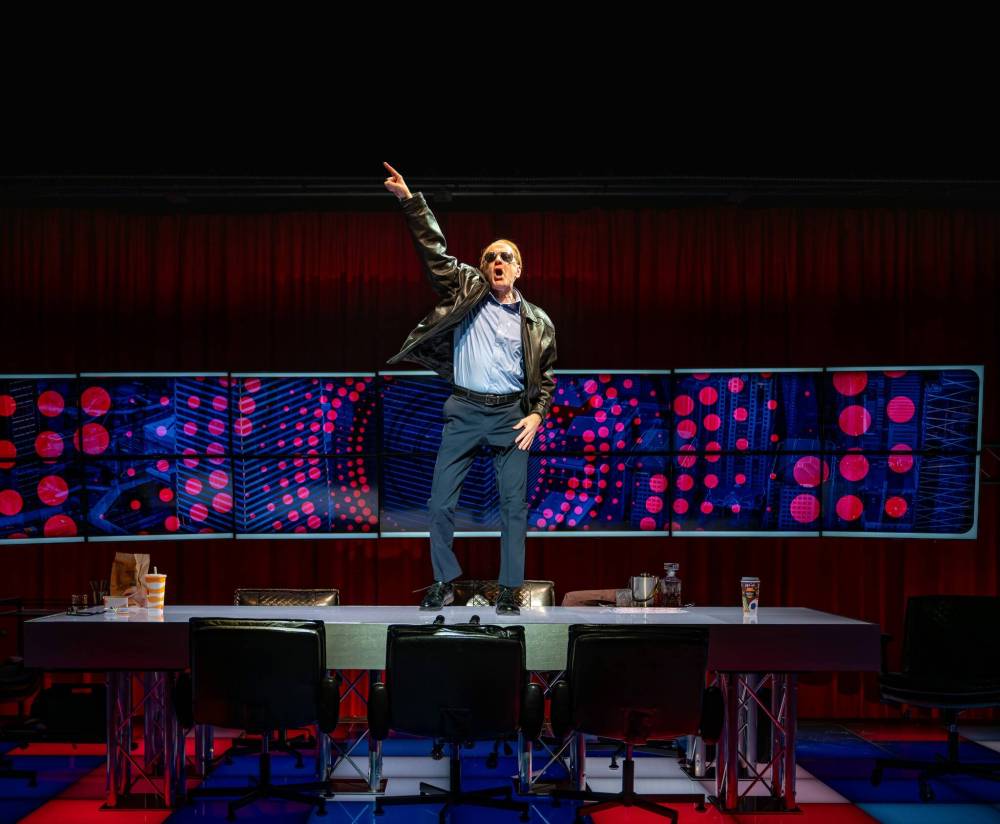
Over the course of the ensuing 80 minutes, without intermission, Rooney earns unanimous approval for his more than a dozen characterizations, keeping the audience meaningfully invested in a production that can’t afford for a moment to relinquish control.
One of the country’s most distinguished stage actors, having spent 13 seasons at the Stratford Festival, the Saskatchewan-raised Rooney answers the call, skilfully alternating modes and modalities, most notably as Boswell — the arms-akimbo consumer guardian — and as the bumbling Rogers family scion. Edward inherited his father’s first name, but is far from daddy’s first choice to inherit the multibillion-dollar corporation he constructed before his death in 2008.
As the stuttering Edward, Rooney stre-e-e-e-tches his si-hi-hi-hi-hillables, at first to comedic effect. But there’s a wise technique at play there: shivering through each pronunciation, even the least natural speaker Rooney portrays keeps the audience listening as he explicates his strategy for control.
The conversational tic also feels closely aligned with the self-doubt and mental anguish of a character who has been interrupted, misunderstood and underestimated his entire life: the punchline deepens to reveal the bruise.
By contrast, Boswell’s speechifying serves as an explicit rallying cry as he delineates the macroeconomic realities underlying the national illusions of consumer choice: you may like the nostalgic smell of vulcanized rubber, but you might not look at your neighbourhood Canadian Tire the same way after Boswell opens its corporate umbrella for analysis.
Under the direction of Crow’s Theatre’s artistic director Chris Abraham, Rooney is terrific, but to its credit, each production element meets his level.
DAHLIA KATZ PHOTO Tom Rooney explains the ins and outs of corporate mergers in an entertaining way.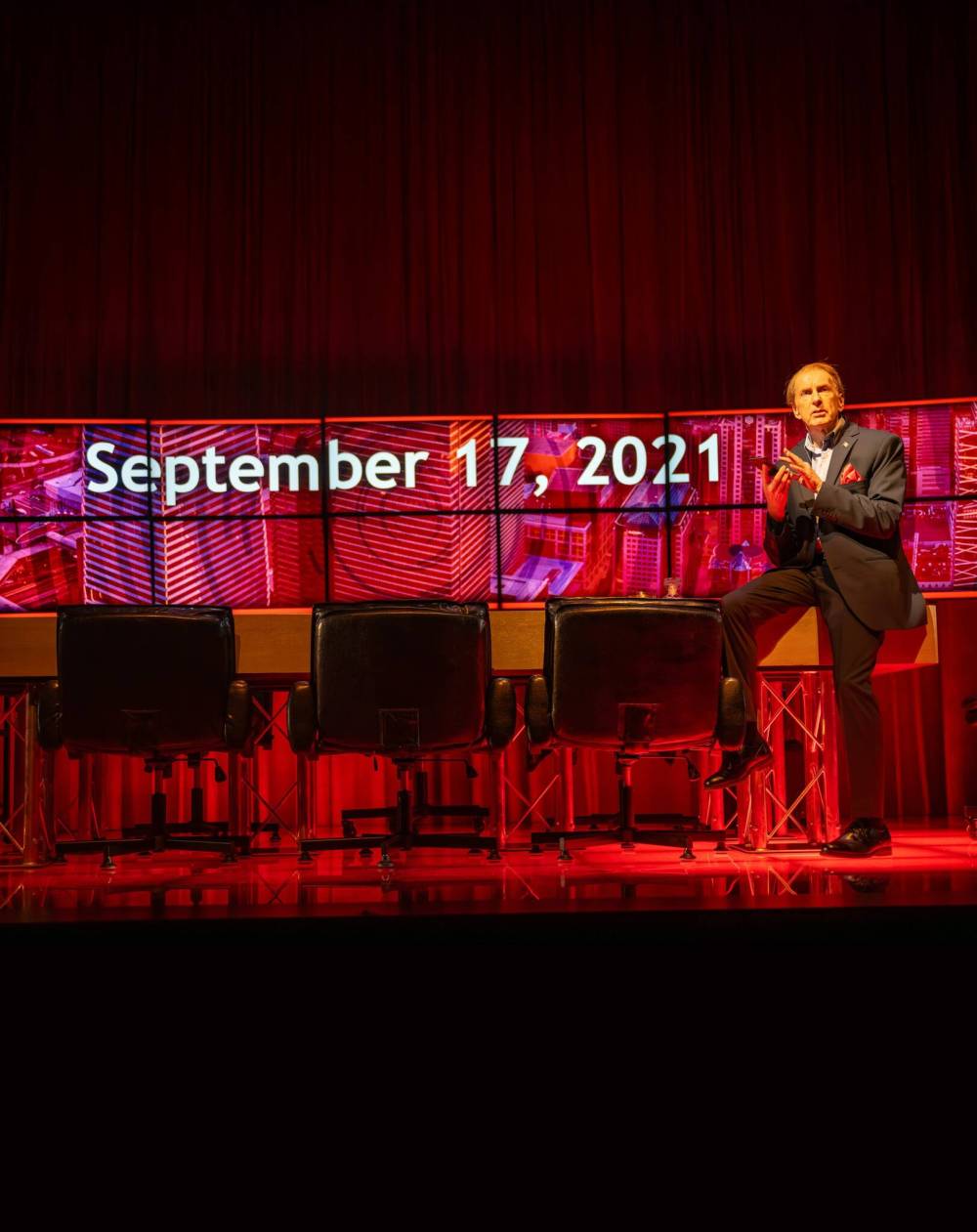
Joshua Quinlan’s set calls attention to the repeating patterns that unite the corporate class and our national infrastructure: the boardroom table Rooney stalks is constructed from the same steel beams as the scaffolding that frames the action. Imogen Wilson’s triple-layered lighting design gives the sense that access is being granted to secret conversations.
Behind the table are 14 LCD screens, frequently used by video designer Nathan Bruce as a corporate deck. Rooney’s Boswell often points there for graphic explanations of corporate acronyms (EBITDA and ARPU, anybody?) and Rogers uses the screens to remind the audience — and at times, himself — which obstacles he must surpass to reach the top of the executive ladder. These visual cues are absolutely necessary.
The set, video and lighting elements all work together brilliantly during the play’s emergency Zoom call, when Rooney is tasked with playing all 10 participants voting on the fate of the company’s interim CEO, including Edward Rogers, his sisters Martha and Melinda, and his own disapproving mother, Loretta.
And you thought your family groupchat was tense.
Rooney’s interpretation of the text is always buttressed, cushioned and heightened by Thomas Ryder Payne’s varied sound design, which again serves as an effective method for keeping the audience members engaged instead of checking their wristwatches, or worse, their cellphones.
Healey and, by extension, Rooney’s Boswell, are men of their word, keeping the production flowing along, with plenty of solid comedy to help the anti-capitalist theory go down smoothly.
winnipegfreepress.com/benwaldman
Ben Waldman is a National Newspaper Award-nominated reporter on the Arts & Life desk at the Free Press. Born and raised in Winnipeg, Ben completed three internships with the Free Press while earning his degree at Ryerson University’s (now Toronto Metropolitan University’s) School of Journalism before joining the newsroom full-time in 2019. Read more about Ben.
Every piece of reporting Ben produces is reviewed by an editing team before it is posted online or published in print — part of the Free Press‘s tradition, since 1872, of producing reliable independent journalism. Read more about Free Press’s history and mandate, and learn how our newsroom operates.
Our newsroom depends on a growing audience of readers to power our journalism. If you are not a paid reader, please consider becoming a subscriber.
Our newsroom depends on its audience of readers to power our journalism. Thank you for your support.
Theatre review
Rogers v. Rogers
Royal Manitoba Theatre Centre
John Hirsch Mainstage, 174 Market Ave.
To March 14
Four out of five
Ben Waldman is a National Newspaper Award-nominated reporter on the Arts & Life desk at the Free Press. Born and raised in Winnipeg, Ben completed three internships with the Free Press while earning his degree at Ryerson University’s (now Toronto Metropolitan University’s) School of Journalism before joining the newsroom full-time in 2019. Read more about Ben.
Every piece of reporting Ben produces is reviewed by an editing team before it is posted online or published in print — part of the Free Press‘s tradition, since 1872, of producing reliable independent journalism. Read more about Free Press’s history and mandate, and learn how our newsroom operates.
Our newsroom depends on a growing audience of readers to power our journalism. If you are not a paid reader, please consider becoming a subscriber.
Our newsroom depends on its audience of readers to power our journalism. Thank you for your support.
Related Articles
Consolidation plan: Actor takes on challenge of multiple roles in Rogers v. Rogers one-man show

Advertisement Advertise With Us
Advertisement Advertise With Us
History
Updated on Monday, February 23, 2026 5:07 PM CST: Corrects misidentification in headline