The Love That Remains an intimate family divorce drama

Advertisement
Read this article for free:
or
Already have an account? Log in here »
To continue reading, please subscribe:
Digital Subscription
One year of digital access for only $1.44 a week*
- Enjoy unlimited reading on winnipegfreepress.com
- Read the E-Edition, our digital replica newspaper
- Access News Break, our award-winning app
- Play interactive puzzles
*Billed as $5.77 plus GST every four weeks. After 52 weeks, price increases to the regular rate of $19.95 plus GST every four weeks. Offer available to new and qualified returning subscribers only. Cancel any time.
To continue reading, please subscribe:
Add Free Press access to your Brandon Sun subscription for only an additional
$1 for the first 4 weeks*
- Enjoy unlimited reading on winnipegfreepress.com
- Read the E-Edition, our digital replica newspaper
- Access News Break, our award-winning app
- Play interactive puzzles
*Your next Brandon Sun subscription payment will increase by $1.00 and you will be charged $17.95 plus GST for four weeks. After four weeks, your payment will increase to $24.95 plus GST every four weeks.
Read unlimited articles for free today:
or
Already have an account? Log in here »
Hey there, time traveller!
This article was published 27/02/2026 (231 days ago), so information in it may no longer be current.
From Icelandic writer-director Hlynur Palmason (Godland, A White, White Day), this family story is intimate but emotionally guarded, lightly funny but deeply melancholy.
The Love That Remains (in Icelandic, Swedish, French and English, with subtitles) could be called a divorce drama, but Palmason’s “scenes from a marriage” aren’t the usual round of regret, recrimination and wall-punching we see in such tumultuous films as Marriage Story.
Using a slow, subdued narrative that is both intermittently surreal and sweetly, completely mundane, the 41-year-old filmmaker starts with the separation of Anna (Saga Gardarsdottir) and Magnus (Sverrir Gudnason) as a quietly established fact.
He then tracks a year in the life of this rural family as the former couple and their somewhat confused children attempt to adjust, mostly with good intentions and the love that’s right there in the title. (Mostly.)
The kids are played with messy, easygoing naturalism by the director’s own children, daughter Ida Mekkín Hlynsdottir and twin boys Grímur Hlynsson and Thorgils Hlynsson. There’s also the family dog, Panda, an Icelandic sheepdog who plays herself and is easily the most emotionally accessible character onscreen. (For her standout work, Panda won last year’s Palm Dog at Cannes. Who’s a good girl?)
Anna is a visual artist who makes large, time-intensive pieces that draw on the breathtaking natural landscape around her. She’s over 40 and has never had a studio with a bathroom, she mentions at one point, and she’s “getting tired of peeing in a bucket.”
This career crisis is not helped by the hilariously awful Swedish gallerist who comes to look at her work.
“He just talks and talks,” she relates later to Magnus, and that’s not a compliment in this soft-spoken family.
Magnus works on a fishing trawler and is often at sea — both literally and figuratively, it turns out — allowing Palmason to subtly explore ideas about male isolation, a theme he covered in A White, White Day.
Still Vivid
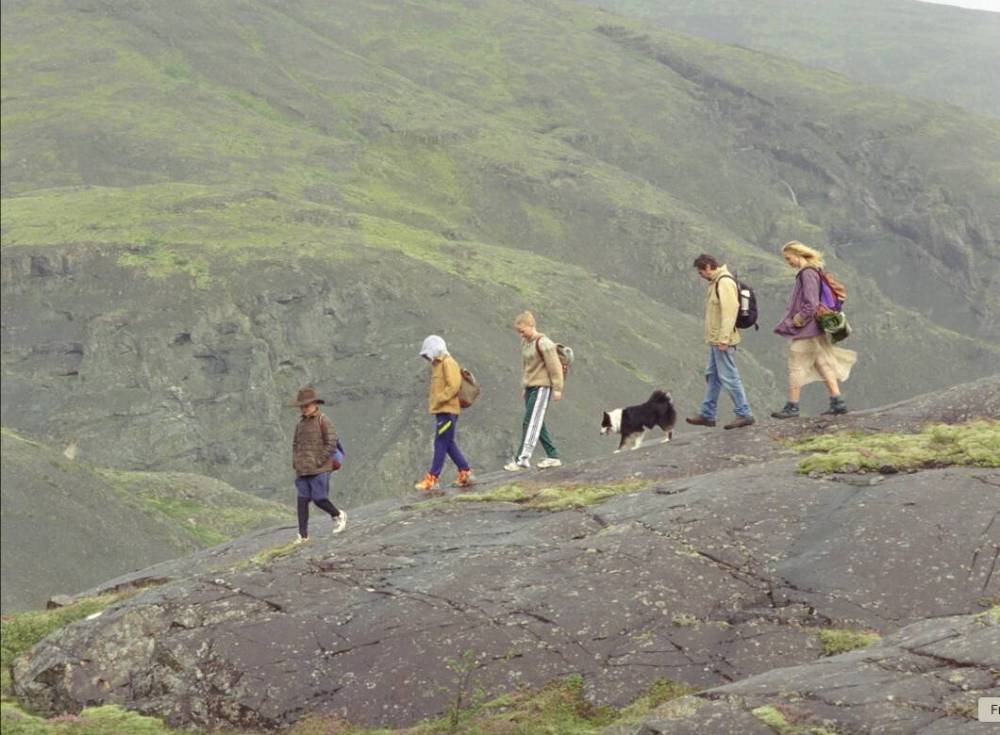
The film is undramatic but never dull, partly due to the sheer beauty of the backdrop.
Palmason is not really a plot guy, and here he is much more interested in the textures and rhythms of daily life. He conveys Anna and Magnus’s labour in patient detail, following Anna as she laser-cuts weathering steel and Magnus as he works among reeled-out ropes of fishing nets and silvery showers of herring.
The kids mess around outside, skating, tobogganing, digging, getting up to things with bows and arrows. There are chickens, geese and sturdy Icelandic ponies. The family forages for berries and mushrooms.
Daily domestic routines are set against the longer cycles of nature, with Palmason offering up stunning, sweeping shots that take in cliffs and sea and track the passing seasons with repeated images of snow, mist, drizzle and summer sun.
It’s deliberately undramatic but never dull, partly because of Palmason’s observational camera and carefully considered framing, and partly because of the sheer beauty of the backdrop.

Through the clatter of dishes and racks of drying laundry, we see the family in short impressionistic bursts of silliness or happiness or exhaustion. Palmason uses these seemingly casual interactions to gradually tease out some of the family’s dynamics, though even deep emotions tend to be randomly overheard rather than explained.
Pain comes out sideways in The Love That Remains, with deep-set issues disguised by conversations about an obstreperous rooster or dishwashing protocol.

Still Vivid
The kids are played by writer-director Hlynur Palmason’s own children, Thorgils Hlynsson (left) and Grímur Hlynsson, as well as Ida Mekkín Hlynsdottir (not pictured).
Feelings also break through in dreams and visions and sudden surreal events — sometimes comic, sometimes slightly sinister. Palmason’s tendency to mix everyday actuality and crazy metaphor culminates in a final sequence that viewers might find poetic, disquieting or just plain exasperating.
Palmason is clearly willing to risk a little audience exasperation. He has a genius for catching passing moments and a tender affection for domestic life, but The Love that Remains purposely keeps its individual characters at arm’s length. The results are lovely and delicate but ultimately enigmatic — sometimes too enigmatic.
winnipegfreepress.com/alisongillmor
Studying at the University of Winnipeg and later Toronto’s York University, Alison Gillmor planned to become an art historian. She ended up catching the journalism bug when she started as visual arts reviewer at the Winnipeg Free Press in 1992.
Our newsroom depends on a growing audience of readers to power our journalism. If you are not a paid reader, please consider becoming a subscriber.
Our newsroom depends on its audience of readers to power our journalism. Thank you for your support.
Movie review
The Love That Remains
Starring: Saga Gardarsdottir and Sverrir Gudnason
● Dave Barber Cinematheque
● 109 minutes, 14A
★★★½ out of five
Studying at the University of Winnipeg and later Toronto’s York University, Alison Gillmor planned to become an art historian. She ended up catching the journalism bug when she started as visual arts reviewer at the Winnipeg Free Press in 1992.
Our newsroom depends on a growing audience of readers to power our journalism. If you are not a paid reader, please consider becoming a subscriber.
Our newsroom depends on its audience of readers to power our journalism. Thank you for your support.
Advertisement Advertise With Us
Advertisement Advertise With Us