Articulating conflict
Docu-drama 'The Voice of Hind Rajab' uses real recordings to speak to horror of war

Advertisement
Read this article for free:
or
Already have an account? Log in here »
To continue reading, please subscribe:

Digital Subscription
One year of digital access for only $205*
- Enjoy unlimited reading on winnipegfreepress.com
- Read the E-Edition, our digital replica newspaper
- Access News Break, our award-winning app
- Play interactive puzzles
*First annual payment billed as $205.00 + GST for one year. This annual subscription will automatically renew at $233.00 + GST every 52 weeks (10% off the regular annual price of $259.35). Offer available to new and qualified returning subscribers only. Cancel any time.
To continue reading, please subscribe:
Add Free Press access to your Brandon Sun subscription for only an additional
$1 for the first 4 weeks*
- Enjoy unlimited reading on winnipegfreepress.com
- Read the E-Edition, our digital replica newspaper
- Access News Break, our award-winning app
- Play interactive puzzles
*Your next Brandon Sun subscription payment will increase by $1.00 and you will be charged $17.95 plus GST for four weeks. After four weeks, your payment will increase to $24.95 plus GST every four weeks.
Read unlimited articles for free today:
or
Already have an account? Log in here »
Both Gaza and Israel have humanitarian aid societies that are members of the International Red Cross. Gaza, like the West Bank and much of the Arab world, has the Red Crescent, while Israel has Magen David Adom.
As members of the Red Cross, both are officially neutral. At the same time, Magen David Adom is an auxiliary medical arm of the Israeli Defence Forces during times of war, while Gaza’s Red Crescent operates under Hamas-controlled territory. Both are largely run by volunteers and staff, and serve civilians and combatants, on opposite sides of a century-long conflict.
Directed by Kaouther Ben Hania (the Oscar-nominated Four Daughters), the urgent, almost unbearably bleak The Voice of Hind Rajab treats one of these counterparts as its claustrophobic setting, a Gaza Red Crescent call-centre, where workers try desperately to co-ordinate the rescue of a five-year-old Palestinian girl named Hind Rajab. After her family’s car is shot by Israeli soldiers in Gaza City, killing Hind’s cousins, uncle and aunt, she begs for help to emergency call dispatchers Rana and Omar.
In one sense, the film — nominated for Best International Feature Film as the Tunisian entry at this year’s Academy Awards — is a universalist cri du coeur. In another, it’s a provocative case for the impossibility of neutrality in representing or addressing the Palestinian-Israeli conflict.
What it is not quite is a tight, narrative film, and this is almost unavoidable because of its docu-drama nature.
The characters are real people, with Rana and Omar played effectively by actors Saja Kilani and Motaz Malhees. The heartrending voice of Hind is her own, taken, controversially, from recordings of the actual calls between her and the Red Crescent before she was killed.
Rana and Omar do everything they can to calm her, asking her about school and her favourite colours, praying with her and assuring her that help is on the way.
They also try to convince her that her family is merely sleeping, but she knows better. What Hind doesn’t seem to understand is why people are still shooting near her and why it’s taking so long for Red Crescent to rescue her.
Hind’s voice is so tender, so confused and so innocent that its effect may feel politically transcendent, a protest against war itself spoken through the universal voice and rights of children.
And yet the decision to use Hind’s real voice — with her family’s permission — has understandably also proven to be the film’s most polarizing aspect.
The Voice of Hind Rajab received a 24-minute standing ovation at its Venice Film Festival première, the festival’s longest on record. Its long list of producers are a Hollywood who’s who: Spike Lee, Brad Pitt, Joaquin Phoenix and other notables, and it has a 95 per cent approval on the Rotten Tomatoes film-rating site, reflecting near unanimous acclaim.
However, even its champions have called the film’s methods “reckless” and questioned whether tragedy and realism can ever meet in such an intimate way in art. These concerns raise old-standing, complex questions.
“To write poetry after Auschwitz is barbaric,” the great German-Jewish philosopher Theodor Adorno wrote in 1949. He understood the Holocaust as the century’s defining moral catastrophe, next to which culture seemed almost trivial.
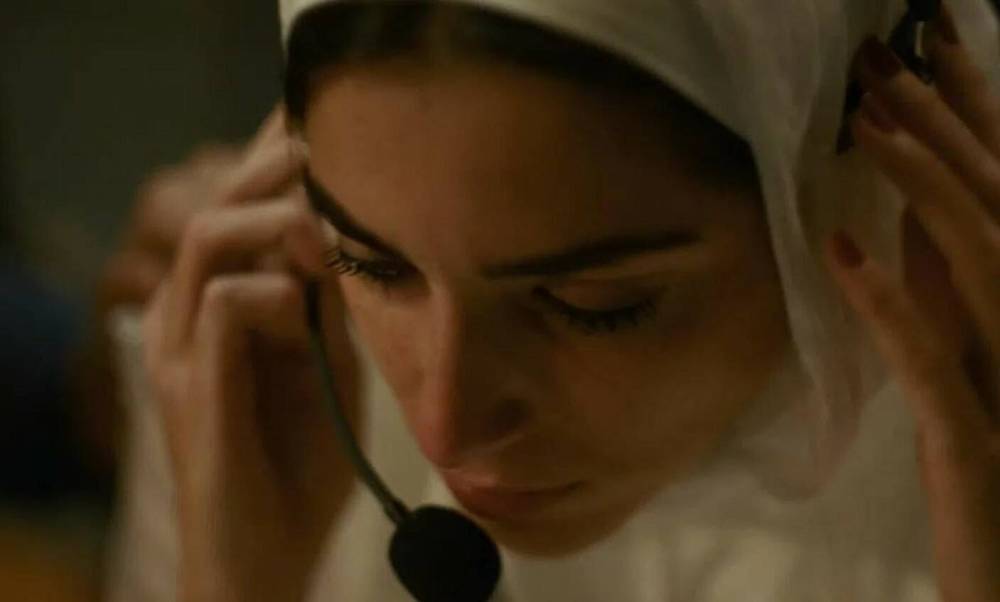
Mime Films
Red Crescent call-centre employees want to circumvent the system to save Hind Rajab.
He also doubted art’s ability to represent real-world tragedy. While many critics pushed realism as a tool of political art, even propaganda, he’d long and famously argued for the redemptive experiences of abstract art.
The Voice of Hind Rajab is a brutally concrete, daring and uneven film aware of its own political purposes, but it does not grandstand. It lets the harrowing recordings speak for themselves, though we’re often relieved when the film’s lens strays to re-enacted dramas among the call centre’s workers.

Omar and Rana are the film’s most passionate character voices, driven to break down by Hind’s pleas and Red Crescent’s hesitance to deploy an ambulance. Omar confronts his supervisor, who seems callous and bureaucratic at first. But he reminds Omar of procedure: Red Crescent does not speak to the IDF directly, but must go through a dizzying chain of communications to establish a secure route for rescue ambulances.
When Omar protests that the rescuers go without permission from the IDF, his supervisor points to a wall showing all the Red Crescent rescuers recently “martyred,” reminding him that they too had families.
All lives are sacred, but one must calculate, soberly but impossibly, how many are worth risking to save one.
The film’s centre is young Hind and those struggling hardest to save her, though moments like these evoke much larger contexts. Contexts of strategy, culture, religion and history that escape oversimplification — but are haunted by this conflict’s deep, abiding imbalance of civilian casualties against the Palestinians.
winnipegfreepress.com/conradsweatman
Conrad Sweatman is an arts reporter and feature writer. Before joining the Free Press full-time in 2024, he worked in the U.K. and Canadian cultural sectors, freelanced for outlets including The Walrus, VICE and Prairie Fire. Read more about Conrad.
Our newsroom depends on a growing audience of readers to power our journalism. If you are not a paid reader, please consider becoming a subscriber.
Our newsroom depends on its audience of readers to power our journalism. Thank you for your support.
Movie review
The Voice of Hind Rajab
Directed by Kaouther Ben Hania
● Cinematheque, today to Sunday
● 89 minutes
★★★★ out of five
Other voices
This time, the view of the horizon and sea is clear. In Ben Hania’s hands, what is real and what is imagined matters less once reality becomes unimaginable.
— Michael Andor Brodeur, Washington Post
Kaouther Ben Hania carefully sidesteps ethical questions about the use of performance alongside archival evidence with a clear-headed chronicle of a tragedy and of wider Palestinian suffering.
— Tara Brady, Irish Times
The result feels like a cavalier stunt— an audio-documentary shrine erected on a wobbly visual-narrative foundation. The Voice of Hind Rajab ultimately overpowers the voice of Hind Rajab.
— Justin Chang, The New Yorker
About as powerful as cinema gets. Its hybrid blend of documentary audio and devastating dramatisation is heart-wrenchingly, shatteringly effective.
— John Nugent, Empire Magazine
Conrad Sweatman is an arts reporter and feature writer. Before joining the Free Press full-time in 2024, he worked in the U.K. and Canadian cultural sectors, freelanced for outlets including The Walrus, VICE and Prairie Fire. Read more about Conrad.
Our newsroom depends on a growing audience of readers to power our journalism. If you are not a paid reader, please consider becoming a subscriber.
Our newsroom depends on its audience of readers to power our journalism. Thank you for your support.
Advertisement Advertise With Us
Advertisement Advertise With Us