Queen’s motivations not fully explored in RMTC’s royal drama The Last Wife
Read this article for free:
or
Already have an account? Log in here »
To continue reading, please subscribe:

Digital Subscription
One year of digital access for only $205*
- Enjoy unlimited reading on winnipegfreepress.com
- Read the E-Edition, our digital replica newspaper
- Access News Break, our award-winning app
- Play interactive puzzles
*First annual payment billed as $205.00 + GST for one year. This annual subscription will automatically renew at $233.00 + GST every 52 weeks (10% off the regular annual price of $259.35). Offer available to new and qualified returning subscribers only. Cancel any time.
To continue reading, please subscribe:
Add Free Press access to your Brandon Sun subscription for only an additional
$1 for the first 4 weeks*
- Enjoy unlimited reading on winnipegfreepress.com
- Read the E-Edition, our digital replica newspaper
- Access News Break, our award-winning app
- Play interactive puzzles
*Your next Brandon Sun subscription payment will increase by $1.00 and you will be charged $17.95 plus GST for four weeks. After four weeks, your payment will increase to $24.95 plus GST every four weeks.
Read unlimited articles for free today:
or
Already have an account? Log in here »
Hey there, time traveller!
This article was published 27/03/2026 (187 days ago), so information in it may no longer be current.
Why is it that in the game of chess, the queen can move as much as she wants, all over the board, but the king can only move one square at a time?
Theatre review
The Last Wife
Royal Manitoba Theatre Centre
● John Hirsch Mainstage
● To April 18
★★★½ out of five
When King Henry VIII asks that question in the feminist play The Last Wife, it’s a metaphorical recognition that his sixth wife, Katherine Parr, is using her wits to strategically outplay him.
The Last Wife, a contemporized historical drama by Canadian playwright Kate Hennig, directed by Cherissa Richards, opened Thursday on the Royal Manitoba Theatre Centre mainstage.
Set in the 16th century but using present-day language, without English accents, it explores the power dynamics between the autocratic Henry (Cory Wojcik) and the educated, ambitious Katherine (Amelia Sargisson).
Hennig traces the relationship from Henry’s aggressive courtship of his chosen bride through their three-year marriage, which ended with his death at age 55.
Both leads are solid. Sargisson’s portrayal of Katherine ranges from frightened vulnerability to ballsy self-assurance. Wojcik’s entitled king is often funny in his bluster, but his strongest scene is Henry’s final one, when he’s facing death and feeling anguish.
Set designer Brian Perchaluk’s magnificent castle interior includes high, dark-panelled walls, a towering window, heavy furniture, red and gold fabrics and candle effects. The space is overseen by four mounted buck heads, evoking masculine ritual and the taking of trophies.
Dylan Hewlett photo Queen Kate (Amelia Sargisson) tends to King Henry VIII’s (Cory Wojcik) nasty leg wound in The Last Wife.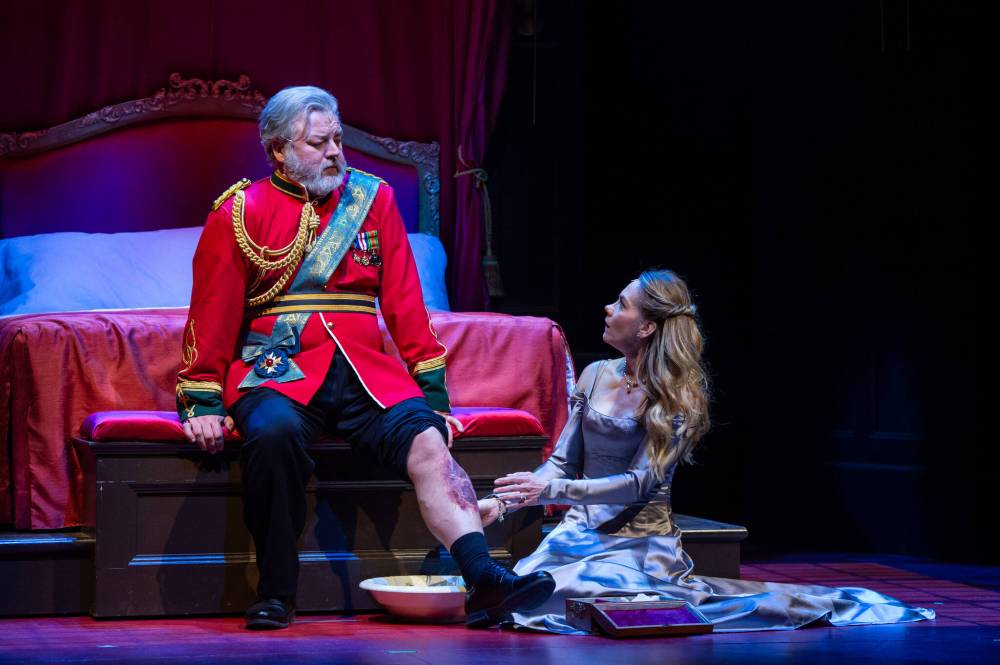
Hugh Conacher’s striking lighting alludes to church and state, with shafts of cathedral-like illumination, and ominous, cage-like shadows. Joseph Abetria’s thoughtfully conceived costumes are contemporary with Tudor touches, such as a boy’s ruffled collar worn with a T-shirt.
At the outset, why does the much-younger Katherine agree to marry the pushy monarch and to educate his school-age heir, Eddie (the future King Edward VI, played by Blake Beachell)? Mostly because Henry is a ruthless tyrant who won’t accept the word no.
“I’m a creep,” the king admits. His disturbing actions include changing Katherine’s wedding vows so she promises to be “courteous and compliant” in bed. He later threatens that if she tells anyone the things he’s told her in private, “I’ll have to kill you.”
As queen, Katherine carries on a risky affair with a dashing sea captain, Thom Seymour (Sébastien Heins, whose lusty performance has an effective shifty undercurrent).
The feminist heart of the narrative, though, is what Katherine accomplishes by persuading Henry to reinstate the succession rights of his two shunned daughters, the embittered 20-something Mary (the future Queen Mary I, played by Julie Lumsden in a fierce, standout performance) and the sweeter, younger Bess (the future Queen Elizabeth I, played by Katie Welham).
Dylan Hewlett photo From left: Bess (Katie Welham) and Mary (Julie Lumsden) are Henry VIII’s two shunned daughters in The Last Wife. 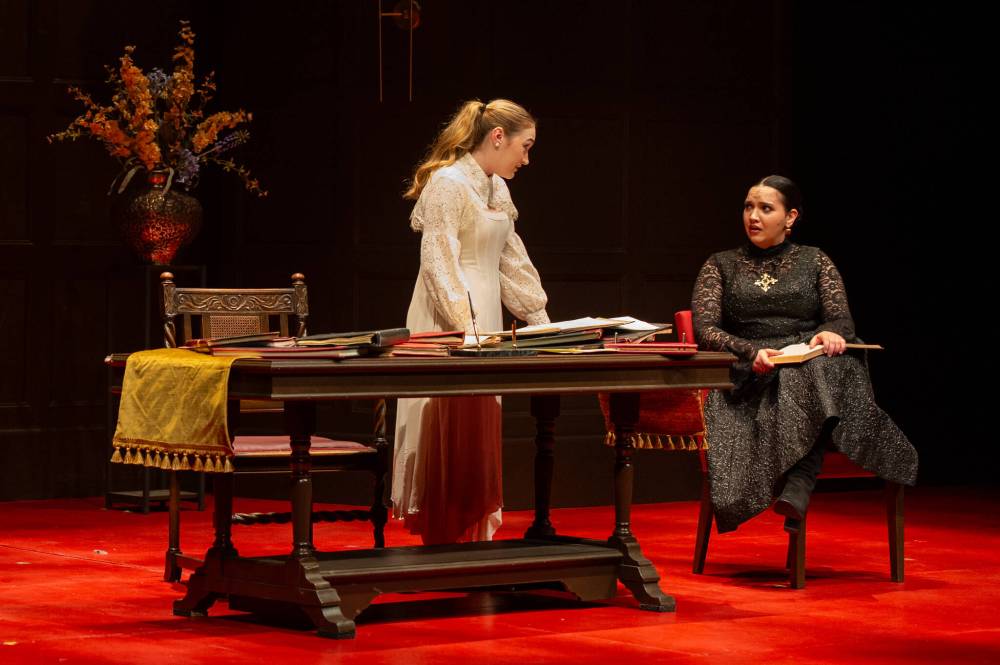
No matter what happens, Katherine is determined to guide, parent and protect the two girls.
In the program, Hennig describes The Last Wife (her first major play, dating from 2015) as “an imagining of history” and says that some parts of it are accurate and others fabricated. She says her key interest is in the humanity of the historical figures.
But the story is overly long (2 1/2 hours including intermission) and weighed down with too much history-lesson exposition about Henry’s younger days and his previous five wives. The writing doesn’t succeed in drawing the audience in to strongly identify with Katherine.
We observe that she’s highly intelligent and decisive — just as capable as any man of leading a nation. We admire her for kindly nurturing the children. We’re amazed at how she becomes both willing nurse and sexual partner to the portly Henry, who has a festering, foul-smelling leg wound and eventually becomes impotent.
We recognize the universality of her quiet heroism in doing what she must to make things better for the next generation.
Dylan Hewlett photo Queen Kate (Amelia Sargisson) risks everything in getting involved with Thom Seymour (Sébastien Heins) in the Royal Manitoba Theatre Centre’s production of The Last Wife.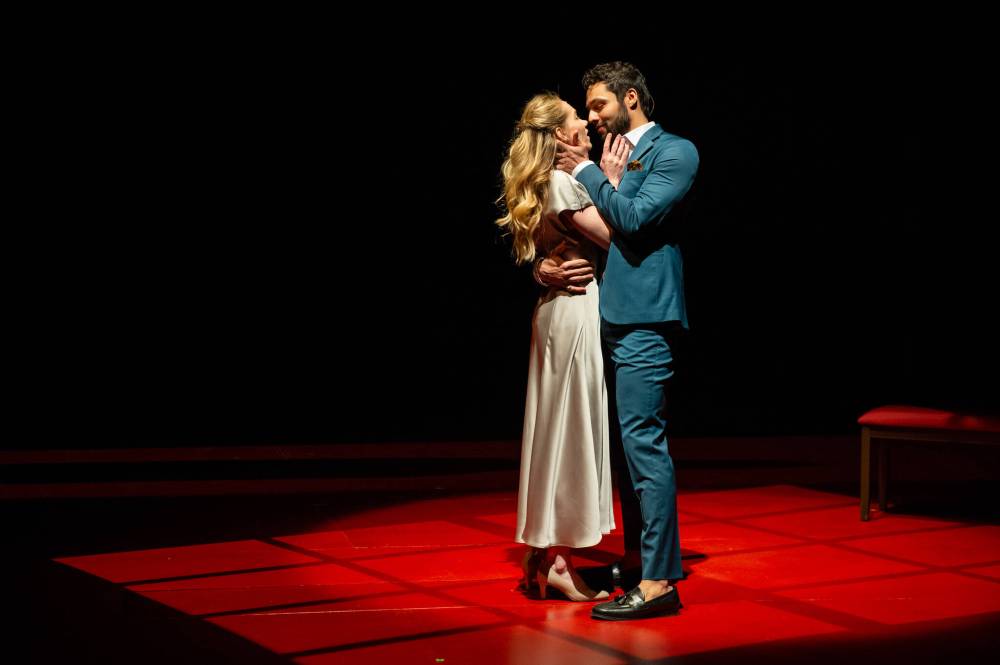
But Hennig’s script doesn’t foster emotional engagement with Katherine, a rape survivor who is living what most women would consider a nightmare.
She’s not just at the king’s mercy in an “Off with her head!” sense. In several harrowing scenes, Henry reacts to her strength and assertiveness by exploding into domestic abuse, violently assaulting her or the children.
Since Katherine has no soliloquies and no confidante, such as a lady-in-waiting, to talk to, we have no entry point into her emotions about this. She just soldiers on, and it’s unclear (perhaps deliberately so) whether she actually develops love for the creep who is abusing her.
Some of the play’s dark humour — such as a scene in which Eddie has a nightmare about Katherine being covered in blood, and Henry gets a laugh with his reaction — may be distasteful to some viewers.
The playwright does endeavour to show human complexity in both king and queen. Henry comes to feel remorse and knows that he’s been corrupted by power and by his rigid gender role.
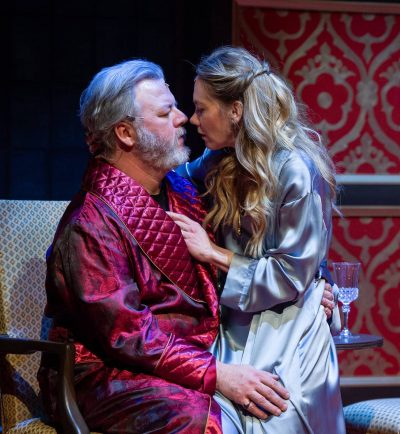
Dylan Hewlett photo The relationship between King Henry VIII (Cory Wojcik) and Kate (Amelia Sargisson) can be complicated and cruel in The Last Wife.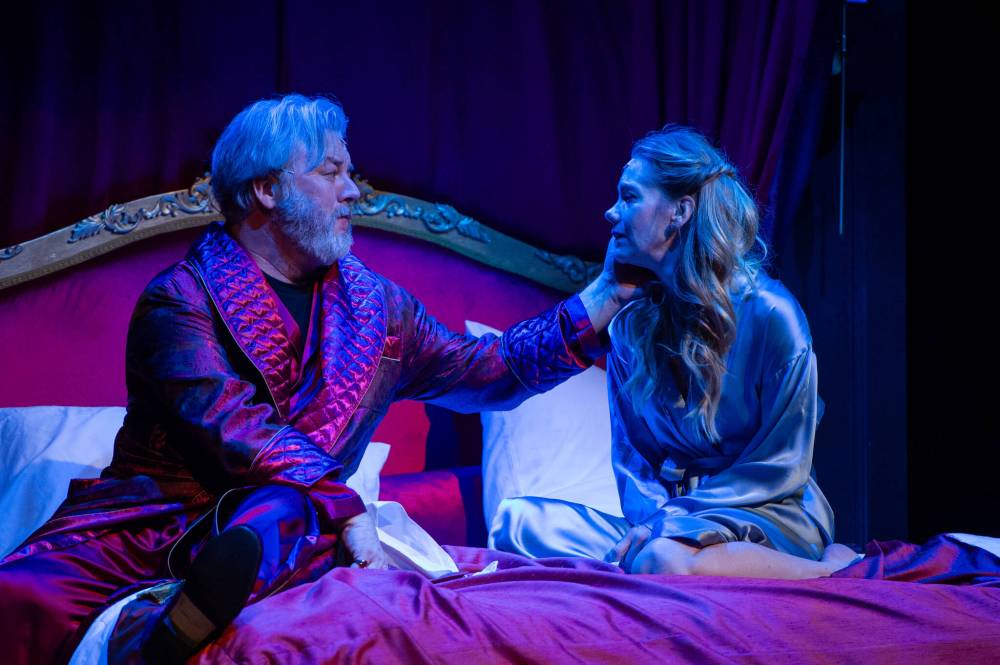
On the flip side, when Katherine is left in charge of military decisions, she’s so intoxicated by her taste of power and success that we glimpse her potential for going too far.
Hennig’s point in contemporizing the story is presumably to say that the patriarchy is still in force and that men’s rage is stirred whenever women show independence or achieve any progress toward equality (witness the current resentful rise of the manosphere).
That’s valid. But with its small, six-person cast and a script that doesn’t resonate as deeply as one would hope, the play falls short of being a compelling portrait of the final wife mentioned in the traditional Henry VIII rhyme: “divorced, beheaded, died, divorced, beheaded, survived.”
fparts@freepress.mb.ca