Henry VIII’s stage fight
Stage combat direction amps up royal rumblings in RMTC's The Last Wife

Advertisement
Read this article for free:
or
Already have an account? Log in here »
To continue reading, please subscribe:

Digital Subscription
One year of digital access for only $205*
- Enjoy unlimited reading on winnipegfreepress.com
- Read the E-Edition, our digital replica newspaper
- Access News Break, our award-winning app
- Play interactive puzzles
*First annual payment billed as $205.00 + GST for one year. This annual subscription will automatically renew at $233.00 + GST every 52 weeks (10% off the regular annual price of $259.35). Offer available to new and qualified returning subscribers only. Cancel any time.
To continue reading, please subscribe:
Add Free Press access to your Brandon Sun subscription for only an additional
$1 for the first 4 weeks*
- Enjoy unlimited reading on winnipegfreepress.com
- Read the E-Edition, our digital replica newspaper
- Access News Break, our award-winning app
- Play interactive puzzles
*Your next Brandon Sun subscription payment will increase by $1.00 and you will be charged $17.95 plus GST for four weeks. After four weeks, your payment will increase to $24.95 plus GST every four weeks.
Read unlimited articles for free today:
or
Already have an account? Log in here »
Last month at the Tom Hendry Warehouse, when the actors used paintbrushes and purses as ammunition in playwright Trish Cooper’s Holland, none of their movements were random. Every jab and swing was intricately plotted with the help of the production’s secret weapon.
Over the past decade, Jacquie Loewen has become Winnipeg’s go-to co-ordinator of onstage battles, hired to develop the physical language of conflict and character on stage with chessboard precision.
When theatre directors want to punch up their productions with carefully constructed realism or cartoonish slapstick, they often turn to Loewen to choreograph the good fight.
But fight direction isn’t only about the bumps and bruises, says Loewen, who worked with director Cherissa Richards to choreograph the royal rumbling in The Last Wife, the second-last production of Royal Manitoba Theatre Centre’s mainstage season. It’s about the slow accumulation of action that may or may not lead toward collision.
MIKAELA MACKENZIE / FREE PRESS FILES Fight director Jacquie Loewen choreographs violence in the royal court for The Last Wife.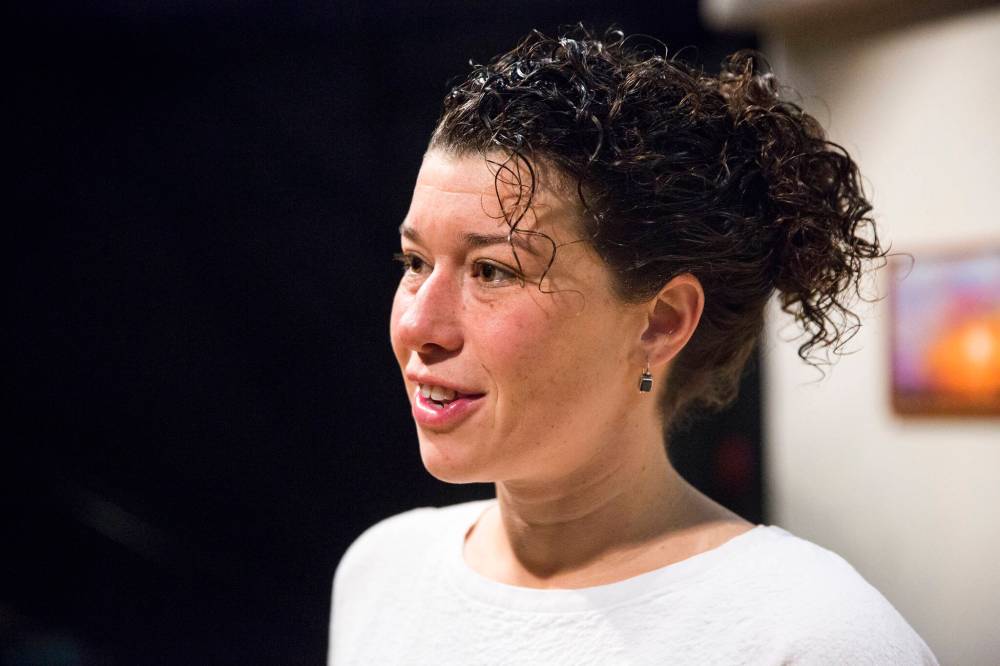
In The Last Wife, that buildup occurs in the court of King Henry VIII (Cory Wojcik), whose matrimonial track record is as well known as it is horrific. Playwright Kate Hennig’s script picks up after the beheading of Katherine Howard, Henry’s penultimate wife, and introduces us to his sixth and final, Katherine Parr (Amelia Sargisson), named in the program as Kate.
“The violence, in this case, is in the lead-up and the intention and the attitude,” says Loewen, who for years performed as a member of the award-winning comedy troupe Hot Thespian Action.
“A violent movement could be something that’s technically, incredibly simple, but when it is specific and precise — a physical action that comes out of a rising tension — then that violence, I think, dramaturgically, is much more graceful.
“When I started this job” — her first gig was RMTC’s Romeo and Juliet in 2011 — “I was like, ‘OK. You’ve got punches, slaps, kicks and hair-pulls: let’s put those tools to good use.’
“And now I understand (that fight choreography) can be the very quick step of a man in front of a door as a woman is trying to leave.”
“And now I understand (that fight choreography) can be the very quick step of a man in front of a door as a woman is trying to leave.”
That’s the kind of violence that permeates The Last Wife, says Loewen, who worked with fellow University of Winnipeg theatre alum Wojcik to imbue Henry, whom Loewen compares to an aging lion, with a potent sense of physical authority.
In one scene, as Kate walks by, Henry grabs her roughly and pulls her toward him as he carries on speaking.
“In that move, nobody will get physically hurt — it’s not technically difficult — but we worked on it for an hour and a half, because it’s about figuring out where that violent quality is within that,” says Loewen, who will direct the University of Manitoba theatre program production of Caryl Churchill’s Mad Forest from April 1 to 4 ($12 at eventbrite).
“In The Last Wife, the question is always about how dominance is being asserted. People will always talk until they can’t anymore, and then something physical has to happen. I think that bridge between the two is the most delicate part,” she adds.
“Somebody once told me that the fight begins when the words run out. So in a play like this, it’s about working two or three minutes ahead of that to get the violence to mount, until the words are no longer sufficient and that dominance has to be physical.”
DYLAN HEWLETT PHOTO Royal Manitoba Theatre Centre’s The Last Wife tells the story of King Henry VIII (Cory Wojcik) and his sixth and last wife, Katherine Howard (Amelia Sargisson).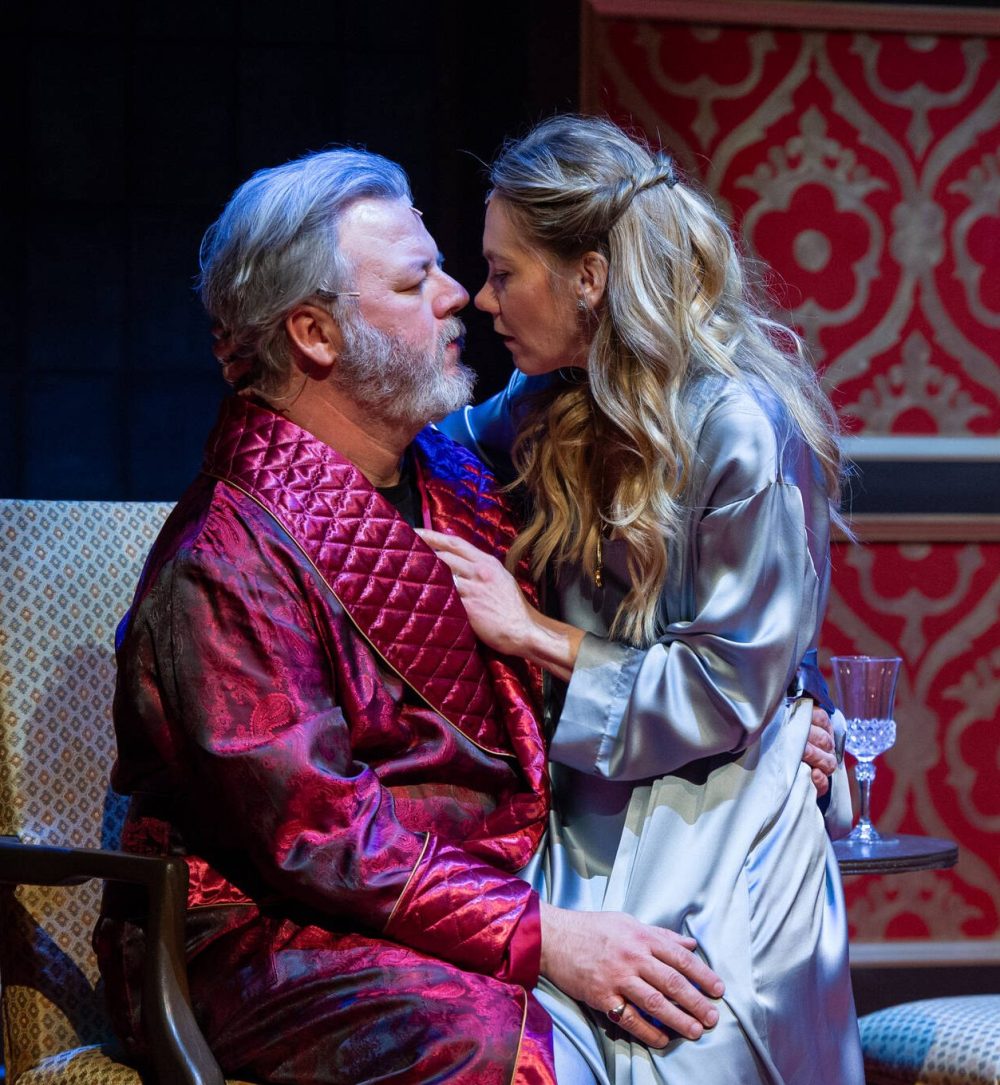
That differs from Holland, which traded in more direct communication of onstage violence, softened by comedic edges.
“In that case, I wanted to be able to create images the audience could see and read that come in a particular tempo, subverting the images that came before,” she says. “To make the fights intentional, then to change the pace and the quality, I can’t think of a better way to describe it than as being made of right angles.
“If you think about the Road Runner, it’s funny because he runs straight, looks down and falls straight at a 90-degree angle,” says Loewen. “The comedy is in his moment of realization and his quick change of direction.”
“In The Last Wife, a drama, the violence that happens is on a curve.”
winnipegfreepress.com/benwaldman

Ben Waldman is a National Newspaper Award-nominated reporter on the Arts & Life desk at the Free Press. Born and raised in Winnipeg, Ben completed three internships with the Free Press while earning his degree at Ryerson University’s (now Toronto Metropolitan University’s) School of Journalism before joining the newsroom full-time in 2019. Read more about Ben.
Every piece of reporting Ben produces is reviewed by an editing team before it is posted online or published in print — part of the Free Press‘s tradition, since 1872, of producing reliable independent journalism. Read more about Free Press’s history and mandate, and learn how our newsroom operates.
Our newsroom depends on a growing audience of readers to power our journalism. If you are not a paid reader, please consider becoming a subscriber.
Our newsroom depends on its audience of readers to power our journalism. Thank you for your support.
Theatre preview
The Last Wife
Royal Manitoba Theatre Centre
John Hirsch Mainstage, 174 Market Ave.
Opens Thursday, runs to April 18
Tickets: $30 to $115 at royalmtc.ca
Ben Waldman is a National Newspaper Award-nominated reporter on the Arts & Life desk at the Free Press. Born and raised in Winnipeg, Ben completed three internships with the Free Press while earning his degree at Ryerson University’s (now Toronto Metropolitan University’s) School of Journalism before joining the newsroom full-time in 2019. Read more about Ben.
Every piece of reporting Ben produces is reviewed by an editing team before it is posted online or published in print — part of the Free Press‘s tradition, since 1872, of producing reliable independent journalism. Read more about Free Press’s history and mandate, and learn how our newsroom operates.
Our newsroom depends on a growing audience of readers to power our journalism. If you are not a paid reader, please consider becoming a subscriber.
Our newsroom depends on its audience of readers to power our journalism. Thank you for your support.
Advertisement Advertise With Us
Advertisement Advertise With Us
History
Updated on Wednesday, March 25, 2026 7:36 PM CDT: Corrects that this is the second-last production of the mainstage season.