The birds & the beef
What feathered creatures signify for the health of the herd

Advertisement
Read this article for free:
or
Already have an account? Log in here »
To continue reading, please subscribe:

Digital Subscription
One year of digital access for only $205*
- Enjoy unlimited reading on winnipegfreepress.com
- Read the E-Edition, our digital replica newspaper
- Access News Break, our award-winning app
- Play interactive puzzles
*First annual payment billed as $205.00 + GST for one year. This annual subscription will automatically renew at $233.00 + GST every 52 weeks (10% off the regular annual price of $259.35). Offer available to new and qualified returning subscribers only. Cancel any time.
To continue reading, please subscribe:
Add Free Press access to your Brandon Sun subscription for only an additional
$1 for the first 4 weeks*
- Enjoy unlimited reading on winnipegfreepress.com
- Read the E-Edition, our digital replica newspaper
- Access News Break, our award-winning app
- Play interactive puzzles
*Your next Brandon Sun subscription payment will increase by $1.00 and you will be charged $17.95 plus GST for four weeks. After four weeks, your payment will increase to $24.95 plus GST every four weeks.
Read unlimited articles for free today:
or
Already have an account? Log in here »
Usually, Winnipeg snowbirds are known for going no further south than Florida.
But one migratory bird, the lesser yellowlegs, can go all the way to the southern tip of South America from Alaska and back, with midway stops in the prairies.
Most yellowlegs, like “Cholao 2,” don’t go quite that far.
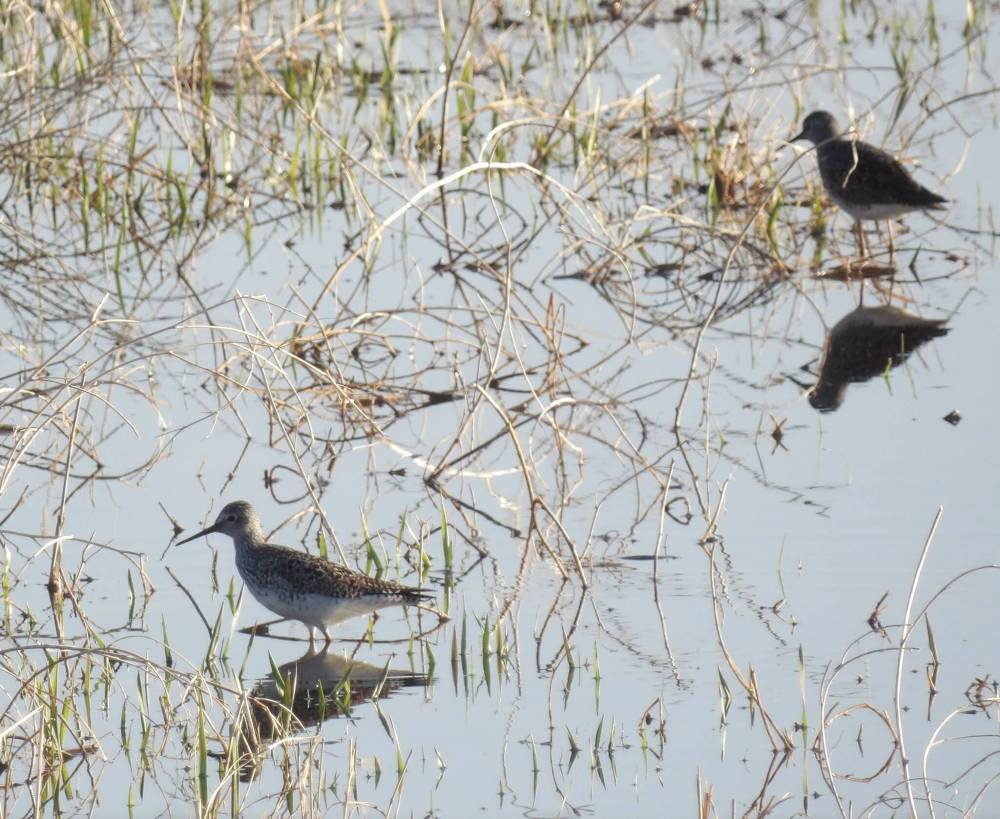
Arron Nerbas photos
Yellowlegs hunt for food in Shellmouth.
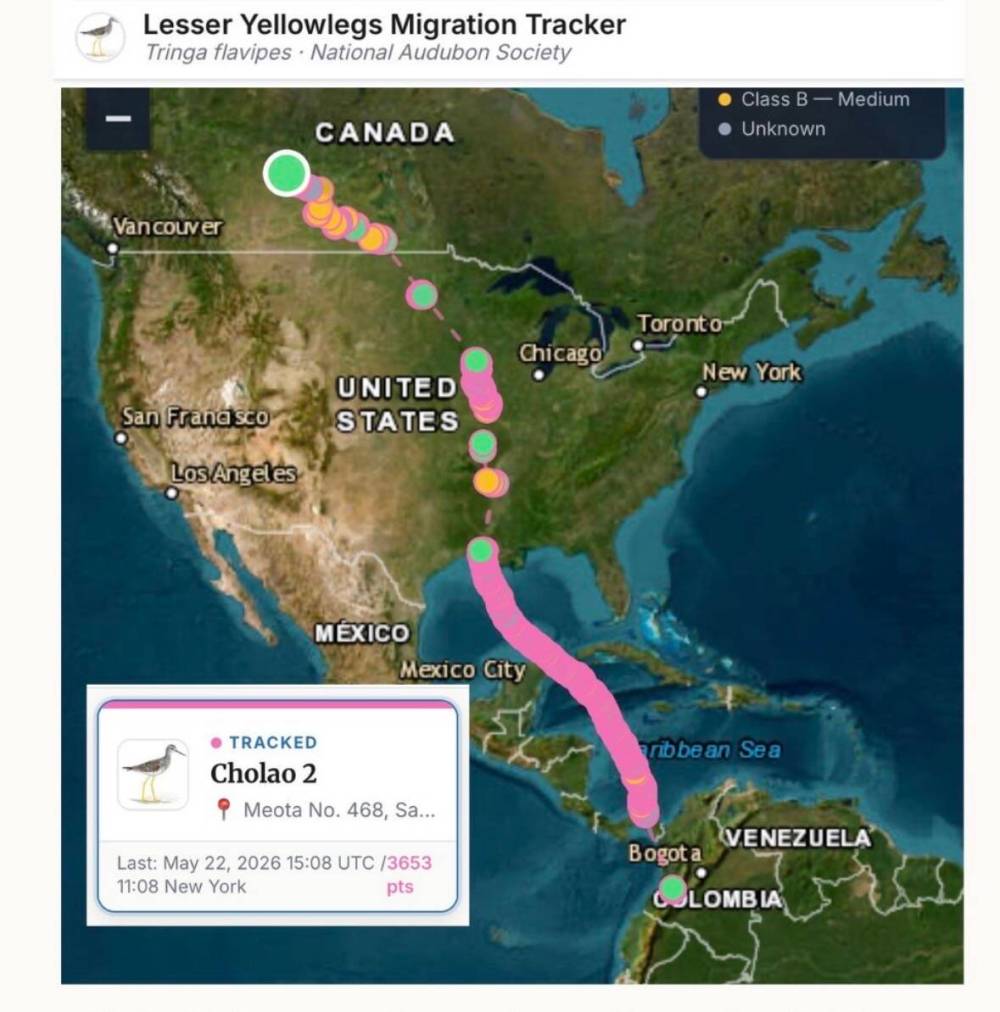
That’s the name given to a specimen tracked as travelling from Cali, Colombia, to near North Battleford, Sask., and which will likely summer in the subarctic or Arctic.
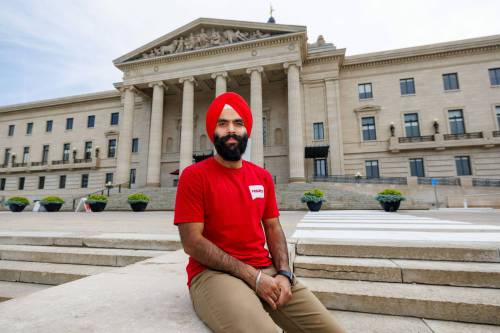
The story of Cholao 2, a bird weighing less than a baseball whose adventures include crossing the Gulf of Mexico in a 48-hour non-stop flight, fascinates Manitoba beef farmer Arron Nerbas.
This past February, his interest in the critter inspired him to take flight, taking a break from tending his family’s cows and bulls to travel to the Colombia Birdfair in Cali.
“The distance (lesser yellowlegs) travel is mind-blowing … Two weeks ago, I was in our valley and I was like, ‘I’m pretty sure those are lesser yellowlegs’ … and sure enough here they are,” says Nerbas, who lives just outside Shellmouth at the edge of the Saskatchewan border.
There he operates Nerbas Bros. Angus with his family, his brother’s family and his parents. While he sometimes dresses the part, he does not cut the stereotypical image of the cowpoke.
Nerbas is a strategic, not just casual, birder; his livelihood indirectly depends on it.
“Birds are indicator species. Where there are birds, there is life,” he says. “They eat insects, and insects are critical to soil health.”
The expression “canary in the coal mine” comes to mind, but seems too grimy. Nerbas practises “regenerative agriculture,” a farming approach focusing heavily on land management and biodiversity. In addition to lowering carbon footprints, its most immediate benefit for farmers — which requires patience, building gradually over time — is healthier soil.
This, in turn, stabilizes crop yields — meaning food supplies for grazing livestock. The Nerbas brothers sell much of their beef, from farm to table, directly to consumers through E Butchery on Main in neighbouring Russell, Man.
“I think modern industrial farming these days is quite extractive, you know. You’re taking stuff from the soil and you’re not necessarily putting it back in,” he says.
Screenshot
The route taken by the lesser yellowlegs known as Cholao 2.
“But we’re grass farmers … It’s not really about the cows — it’s about growing more grass. The cow is just an efficient harvester of the grass.”
While cattle aren’t really chowing down on the wetlands themselves, those areas help sustain surrounding grasslands by retaining moisture and supporting the ecosystem in other ways.
So, the presence of sandpipers, killdeer and yellowlegs pecking and probing the surface of a marsh can indirectly signal how happy your cattle are.
In regenerative systems, they can tell you if the wetlands and surrounding grasslands are healthy.
It’s with this consideration that the Manitoba Forage & Grassland Association led a monitoring survey from 2023 to 2025 on a rotating sample of farms where birds were in abundance, flying through and along the edges of beef, sheep, bison and grain operations.
Word of the study migrated to the legendary National Audubon Society, the world’s largest bird conservation group.
A 120-year-old bird fan club with almost two million members and Washington, D.C., political leverage, the American society saw MFGA’s work as being on the cutting edge.
“(It’s) definitely a trend in the conservation world — thinking about how to make agricultural lands more bird-friendly, and then how to measure it,” says Jeff Wells, the vice-president of Audubon’s Canada Program.
“This work that MFGA is doing is right in that same sweet spot.”
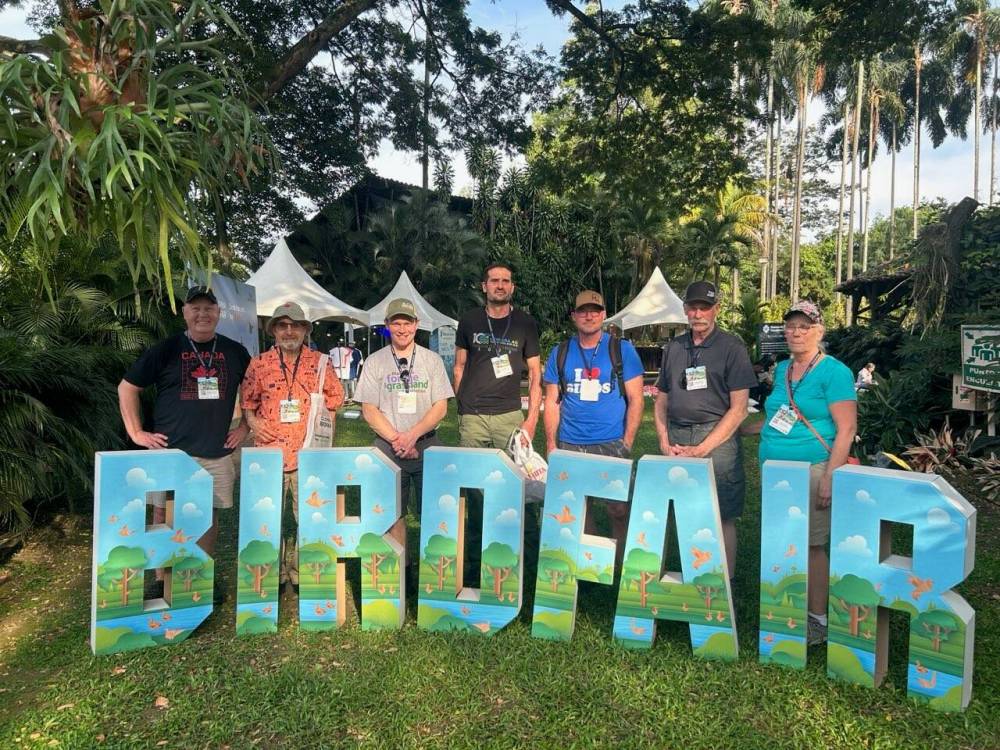
SUPPLIED
Arron Nerbas (third from right) attended the Colombia Bird Fair in Cali in February.
It’s this connection that led Nerbas, with six other regenerative MFGA-affiliated farmers, to attend the Colombia Birdfair by Audubon’s invitation.
Colombia, as well as being one of the most persistently conflict-ridden countries in the Western Hemisphere, is also among the world’s most diverse bird countries — and the two aren’t entirely unrelated.
Half a century of fighting and insecurity in remote rural regions inadvertently constrained development and agricultural expansion. For birds — including migratory shorebirds such as lesser yellowlegs — this meant vast sweeps of grassland, river marsh, mangrove coast and rainforest to stop over or kick back for the winter.
The 2016 peace deal between the government of Colombia and the Revolutionary Armed Forces of Colombia (FARC) has helped fuel a birding tourism boom in rural regions, though violence related to narco-trafficking still goes on.
“There are cartel-occupied zones still in Colombia, but I never felt unsafe … It was a wonderful, clean country, friendly people, reasonably priced,” Nerbas says.
Nerbas used the tail-end of the trip to visit regenerative farms, sugar cane and rice plantations, to discuss farming and its relationship to hemispheric bird migration.
But the fair itself was a flurry of bird activity: early morning excursions to rainforest, river, jungle, cloudforest and wetland habitats with local guides to take in the rich tropical birdlife of the Cali region.
“Let me tell you, after being to a bird fair, I know what a real birder is, and I’m not one of them. They’re serious people,” says Nerbas. “(But) it was a really, really cool experience.”
Somewhere along the way, he snapped a picture of a lesser yellowlegs sitting pensively in a marsh — a striking experience he says.
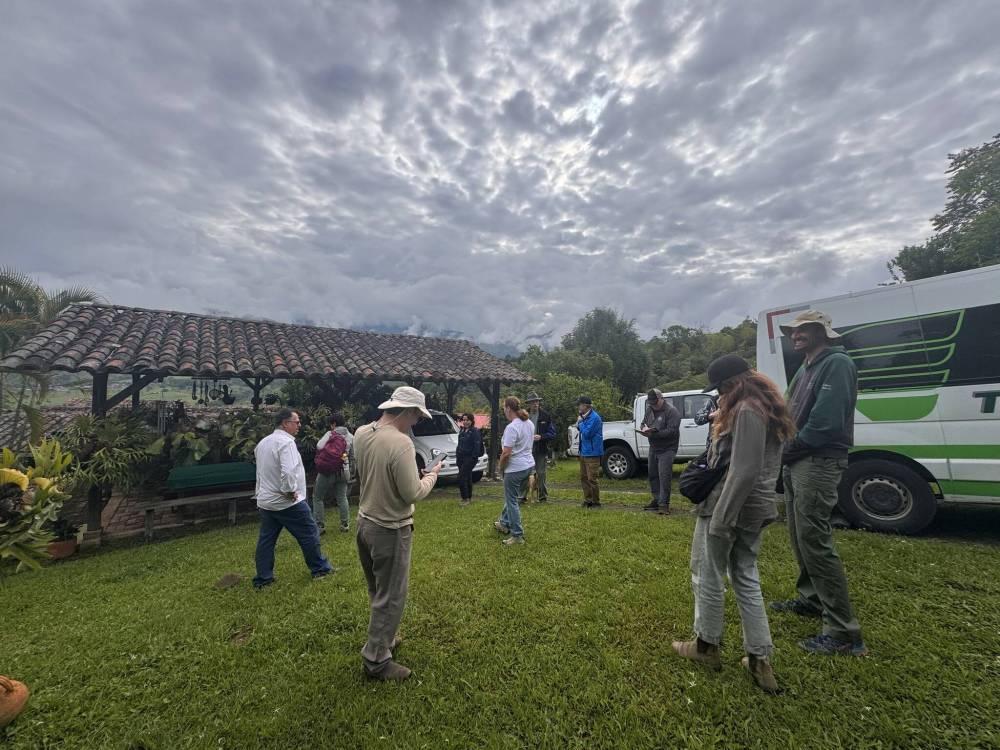
Arron Nerbas photos
While in Colombia, Arron Nerbas and others attendees of the Birdfair toured regenerative farms and plantations.
But Colombia’s rich shoreline areas are only one half of the story when it comes to the yellowlegs and birds of all colours migrating back and forth from South and North America.

The other is a vast network of northern habitats, from Manitoba’s Prairie wetlands to the Arctic tundra, where these birds refuel and breed.
“They need to find little restaurants and hotels, if you will, of the bird world to stop at and eat and rest,” says Wells. “Their whole migration is a big gamble in a way … There are things like peregrine falcons that can catch them and feed on them. They can run into contaminants and pollution and different things along the way that may cause them to get sick or die,” says.
While neither Nerbas nor the MFGA would credit Manitoba’s regenerative farming practices for enabling the sweeping migratory arc of Cholao 2, Wells praises their holistic approach to farming — one that includes farm-to-table, but also nature-to-farm.
“It just seemed like a great collaboration, a great connection, something worth highlighting and encouraging — more knowledge transfer and sharing of ideas,” says Wells.
winnipegfreepress.com/conradsweatman
Conrad Sweatman is an arts reporter and feature writer. Before joining the Free Press full-time in 2024, he worked in the U.K. and Canadian cultural sectors, freelanced for outlets including The Walrus, VICE and Prairie Fire. Read more about Conrad.
Our newsroom depends on a growing audience of readers to power our journalism. If you are not a paid reader, please consider becoming a subscriber.
Our newsroom depends on its audience of readers to power our journalism. Thank you for your support.
Conrad Sweatman is an arts reporter and feature writer. Before joining the Free Press full-time in 2024, he worked in the U.K. and Canadian cultural sectors, freelanced for outlets including The Walrus, VICE and Prairie Fire. Read more about Conrad.
Our newsroom depends on a growing audience of readers to power our journalism. If you are not a paid reader, please consider becoming a subscriber.
Our newsroom depends on its audience of readers to power our journalism. Thank you for your support.
Advertisement Advertise With Us
Advertisement Advertise With Us