Bringing remains on planes a real pain
Rules for transporting ashes of loved ones leave grieving travellers in the lurch

Advertisement
Read this article for free:
or
Already have an account? Log in here »
To continue reading, please subscribe:

Digital Subscription
One year of digital access for only $205*
- Enjoy unlimited reading on winnipegfreepress.com
- Read the E-Edition, our digital replica newspaper
- Access News Break, our award-winning app
- Play interactive puzzles
*First annual payment billed as $205.00 + GST for one year. This annual subscription will automatically renew at $233.00 + GST every 52 weeks (10% off the regular annual price of $259.35). Offer available to new and qualified returning subscribers only. Cancel any time.
To continue reading, please subscribe:
Add Free Press access to your Brandon Sun subscription for only an additional
$1 for the first 4 weeks*
- Enjoy unlimited reading on winnipegfreepress.com
- Read the E-Edition, our digital replica newspaper
- Access News Break, our award-winning app
- Play interactive puzzles
*Your next Brandon Sun subscription payment will increase by $1.00 and you will be charged $17.95 plus GST for four weeks. After four weeks, your payment will increase to $24.95 plus GST every four weeks.
Read unlimited articles for free today:
or
Already have an account? Log in here »
Vincent Masse holds up a snack-size Ziploc containing ashes belonging to his late dog Balthazar.
While smugglers sometimes successfully whisk other bagged powders past airport security, this one barely made it through.
“The Halifax security were all going like this,” says Masse’s new friend Kerri Parnell, crossing her fingers. She means they were hoping that the airport’s new CT X-ray scanners for carry-on bags, installed at Canadian airports over the past couple of years, would not once again flag Balthazar’s remains.
MIKAELA MACKENZIE / FREE PRESS Winnipeg cremation artist Kerri Parnell, right, and Vincent Masse. Parnell is one of few tattoo artists doing cremation tattooing, and Masse had sought out her services for help with a special memorial piece.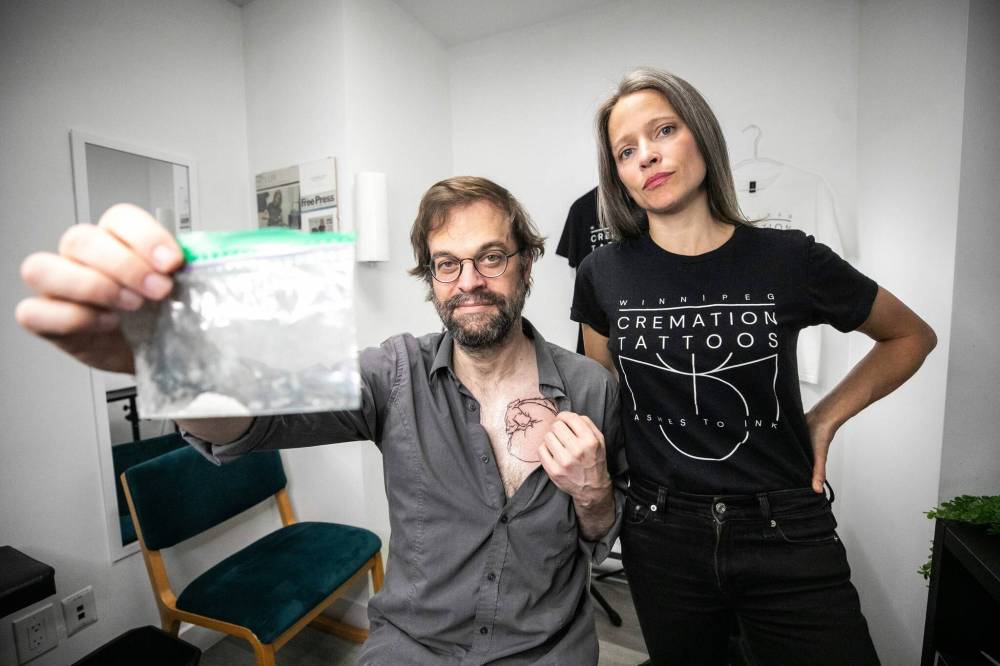
That’s what they had done the day before, leading Masse to miss his flight — and costing him about $1,000 to rebook.
“We did a Facetime and it was very emotional for him. And I was like, ‘I’m here with you,’” she says.
Parnell was waiting in Winnipeg for Masse.
Parnell is one of only a few Canadians doing cremation tattooing. The practice, using ink infused with cremation ashes, allows people to pay tribute to dead loved ones — children, siblings and even pets.
“It was very emotional for him.”
For Masse — a French and history professor at the University of Dalhousie in Halifax who was flying to Winnipeg to receive a tattoo from her — that loved one was his small dachshund.
Masse says Halifax airport security and WestJet staff could not tell him specifically why Balthazar’s remains, contained in a wooden box and amounting, says Masse, to less than 200 ml, had been flagged by the new scanners.
He says he was told that if he wanted to travel with the remains as carry-on he should book another flight and hope for better luck with the scanners the next time — perhaps with a different container or lighter contents. This proved successful.
“(Before my second attempted flight) I said, ‘Let me get it straight. The best chance I would have is to show up one day with, like, five boarding passes, so I would have five tries through the CT scan.’ They said, ‘Yeah, that would,’” says Masse.
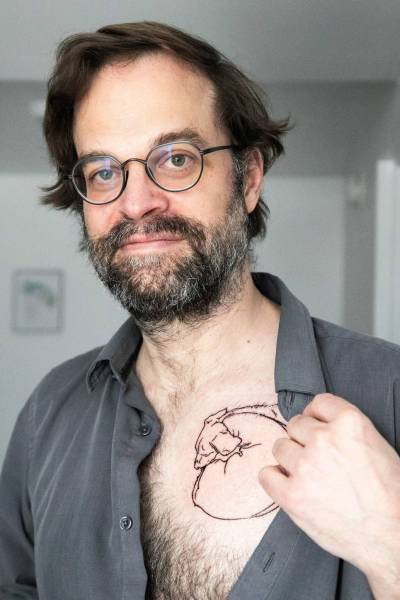
MIKAELA MACKENZIE / FREE PRESS Masse shows the tattoo of his beloved dog, created by using ashes in the ink.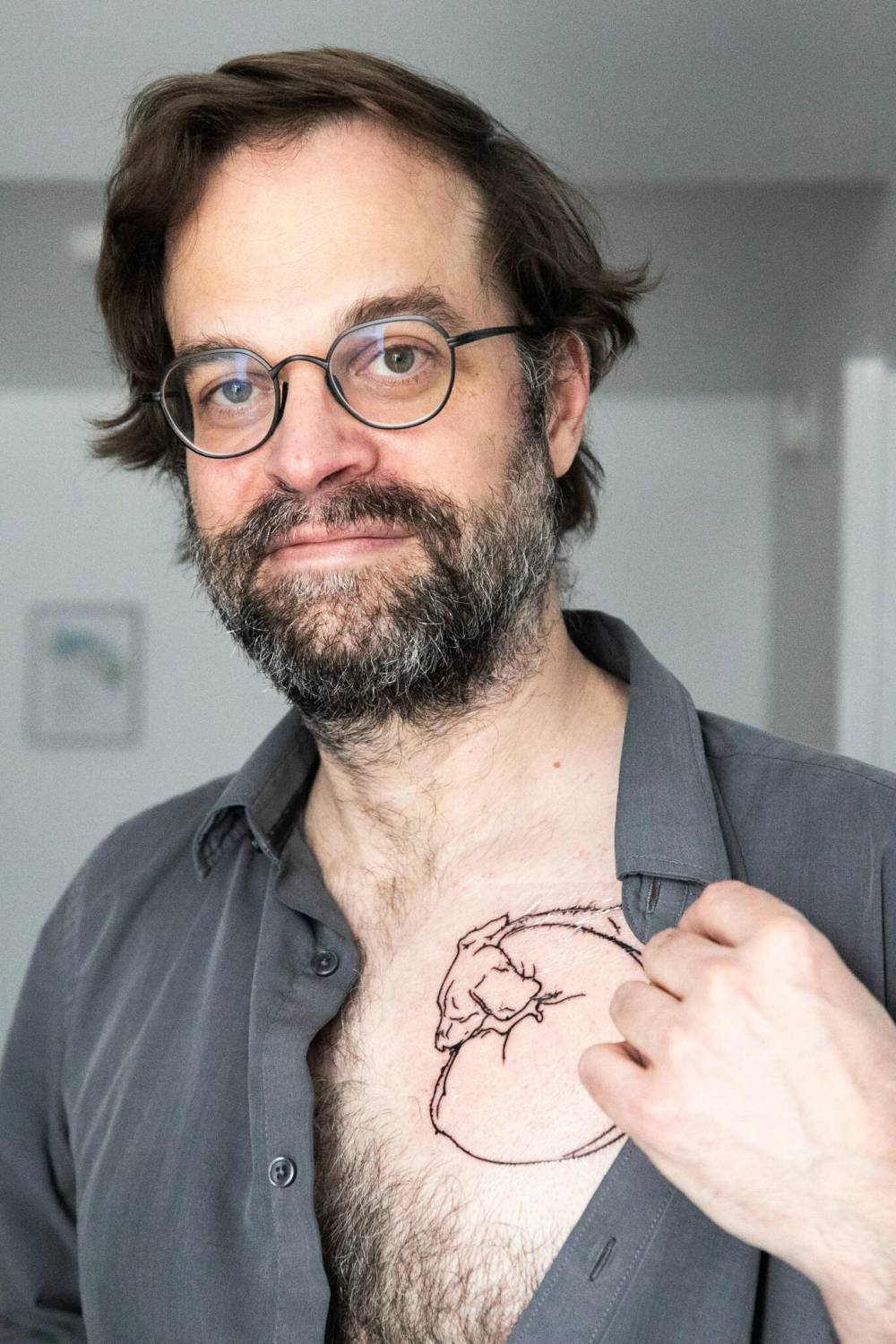
Few Canadians are travelling with dog remains — even fewer to make an appointment with a tattoo artist. Masse’s situation may seem unique, and possibly a result of poor customer service.
Funeral-sector stakeholders, however, point to bigger problems with new guidelines published by Canadian Air Transport Security Authority (CATSA) for transporting cremated remains.
Pam Moss, executive director of the Funeral Service Association of Canada, says by email that these guidelines are “creating significant concern and distress for many travellers,” not least of all because of the “confusion” caused by their wording.
“Nobody’s on the same page,” says Shannon Jackson, funeral director of Wojcik’s Funeral Chapel & Crematorium in Winnipeg. “The federal government’s not on the same page, the airlines are not on the same page, but of course the onus is falling back on the public in general … There is going to be a lot of letdown for families.”
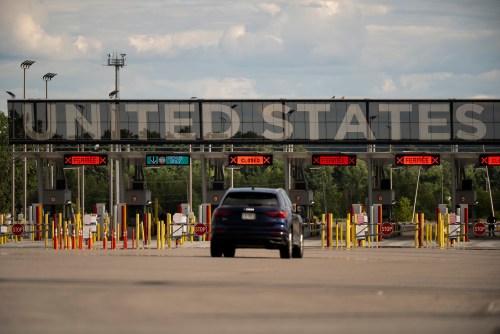
Historically, travellers on Canadian airlines have had the option of flying with cremation ashes in carry-on baggage. Since rolling out the new CT scanners, CATSA — which carries out passenger and baggage screening under Transport Canada’s regulations — has published updated guidelines for cremation remains in accordance these regulations.
The guidelines state that “cremated remains (less than 350 ml) are more likely to be successfully screened, depending on the type of container used” and that plastic, cardboard, cloth and wood containers are “most likely to be permitted” while metal, stone and ceramic containers are “least likely to be permitted.”
“Nobody’s on the same page.”
Airlines set their own carry-on allowances within the pre-existing framework. WestJet’s policy for cremated remains on its website, for instance, begins by stating that “WestJet Cargo offers support to transport cremated remains with care and confidence.”
Two bullet points down, it states: “Up to 350 millilitres (ml) of cremated remains are accepted as carry-on baggage. If the volume is more than 350 ml, the cremated remains may be transported in checked baggage.”
Moss says 350 ml is only about 10 per cent of an average adult’s cremated remains.
“Many families are understandably uncomfortable being separated from their loved one’s remains and therefore do not wish to place them in checked baggage or ship them through Canada Post or an airline carrier,” Moss says.
“In addition, for some cultures and religions, dividing the cremated remains into multiple containers is simply not an acceptable option.”
Compelling people to transport remains with luggage runs counter to established norms, Jackson says.
“You’re not supposed to check cremated remains, they’re supposed to be going in your carry-on. What happens if the luggage gets lost? There’s no guarantee of it being retrieved. The reason it’s always been in carry-on is for people to take responsibility of their own personal items,” she says.
Masse found it frustrating that security personnel appeared to lack the authority to bypass the alarm but could not tell him precisely what to do to resolve the problem.
The professor, who teaches medieval European history, jokes that the apparent arbitrariness of his experience echoes how peasants might have encountered medieval law, with a caveat: “When they would burn you as a witch (in the Middle Ages), they wouldn’t tell you, ‘That’s because the machine told us to do it.’ They would say, ‘It’s because we think you’re a witch.’”
“I did find a better way to smuggle ashes through security. You get them tattooed on the skin.”
When contacted for comment, CATSA spokeswoman Anna Maddison said by email, “(We are) working with Transport Canada on how alarms related to cremated remains are assessed and resolved while maintaining compliance with the security screening regulations.”
Asked if CATSA personnel had the authority to bypass alarms, she said, “Please note that when screening equipment triggers an alarm, it must be resolved before the item or individual can be cleared.”
Tattoo artist Parnell is concerned about how to communicate the guidelines to the growing number of her clients who are bereaved family members travelling from other cities for her services.
“I had a consultation with somebody this morning from Saskatchewan, and the first thing I asked is, ‘Are you flying or driving?’ I have consultations from all across Canada. What do I say?”
Despite being rattled by his experience, Masse ends things with more humour: “I did find a better way to smuggle ashes through security. You get them tattooed on the skin,” he says.
winnipegfreepress.com/conradsweatman
Conrad Sweatman is an arts reporter and feature writer. Before joining the Free Press full-time in 2024, he worked in the U.K. and Canadian cultural sectors and freelanced for outlets including The Walrus, VICE and Prairie Fire. Read more about Conrad.
Our newsroom depends on a growing audience of readers to power our journalism. If you are not a paid reader, please consider becoming a subscriber.
Our newsroom depends on its audience of readers to power our journalism. Thank you for your support.
Conrad Sweatman is an arts reporter and feature writer. Before joining the Free Press full-time in 2024, he worked in the U.K. and Canadian cultural sectors and freelanced for outlets including The Walrus, VICE and Prairie Fire. Read more about Conrad.
Our newsroom depends on a growing audience of readers to power our journalism. If you are not a paid reader, please consider becoming a subscriber.
Our newsroom depends on its audience of readers to power our journalism. Thank you for your support.
Advertisement Advertise With Us
Advertisement Advertise With Us