The Blue Coats are coming!
Artist Dara Vandor offers wry vision of American revolution to overrun Canada

Advertisement
Read this article for free:
or
Already have an account? Log in here »
To continue reading, please subscribe:
Digital Subscription
One year of digital access for only $1.44 a week*
- Enjoy unlimited reading on winnipegfreepress.com
- Read the E-Edition, our digital replica newspaper
- Access News Break, our award-winning app
- Play interactive puzzles
*Billed as $5.77 plus GST every four weeks. After 52 weeks, price increases to the regular rate of $19.95 plus GST every four weeks. Offer available to new and qualified returning subscribers only. Cancel any time.
To continue reading, please subscribe:
Add Free Press access to your Brandon Sun subscription for only an additional
$1 for the first 4 weeks*
- Enjoy unlimited reading on winnipegfreepress.com
- Read the E-Edition, our digital replica newspaper
- Access News Break, our award-winning app
- Play interactive puzzles
*Your next Brandon Sun subscription payment will increase by $1.00 and you will be charged $17.95 plus GST for four weeks. After four weeks, your payment will increase to $24.95 plus GST every four weeks.
Read unlimited articles for free today:
or
Already have an account? Log in here »
WHAT IT IS: This is Surrender of the Tecumseth Irregulars, from the ongoing series Pax Americana by Dara Vandor, a Toronto-based visual artist who works across media.
Since 2025, she has put up more than 30 aluminum plaques in public spaces, some on the streets of Toronto and some on the campus of Western University in London, Ont., along with a few outposts in Ottawa, Montreal and Tofino, B.C.
WHAT IT’S ABOUT: Vandor began this body of work as a response to U.S. President Donald Trump’s repeated and inflammatory comments about Canada as “the 51st state.”
Supplied Surrender of the Tecumseth Irregulars, 2025, 18 x 24”, aluminum sign. Posted in Toronto, March 9, 2025.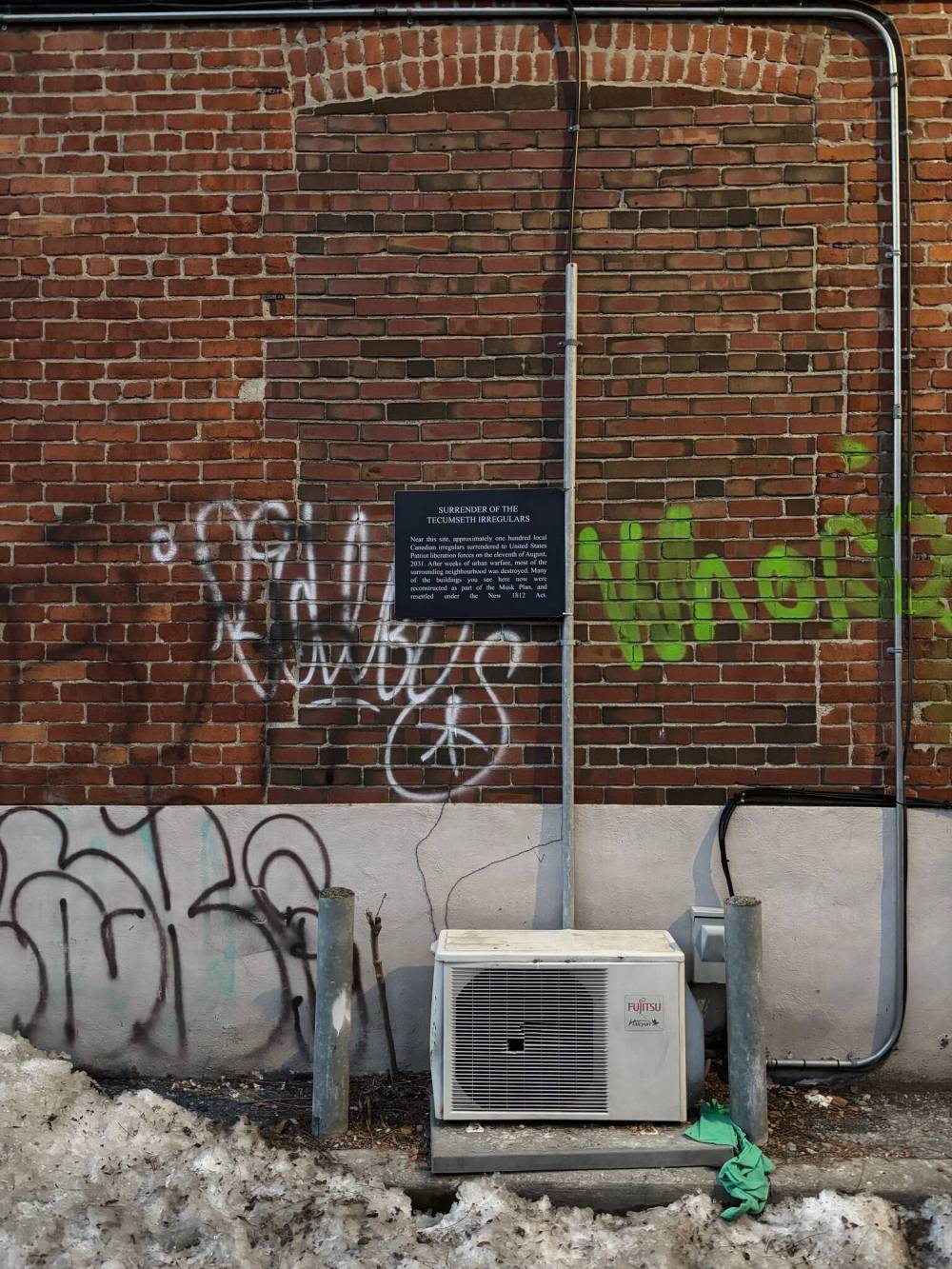
Running with this rhetoric to imagine a full-scale military invasion, occupation and annexation, Vandor creates a dystopian narrative that culminates in the absorption of Canada into the American empire in 2035 under the leadership of President Ivanka Trump.
The plaques serve as sideways social and political commentary. Pretending to be a history written by the complacent American victors, they are actually written by a furious and frustrated Canadian, which adds sly comic layers to the seemingly official prose. Vandor’s tone is smart, snarky and fuelled by weaponized Canuck irony.
Pax Americana plays around with the tropes of propaganda, with the loaded language of triumphalist nationalism and the bland euphemisms that cover over death and destruction.
In this pseudo-authorized account of a U.S. victory, the American aggressors are recast as “Patriot liberation forces.” The so-called Musk Plan, presumably a profiteering corporate boondoggle, is billed as a benevolent rebuilding program. References to “the New 1812 Act” suggest a bit of historical Canada-U.S. score-settling.
Vandor is working within a conceptual art approach that functions at the intersection of language and visual image. In the 1980s, American artists such as Barbara Kruger and Jenny Holzer created text-heavy works that were often situated outside the conventional gallery system, using marquees, billboards, banners and LED screens in public spaces to convey subversive or unsettling ideas about power, identity, money and consumerism.
Supplied Surrender of the Tecumseth Irregulars, 2025, 18 x 24”, aluminum sign. Posted in Toronto, March 9, 2025.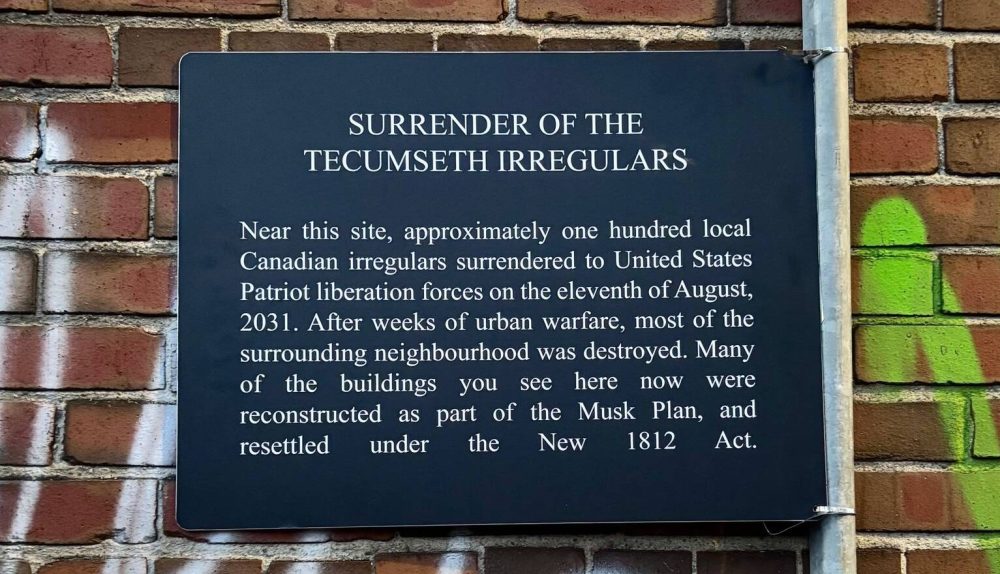
Vandor is clearly interested in the uses and abuses of language, but as an artist she understands the visual power of framing words in unexpected sites. As these plaques began to pop up in odd urban locations and then spread through social media, they were able to grab and focus viewer attention.
Vandor’s visual format also references the cast bronze or etched brass plaques that often mark historical sites, raising questions about who is honoured and what is commemorated in our culture, and how a revised historical account might read if our country were somehow reduced to “the northern territory formerly known as Canada,” as we’re called on one sign.
There are little in-jokes for Canadian history buffs, like the account of two resistance fighters going by the monikers “Banting” and “Best.” But Vandor also addresses deeply serious issues.
A plaque installed in Montreal announces “the Triumph of English” after “the new Language Standardization Act of 2036,” which relegates French to a quaint “heritage language” for use in private homes.
Vandor takes on Alberta separatism, Arctic security and the tricky position of Canadian culture.
One Toronto plaque pretends to mark the site of an American state-run film studio, suggesting that “after becoming the 51st state, Canada was finally able to … participate authentically in the culture of these United States.”
While we’re not yet at the dire point Vandor is envisaging — a future takeover by a MAGAfied American entertainment industry exemplified by such blockbuster movies as Mel Gibson’s Anne of Green Gables: Resurrection — one could argue that in some very real ways, we’ve already surrendered to our overwhelming neighbour.

WHY IT MATTERS: This past week marked both Canada Day and the Fourth of July, as well as an opening of new Pax Americana works at the Massachusetts State House in Boston, which should add some cross-cultural dimensions to this ongoing discourse.
As people on both sides of the Canada-America border consider what our countries mean to us, Vandor’s darkly funny, what-if works offer a stark statement on the mutability of the past, the uncertainty of the future and what she calls “the fragility of democracy and nationhood.”
Think of Pax Americana as a neoconceptual “elbows up,” eh?
winnipegfreepress.com/alisongillmor
Studying at the University of Winnipeg and later Toronto’s York University, Alison Gillmor planned to become an art historian. She ended up catching the journalism bug when she started as visual arts reviewer at the Winnipeg Free Press in 1992.
Our newsroom depends on a growing audience of readers to power our journalism. If you are not a paid reader, please consider becoming a subscriber.
Our newsroom depends on its audience of readers to power our journalism. Thank you for your support.
Studying at the University of Winnipeg and later Toronto’s York University, Alison Gillmor planned to become an art historian. She ended up catching the journalism bug when she started as visual arts reviewer at the Winnipeg Free Press in 1992.
Our newsroom depends on a growing audience of readers to power our journalism. If you are not a paid reader, please consider becoming a subscriber.
Our newsroom depends on its audience of readers to power our journalism. Thank you for your support.
Advertisement Advertise With Us
Advertisement Advertise With Us