Climate change threatens events we wait for all year

Advertisement
Read this article for free:
or
Already have an account? Log in here »
To continue reading, please subscribe:

Digital Subscription
One year of digital access for only $205*
- Enjoy unlimited reading on winnipegfreepress.com
- Read the E-Edition, our digital replica newspaper
- Access News Break, our award-winning app
- Play interactive puzzles
*First annual payment billed as $205.00 + GST for one year. This annual subscription will automatically renew at $233.00 + GST every 52 weeks (10% off the regular annual price of $259.35). Offer available to new and qualified returning subscribers only. Cancel any time.
To continue reading, please subscribe:
Add Free Press access to your Brandon Sun subscription for only an additional
$1 for the first 4 weeks*
- Enjoy unlimited reading on winnipegfreepress.com
- Read the E-Edition, our digital replica newspaper
- Access News Break, our award-winning app
- Play interactive puzzles
*Your next Brandon Sun subscription payment will increase by $1.00 and you will be charged $17.95 plus GST for four weeks. After four weeks, your payment will increase to $24.95 plus GST every four weeks.
Read unlimited articles for free today:
or
Already have an account? Log in here »
This week, owing to extreme heat and a wild storm with tree-snapping winds, the Royal Winnipeg Ballet had to cancel its full run of Ballet in the Park, a much-loved annual tradition at which people from all over Manitoba can enjoy world-class art in the verdant Assiniboine Park.
Two weeks prior, Rainbow Stage, another jewel of a Winnipeg summer, had to cancel the closing matinee of Jesus Christ Superstar owing to heat and humidity.
And at the beginning of July, Winnipeg Folk Festival attendees baked under scorching temperatures — 47 C with the humidex — to enjoy not just the discovery of music, but the community that has formed in Birds Hill Park on the second weekend of July for over 50 years.
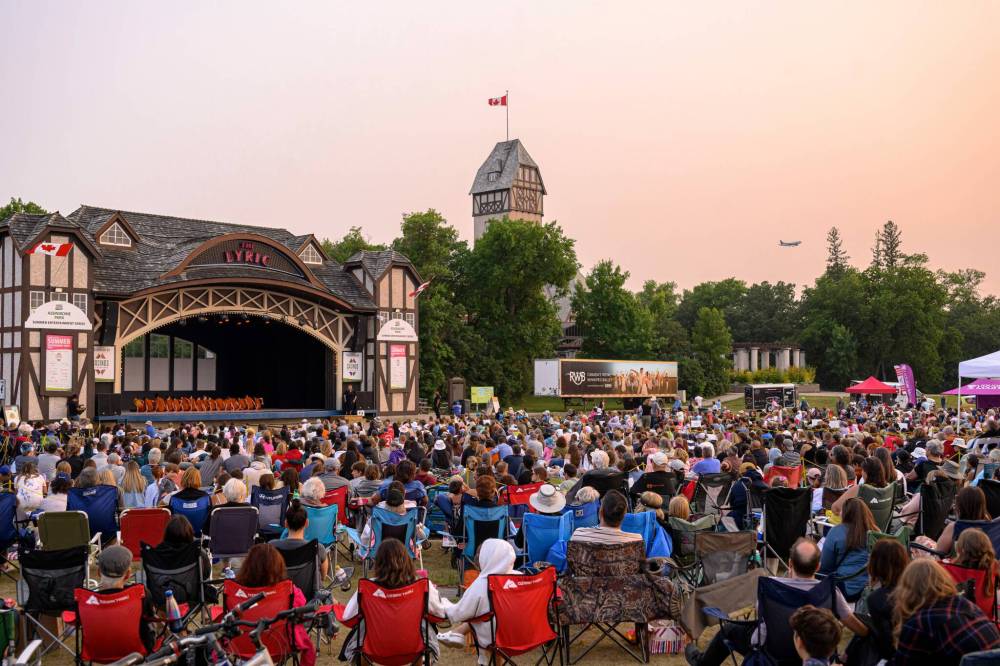
MIKE SUDOMA / FREE PRESS FILES
Last year, wildfire smoke hung over the city during the Royal Winnipeg Ballet’s Ballet in the Park series. This year, the entire event was cancelled because of heat.
This doesn’t feel great. I do not begrudge cancellations — they are absolutely the correct call for the health and safety of performers and patrons — but I can’t be the only one feeling some existential dread about our summers, and the things that make them special, in the face of a changing climate.
After all, this isn’t just a 2026 trend. In July 2025, the final night of Ballet in the Park was cancelled for heat. Rainbow Stage, meanwhile, had to cancel a matinee of Rock of Ages because of wildfire smoke. Shakespeare in the Ruins was forced to cancel several performances, seven of which were directly related to weather or smoke.
These annual vacations to the Devil’s Armpit are getting old, even though I know I’m not supposed to say that.
When you live in a winter city whose core tenets of civic identity include fighting for supremacy on whose winter is the hardest, fighting over windchill vs. temperature and generally being insufferable to Torontonians online whenever they have to deal with snow, you are practically contractually obligated to love summer — or at least not complain about summer because “wait until it’s -30 C!”
Don’t threaten me with a good time.
The thing is, I do love summer, and I love summer in the city. I love how animated it becomes, how much there is to do, how the light lingers on the horizon for so long. I love our festivals, our celebrations and the way we congregate outdoors.
But increasingly I’m finding myself forced inside by ever-more inclement weather, a phrase usually reserved for cold months. Scorching temps, acrid forest fire smoke, humidity I can only describe as enraging — all of this has put a damper on the season we wait all winter for.
I’ve already had to schedule my dog walks for very early in the morning and later in the evening; I think I’ve sat on my deck once this summer because of the oppressive heat.
The same was true last summer, which, you may recall, was a record-breaking one for wildfire smoke. There were 189 smoke hours logged last July, surpassing the previous record-holding 163 smoke hours recorded in August 1961. The sky burned orange, and the air was often too toxic to breathe.
There’s already a scarcity about summer. Now those perfect days — 22 C, light breeze, blue sky with passing puff-ball clouds, no I will not accept arguments to the contrary — are in very short supply.
Now, you could say Winnipeg’s weather has always been marked by extremes. This is an area of the world that sees a 60-degree temperature swing between winter and summer, and we are no stranger to storms and floods and the rest.
But the extremes are being pushed to further extremes by climate change. Winnipeg broke temperature records in July, but we also broke some in May. Environment and Climate Change Canada predicted in January that 2026 will likely be among the hottest years on record, comparable to 2023 and 2025. The warmest year ever observed was 2024.

I hope I don’t need to spell it out but I will: those are the last four years.
I worry what the prolonged punishing heat waves and choking wildfires and more frequent and intense storms mean for our outdoor events and festivals, especially since we’ve already experienced the wholesale loss of these cultural cornerstones in 2020. The pandemic showed us what a summer of silence looks like.
Play this out for the next 50 years. Will our summer festivals have to move to different pages of the calendar? Will they all move indoors? Will February become Festival Month, anchored by Festival du Voyageur? Or will it be too unseasonably warm for that festival, too?
I don’t have the answers. But it does make me want to attend everything I can, for as long as I can.
jen.zoratti@winnipegfreepress.com
Jen Zoratti is a columnist and feature writer working in the Arts & Life department, as well as the author of the weekly newsletter NEXT. A National Newspaper Award finalist for arts and entertainment writing, Jen is a graduate of the Creative Communications program at RRC Polytech and was a music writer before joining the Free Press in 2013. Read more about Jen.
Every piece of reporting Jen produces is reviewed by an editing team before it is posted online or published in print – part of the Free Press‘s tradition, since 1872, of producing reliable independent journalism. Read more about Free Press’s history and mandate, and learn how our newsroom operates.
Our newsroom depends on a growing audience of readers to power our journalism. If you are not a paid reader, please consider becoming a subscriber.
Our newsroom depends on its audience of readers to power our journalism. Thank you for your support.
Jen Zoratti is a columnist and feature writer working in the Arts & Life department, as well as the author of the weekly newsletter NEXT. A National Newspaper Award finalist for arts and entertainment writing, Jen is a graduate of the Creative Communications program at RRC Polytech and was a music writer before joining the Free Press in 2013. Read more about Jen.
Every piece of reporting Jen produces is reviewed by an editing team before it is posted online or published in print – part of the Free Press‘s tradition, since 1872, of producing reliable independent journalism. Read more about Free Press’s history and mandate, and learn how our newsroom operates.
Our newsroom depends on a growing audience of readers to power our journalism. If you are not a paid reader, please consider becoming a subscriber.
Our newsroom depends on its audience of readers to power our journalism. Thank you for your support.
Advertisement Advertise With Us
Advertisement Advertise With Us