That’s freshtastic! Farm to table is better, friendlier, tastier
Read this article for free:
or
Already have an account? Log in here »
To continue reading, please subscribe:

Digital Subscription
One year of digital access for only $205*
- Enjoy unlimited reading on winnipegfreepress.com
- Read the E-Edition, our digital replica newspaper
- Access News Break, our award-winning app
- Play interactive puzzles
*First annual payment billed as $205.00 + GST for one year. This annual subscription will automatically renew at $233.00 + GST every 52 weeks (10% off the regular annual price of $259.35). Offer available to new and qualified returning subscribers only. Cancel any time.
To continue reading, please subscribe:
Add Free Press access to your Brandon Sun subscription for only an additional
$1 for the first 4 weeks*
- Enjoy unlimited reading on winnipegfreepress.com
- Read the E-Edition, our digital replica newspaper
- Access News Break, our award-winning app
- Play interactive puzzles
*Your next Brandon Sun subscription payment will increase by $1.00 and you will be charged $17.95 plus GST for four weeks. After four weeks, your payment will increase to $24.95 plus GST every four weeks.
Read unlimited articles for free today:
or
Already have an account? Log in here »
Every year without fail, when the ground starts to thaw and temperatures begin to rise, Manitobans start calling Scott Schriemer.
“I’ll have people already phone me in the beginning of May asking if the local strawberries are ready yet,” says the proprietor of Vic’s Market (1049 Pembina Hwy.).
“Generally speaking, most people know strawberries don’t start until the end of June, but they get to a point where they have a real craving for something that’s been produced here, that’s fresh and that’s new.”
Ruth Bonneville / Free Press Scott Schriemer, the proprietor of Vic’s Market, displays an array of fresh, local produce.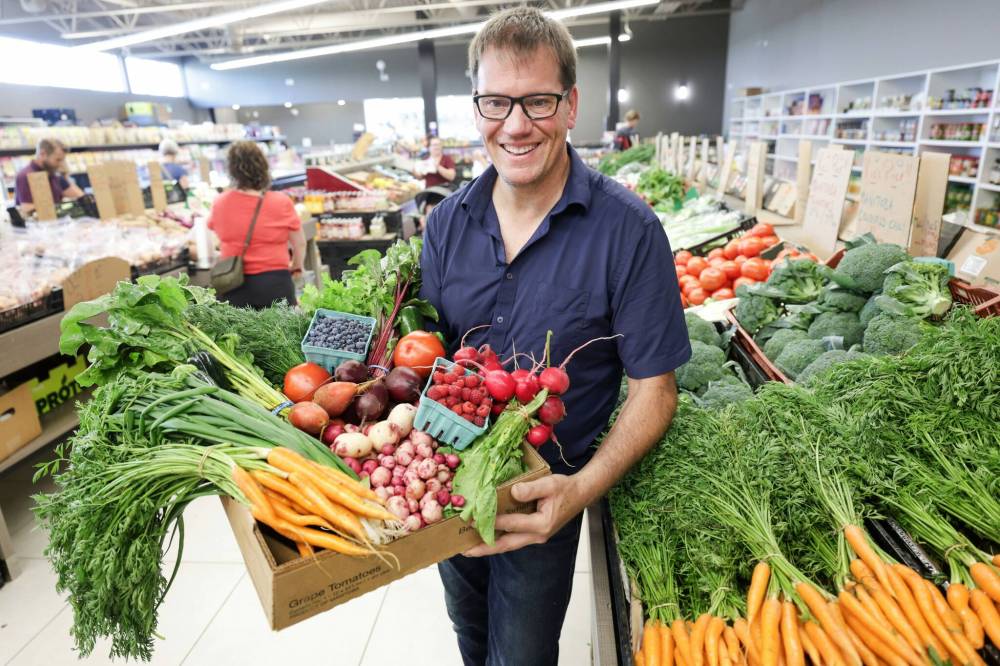
There are plenty of positives for those with access to locally grown, seasonal produce, especially when it comes to how something tastes.
Fruits and vegetables, allowed to mature naturally under the sun and picked days rather than weeks ago, arrive in markets and shops with their full flavour, texture and nutritional value intact.
Nowhere was this more obvious than during a recent family dinner. There were boiled potatoes simply dressed with a knob of butter; pale yellow string beans and glossy, thick zucchinis roasted with oil, salt and pepper; and raw, freshly podded peas — small and crunchy, cold and sweet.
All were locally grown in my in-laws’ kitchen garden and generously shared. It was extraordinary to see plates cleaned, every scrap of food polished off, at the end of the meal.
Ruth Bonneville / Free Press Longtime customers of Vic’s Market, Bob Lamb and Pat Mackay — who have been shopping at Vic’s since 1979 — are all smiles as they pick out a basket of local raspberries.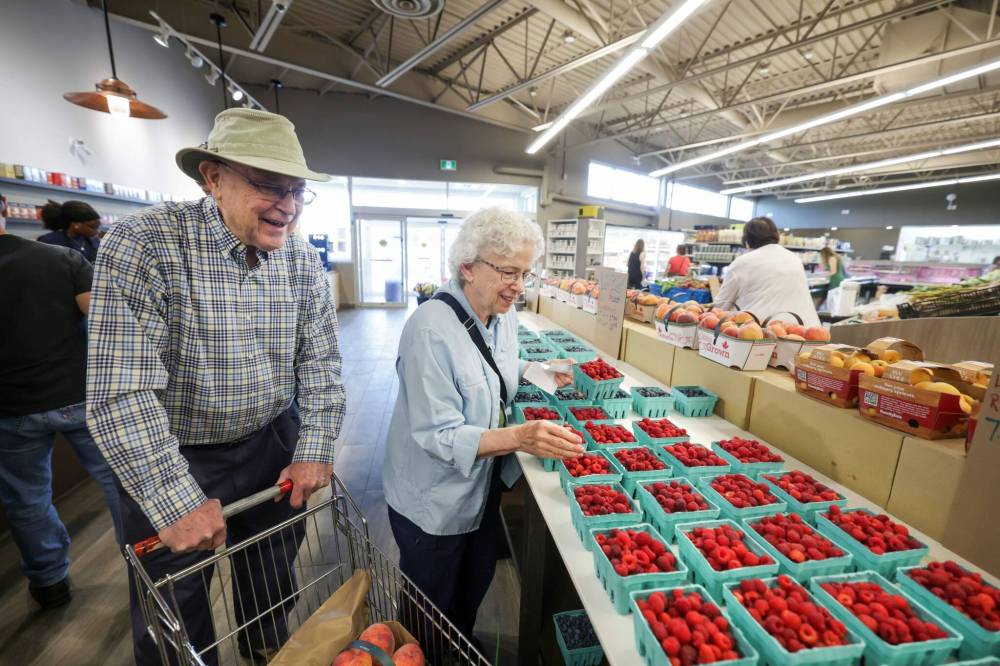
We had, as a precaution, also chucked a handful of frozen chicken fingers in the oven; that’s what 10 years of parenting will do to someone.
But we had sorely underestimated the youngest member of our family. The convenience food was the only thing left on the table that evening.
It’s hard to ignore the contrast between that dinner, featuring local, seasonal veggies, to previous meals cooked entirely from produce that travelled thousands of kilometres before making its way into our kitchen.
Walk down the produce aisle of any big supermarket — it doesn’t matter whether you’re shopping on a frigid February morning or a sweaty afternoon in August — and you’re sure to find punnets of strawberries, bags of beans and thrice-washed pre-chopped salad kits, misted with dots of condensation, sitting under flickering, fluorescent lights.
The produce is often picked and processed before fully ripened, pushed towards a battery of conveyor belts and slapped with branding intended to obfuscate the scale of production, with words such as “farm” and “market” tacked onto labels to evoke a wholesome family run patch.
A ready-made salad kit, priced at just under $6, seems to be a more convenient and economically sensible option than buying individual heads of lettuce, fresh herbs and whole vegetables, which require washing, peeling and chopping.
“The actual carbon footprint of a local product is less because it’s moved around less.”
It’s the face of easy convenience, but what compromises are we making in exchange for this predictable efficiency?
Cheaper doesn’t always translate to better. To survive long transit times, specific varieties of produce are chosen for durability, uniformity and shelf life, rather than for flavour or nutrients.
While not everyone can cultivate a plot of land or has access to family gardens, there are still ways to prioritize buying local fruit and veg.
“My motto is we should really should be enjoying locally produced foods when it’s the season because it is accessible. If people can shift some of their consumption to local goods, they’re going to have better produce which has travelled less and is going to taste better,” says Colin Rémillard, co-owner of Jardin St-Léon Gardens (419 St. Mary’s Rd.)
Ruth Bonneville / Free Press Colin Rémillard, co-owner of Jardin St-Léon Gardens, restocks his table of locally grown beans.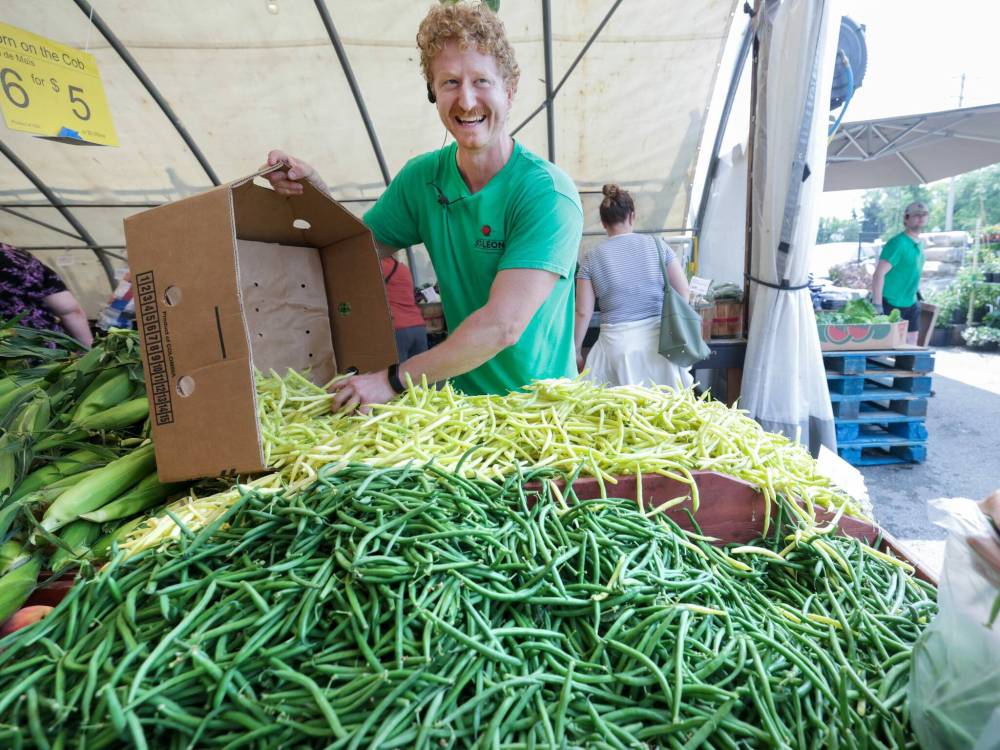
Stepping away from far-reaching supply chains begins by making a conscious decision to look for domestic produce from independent grocers and farmers markets.
“Switching from the grocery store you go to in the winter to a farmers market in the summer is a big ask. It takes more effort to find local options. Everyone lives busy lives, and changing a small habit is actually quite a task. It takes a lot of resistance. But if you can overcome that resistance, you’re in for a treat,” Rémillard says, pointing out that buying local also has environmental benefits.
“The actual carbon footprint of a local product is less because it’s moved around less.”
When it comes to sourcing goods, buyers at St-Léon’s prioritise Manitoba-based producers, working with more than 200 local suppliers to stock their shelves — unless something isn’t available here. Recent weather has played havoc with harvests; corn is late and peas are already done.
Ruth Bonneville / Free Press Jardin St-Léon Gardens has a large selection of locally grown produce.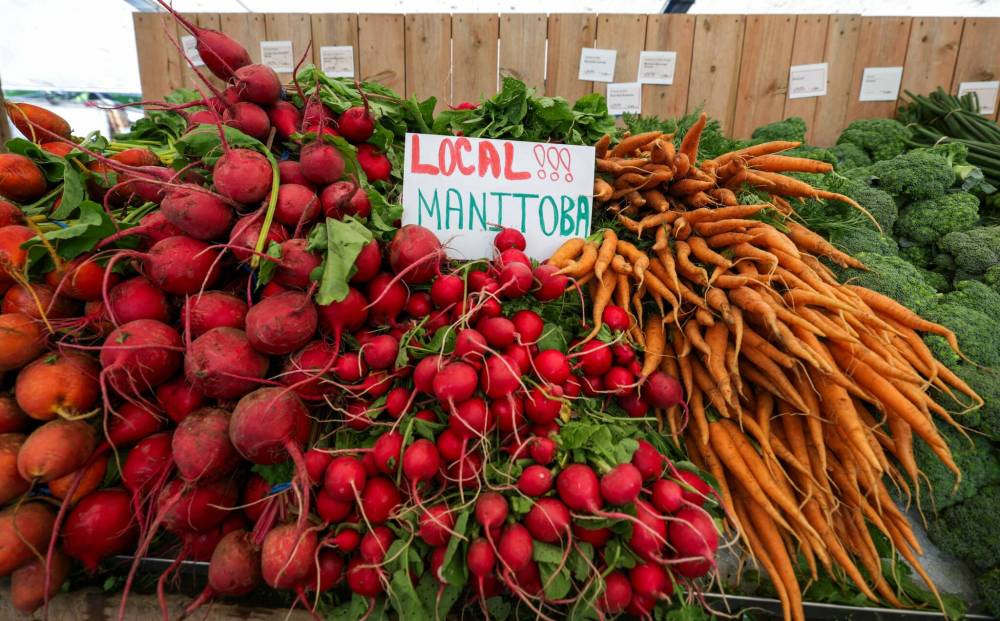
“My brother does all the local buying and my cousin does all the imported buying. They are talking constantly to each other and if they can’t get something locally or in Canada, they’ll shift the search onto my cousin and he’ll look around to find import options,” Rémillard says, acknowledging the market is sometimes forced to buy from the U.S.
“The States is our least preferred source. It’s unfortunate. It’s uncomfortable. But it’s part of the gig. The continent was extremely connected produce-wise before Trump was in power, but the States is definitely bottom of the hierarchy when it comes to our choices.”
Anything sourced outside Canada is clearly labelled — “We’ll say from the U.S. in our store,” Rémillard says — and if there’s even the slightest doubt a vegetable or fruit isn’t strictly from here, the “local” tag is removed.
“We are pretty particular; when we say something’s local it has to be strict because without that who are we?”
“We sell wild blueberries that grow in the bush. Years ago we used to call them local wildberries. Now we don’t because we’re not 100 per cent sure they’re actually within the Manitoba border; the pickers don’t tell us exactly where they go. And that’s no joke.
“We are pretty particular; when we say something’s local it has to be strict because without that who are we? If we can’t be trusted, what else can be trusted? So we take that very seriously,” he says.
Buying herbs, fruits and vegetables from Manitoba brings a host of benefits, not the least of which is simple economics.
Choosing to spend dollars here keeps revenue circulating within local farming communities, creating relationships and agricultural networks that can withstand disruptions — such as the recent food safety crisis in the U.S., where a cyclosporiasis outbreak has been linked to lettuce from produce giant Taylor Farms.
The corporation’s products are available in all major Canadian supermarkets, and while this most recent crisis did not cross the border, in 2024 shelves were cleared of Taylor Farms salad kits due to a possible salmonella contamination.
Mike Sudoma / Free Press FIles St. Norbert Farmers’ Market executive director Danielle Mondor 
“Buying local is certainly more than just safe lettuce,” says Danielle Mondor, executive director at Le Marché St. Norbert Farmers’ Market (3514 Pembina Hwy.).
“When we have emergencies in our food system, people then turn to the person they trust the most. What we’re trying to do is not just be a resource when an emergency happens; we’re trying to be the food source you can trust all the time, 365 days a year. You’re getting names instead of anonymity, you’re getting people instead of companies, and you have the ability to ask all the questions you want so you feel safe.”
St. Norbert works with Direct Farm Manitoba’s Community Food Currency Program, which enables those with limited resources to purchase fresh and local foods such as meat, honey, eggs, milk, vegetables, fruit and grains, Mondor adds.
Mike Sudoma / Free Press Ming Zhai of Fertile Farms arranges cabbage at her booth at Le Marché St. Norbert Farmers’ Market.
“We’ve been doing it for six years now and it’s been really awesome. We hope it becomes a national program. We would love to see it in so many more communities because it’s changed the face of our market for the better,” she says.
When you buy from a farm shop, local market or roadside stand, food is restored to a smaller, more human scale.
The market proprietor knows where the farm supplies are coming from, the weather that nurtured the crop and the farmer who grew the vegetables.
Ruth Bonneville / Free Press Nick Mostert, grandson of the original owner of Vic’s Market, sets out local corn.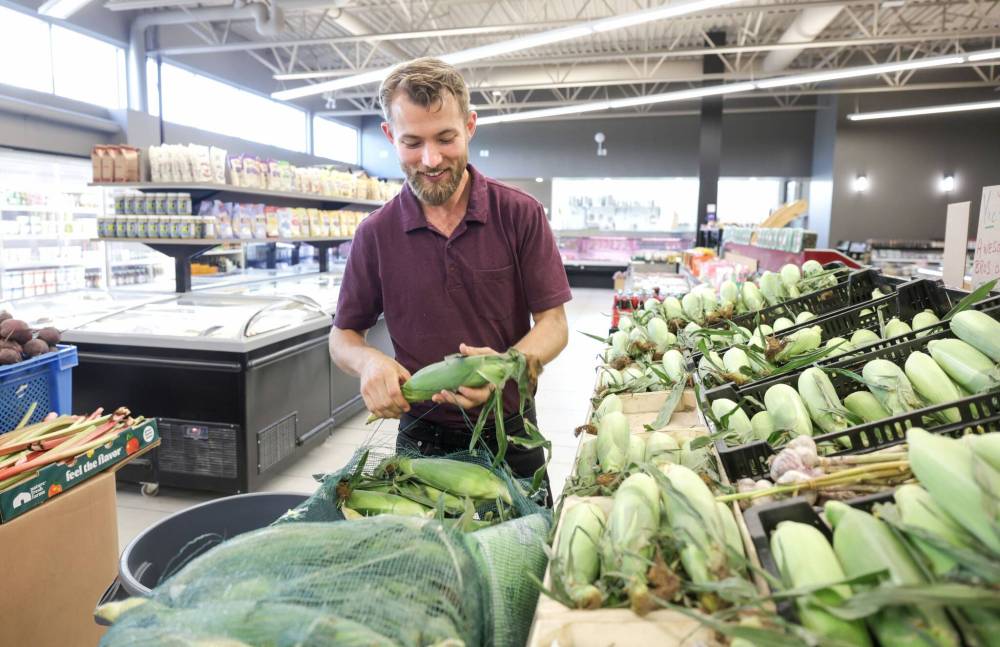
At a market such as Vic’s, founded by Schriemer’s father Wietze (Vic) Schriemer in 1958, the “first line of defence” is to develop good working relationships with local producers.
“The biggest thing is trust,” Schriemer says.
“At the end of the day, large corporations don’t do it better than local markets who know the people intimately, who’ve had breakfast or dinner at their table, sharing stories about their family, kids, grandkids. It’s a unique experience for them and us because it’s not just about a transaction, it’s about building a process that integrates their life into yours, making it meaningful for both parties.”
av.kitching@freepress.mb.ca

AV Kitching is an arts and life writer at the Free Press. She has been a journalist for more than two decades and has worked across three continents writing about people, travel, food, and fashion. Read more about AV.
Every piece of reporting AV produces is reviewed by an editing team before it is posted online or published in print — part of the Free Press‘s tradition, since 1872, of producing reliable independent journalism. Read more about Free Press’s history and mandate, and learn how our newsroom operates.
Our newsroom depends on a growing audience of readers to power our journalism. If you are not a paid reader, please consider becoming a subscriber.
Our newsroom depends on its audience of readers to power our journalism. Thank you for your support.