Captive crew American Hostage stars recall warmth of Winnipeggers during brutal winter
Read this article for free:
or
Already have an account? Log in here »
To continue reading, please subscribe:

Digital Subscription
One year of digital access for only $205*
- Enjoy unlimited reading on winnipegfreepress.com
- Read the E-Edition, our digital replica newspaper
- Access News Break, our award-winning app
- Play interactive puzzles
*First annual payment billed as $205.00 + GST for one year. This annual subscription will automatically renew at $233.00 + GST every 52 weeks (10% off the regular annual price of $259.35). Offer available to new and qualified returning subscribers only. Cancel any time.
To continue reading, please subscribe:
Add Free Press access to your Brandon Sun subscription for only an additional
$1 for the first 4 weeks*
- Enjoy unlimited reading on winnipegfreepress.com
- Read the E-Edition, our digital replica newspaper
- Access News Break, our award-winning app
- Play interactive puzzles
*Your next Brandon Sun subscription payment will increase by $1.00 and you will be charged $17.95 plus GST for four weeks. After four weeks, your payment will increase to $24.95 plus GST every four weeks.
Read unlimited articles for free today:
or
Already have an account? Log in here »
TORONTO — When you stream the eight-part series American Hostage, a sense of familiarity may strike.
That’s because the show was shot in Winnipeg — especially in the Exchange District — from November of last year to the beginning of February, with Winnipeg portraying Indianapolis circa 1977.
The whole world seemed to be watching that midwest American city that year as a hostage crisis unfolded involving one Tony Kiritsis, an angry man who goes ballistic when a mortgage brokerage was poised to foreclose on property he had dreamed of developing into a shopping centre.
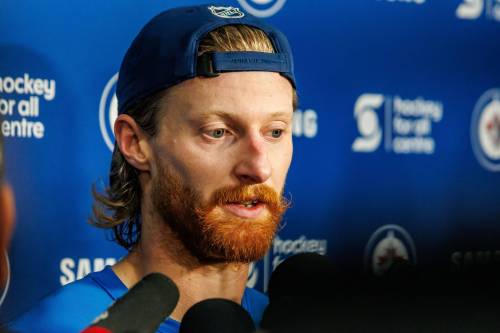
NHL / ANDREW MAHON PHOTO Jon Hamm takes in a Winnipeg Jets came during the filming of American Hostage in November.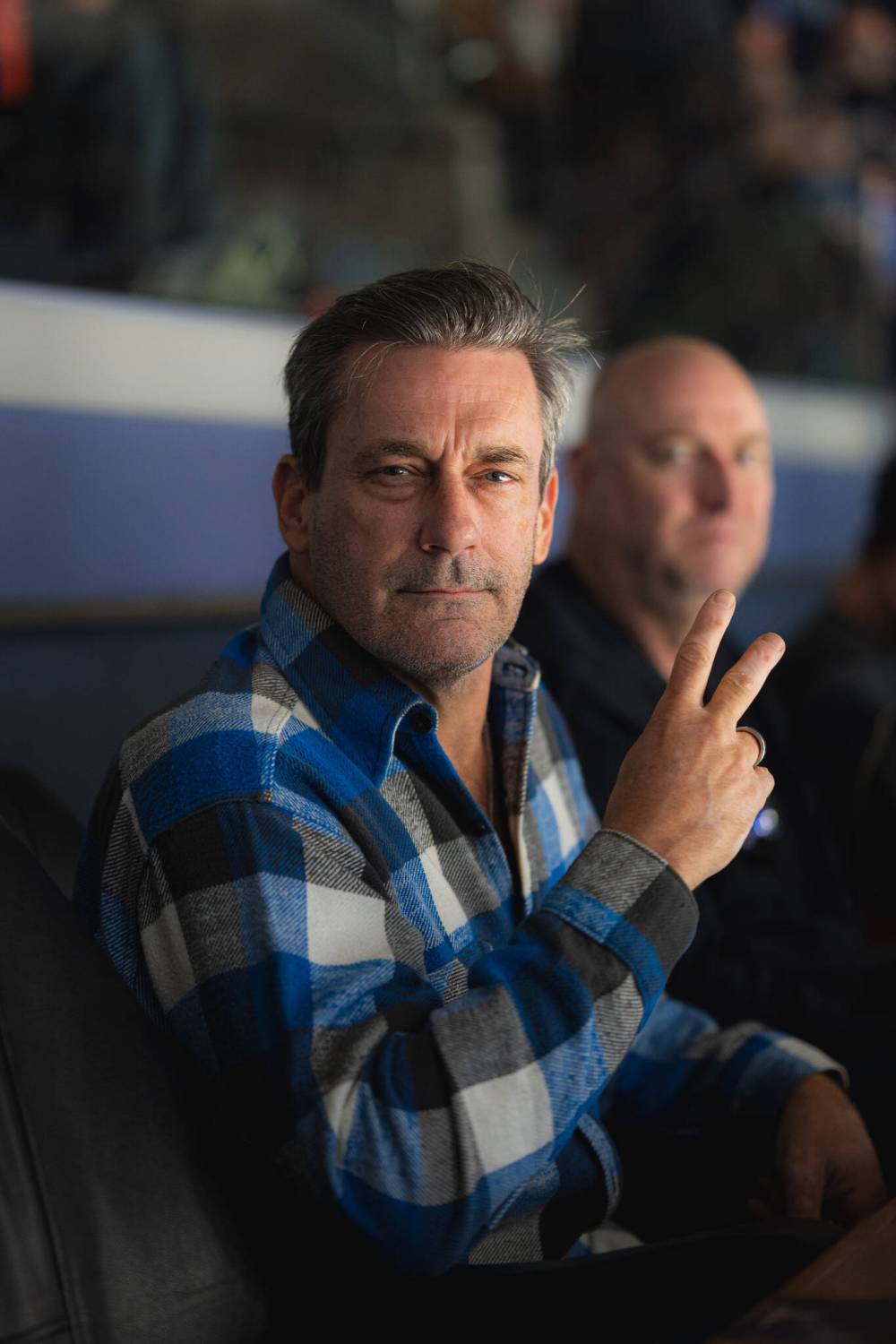
Kiritsis kidnapped his mortgage broker, Richard Hall, wiring a shotgun to the back of his head, and demanded a public airing of his grievances, with the reluctant help of popular radio broadcaster Fred Heckman.
American Hostage, adapted from the podcast of the same name and premièring Sunday on Crave, mainly focuses on Heckman, played by Jon Hamm, whose desire to help both men survive what would be a 63-hour standoff pushes his journalistic ethics to the limit.
Giovanni Ribisi (Sneaky Pete) plays Kiritsis, an explosive-tempered entrepreneur with a history of violence in his past.
Hamm, best known for playing uber-adman Don Draper in the series Mad Men (2007-2015) says Fred is a more benign character than Don, in an interview in a Bell Media studio during the Toronto International Film Festival, where the series premièred last week.
“The difference, I think, with Don Draper is that he, as an advertising creative person, is driving the narrative and driving the conversation, whereas Fred, being a journalist, is trying to be neutral, is trying to just report the facts,” Hamm says.
“And the problem with the situation as it develops is that he is thrust into being a part of the story and trying to navigate the difficulty of finding the line.”
“It was cold, but we knew that going in.”
Hamm, who also served as the show’s executive producer, says he was sold on the location by a good friend.
“My buddy Bob Odenkirk had done some movies up there back-to-back, and he said: ‘You’re going to love Winnipeg,’” Hamm says, referring to Nobody, Nobody 2 and Normal.
“He’s from Illinois. I’m from Missouri. Very similar vibes, so I very much did. It was cold, but we knew that going in.”
It helped undoubtedly that Hamm is a hockey fan and attended his share of Jets games.
“It was shot during hockey season, so I was able to be a part of that,” he says. “Part of it was that I lived right on the river, and so I got to see how beautiful a town it is, even in the wintertime. When you’re on location, you’re on location, you’re not on vacation. You’re there to work. But also part of it is: hey, you’re there, so lean in. I’ve got a lot of heavy coats. I got some sweaters. I know how to dress for the occasion.
“I found a couple of restaurants that I could walk to basically, and I found a couple of places that I really enjoyed going. I very much enjoyed my time in Winnipeg.”
Frank Ockenfels / MGM+ / Sony Pictures Television Giovanni Ribisi portrays hostage-taker Tony Kiritsis in the Winnipeg-shot series.
Ribisi may have had an advantage over Hamm and the rest of the visiting cast, including Mireille Enos (For All Mankind) in the role of Hamm’s wife and William Jackson Harper (The Good Place) as a star reporter at the radio station.
Ribisi had worked in Winnipeg before in the 2005 comedy The Big White, opposite Robin Williams and Holly Hunter.
That shoot was a comparatively brief visit, he says. Working on American Hostage made more of an impression.
“I think Winnipeg, it goes without saying, is an amazing city and the people are at the heart of that.”
“This was an extended stay. I think Winnipeg, it goes without saying, is an amazing city and the people are at the heart of that, obviously,” says Ribisi.
Winter presented challenges, of course.
“There was a moment there, and I don’t know if this happens every winter, but it was on the news. There was a day when they said that it was the coldest place in the world.”
And that would be a day when he had to work outside?
“It was,” Ribisi says with a smile.
“But you know, it’s not a complaint. I mean, the crew is out there busting their asses. At the end of the day, there was no better place to shoot this story and a huge part of that was the crews. In working with them, it felt like I was back in the ’90s where people had different priorities working on films.”
One of the other key players in the American Hostage mix was Adam Arkin (Chicago Hope), who triple-threated as an executive producer, director for half of the episodes, and also as an actor, playing one of Kiritsis’s lawyers.
But while casting himself, Arkin also enthusiastically cast a host of local actors in substantial roles (“We were so delighted at the depth of the talent pool there,” he says) including Erik Athavale as another of Kiritsis’s lawyers and Steven Ratzlaff as the show’s true villain, the patriarch of the Hall family mortgage company, as well as Harry Nelken, Darcy Fehr, Carson Nattrass, Lauren Cochrane, Marina Stephenson Kerr and many more.
“I think in at least three cases, without knowing it, that we had cast couples,” Arkin says, laughing. “So we had cast husband and wife and only after the fact that we realized that we had done that.
“It’s a tight-knit community there, and everybody seems to know one another.”
“And in one case, there was a wonderful actor that we cast in the role of a detective, and a week after we had cast him, I looked up and he was standing in one of our hallways outside the sound stages with a tool belt on.
“And I’m like: ‘What’s going on? Are you like auditioning for another project or what’s happening?’
“He goes, ‘No, I’m on your construction crew.’ So he was acting and working construction, which is great. It’s a tight-knit community there, and everybody seems to know one another.”
Esthetics-wise, the city and its abundance of brutalist architecture proved appropriate for a background that could pass for ’70s structures, including the Royal Manitoba Theatre Centre, which doubles as the radio station where Heckman works.

While Arkin says he has no particular soft spot for brutalism, he felt it defined the period well, and the overall look captured the notion of a media industry in transition.
“The technology allowed so much to be happening in real time for the first time. Not only sound and radio, but now visual images that could be done remotely and (broadcast) live as they happened,” Arkin says.
“I don’t think the media had yet understood how precarious it would be for them to become part of the story. Fifty years later, (the media) seem to relish being part of the story, and want to be more of the story than the story itself. And I think we’re all living with some of the negative ramifications of that evolution.”
randall.king.arts@gmail.com

Our newsroom depends on a growing audience of readers to power our journalism. If you are not a paid reader, please consider becoming a subscriber.
Our newsroom depends on its audience of readers to power our journalism. Thank you for your support.