

A quick look at where provinces and territories stand on time changes
Advertisement
Read this article for free:
or
Already have an account? Log in here »
To continue reading, please subscribe:

Digital Subscription
One year of digital access for only $205*
- Enjoy unlimited reading on winnipegfreepress.com
- Read the E-Edition, our digital replica newspaper
- Access News Break, our award-winning app
- Play interactive puzzles
*First annual payment billed as $205.00 + GST for one year. This annual subscription will automatically renew at $233.00 + GST every 52 weeks (10% off the regular annual price of $259.35). Offer available to new and qualified returning subscribers only. Cancel any time.
To continue reading, please subscribe:
Add Free Press access to your Brandon Sun subscription for only an additional
$1 for the first 4 weeks*
- Enjoy unlimited reading on winnipegfreepress.com
- Read the E-Edition, our digital replica newspaper
- Access News Break, our award-winning app
- Play interactive puzzles
*Your next Brandon Sun subscription payment will increase by $1.00 and you will be charged $17.95 plus GST for four weeks. After four weeks, your payment will increase to $24.95 plus GST every four weeks.
Read unlimited articles for free today:
or
Already have an account? Log in here »
WINNIPEG – Manitoba’s government said Thursday the province will be sticking with daylight time year-round, making it the latest jurisdiction to move away from twice-annual time changes. Here’s a look at where things stand across Canada:
British Columbia said in March that it was moving to permanent Pacific daylight time. The change also means that parts of northeastern B.C., which have been on mountain standard time year round, are now in alignment with the rest of the province.
Alberta also switched to permanent daylight time this year in what it calls Alberta time. The change means it now has the same time as Saskatchewan year round.
Saskatchewan has been on permanent central standard time since 1966.
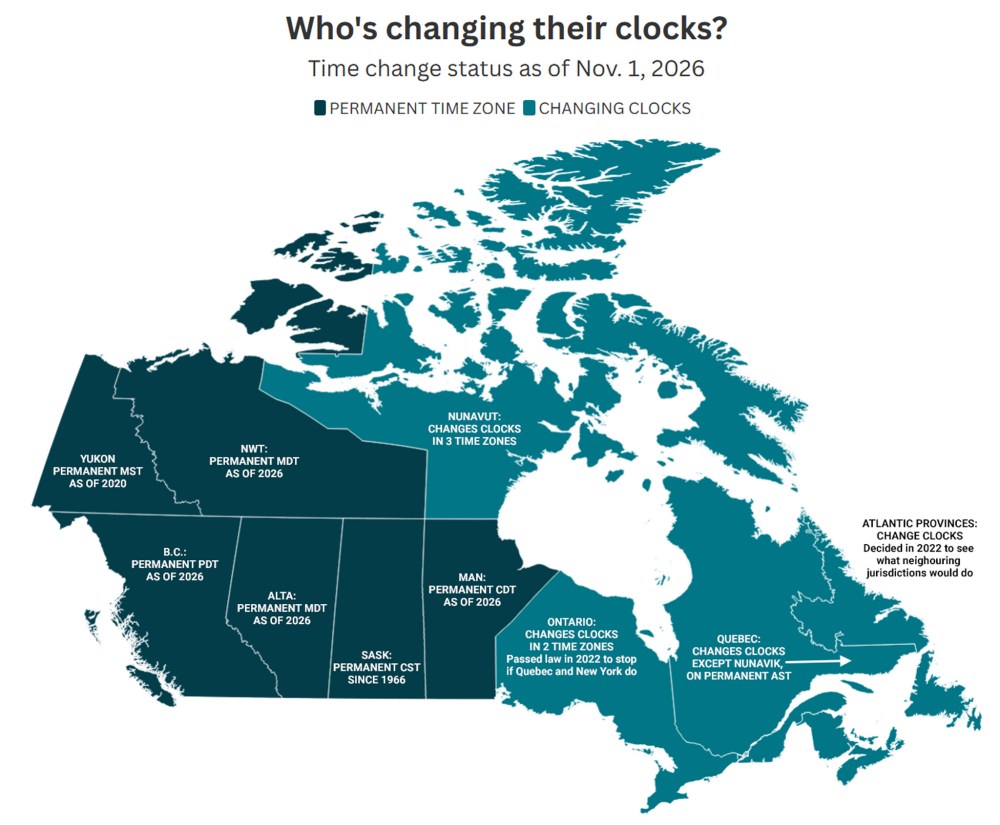
Manitoba will be sticking with daylight time in the central time zone, meaning it won’t be aligned with the other Prairie provinces and will stay one hour ahead.
Ontario passed a law in 2020 to end the twice-yearly changing of clocks and make daylight time permanent — but only if Quebec and New York agreed to do the same.
Quebec released a survey last year that showed 91 per cent of respondents want to stop changing the clocks, but the province has yet to make a change. Nunavik, the northern region of the province, has however moved to permanent daylight time.
Atlantic provinces in 2022 decided to hold off on any move toward dropping the time change until they saw what neighbouring jurisdictions would do.
The Yukon moved to end time changes in 2020. The territory observes mountain standard time.
The Northwest Territories followed Alberta’s lead earlier this year to end seasonal time changes. The territory is on permanent daylight time that matches Alberta.
Nunavut, which spans three time zones, continues to change clocks twice a year.
This report by The Canadian Press was first published Sept. 17, 2026.
Related Articles
Manitoba abandoning spring, fall clock changes

Advertisement Advertise With Us