Robot study gives seniors say in era of AI

Advertisement
Read this article for free:
or
Already have an account? Log in here »
To continue reading, please subscribe:

Digital Subscription
One year of digital access for only $205*
- Enjoy unlimited reading on winnipegfreepress.com
- Read the E-Edition, our digital replica newspaper
- Access News Break, our award-winning app
- Play interactive puzzles
*First annual payment billed as $205.00 + GST for one year. This annual subscription will automatically renew at $233.00 + GST every 52 weeks (10% off the regular annual price of $259.35). Offer available to new and qualified returning subscribers only. Cancel any time.
To continue reading, please subscribe:
Add Free Press access to your Brandon Sun subscription for only an additional
$1 for the first 4 weeks*
- Enjoy unlimited reading on winnipegfreepress.com
- Read the E-Edition, our digital replica newspaper
- Access News Break, our award-winning app
- Play interactive puzzles
*Your next Brandon Sun subscription payment will increase by $1.00 and you will be charged $17.95 plus GST for four weeks. After four weeks, your payment will increase to $24.95 plus GST every four weeks.
Read unlimited articles for free today:
or
Already have an account? Log in here »
It’s no longer the stuff of sci-fi: AI sidekicks that simulate emotional support and guide routines.
Robot companions are increasingly becoming part of everyday life for seniors, with certain U.S. states even subsidizing such devices for personal use through public health-care programs.
Among the many ethical questions this raises: what’s to be done with these robots, and all the secrets and personal data they carry, after the owner dies?
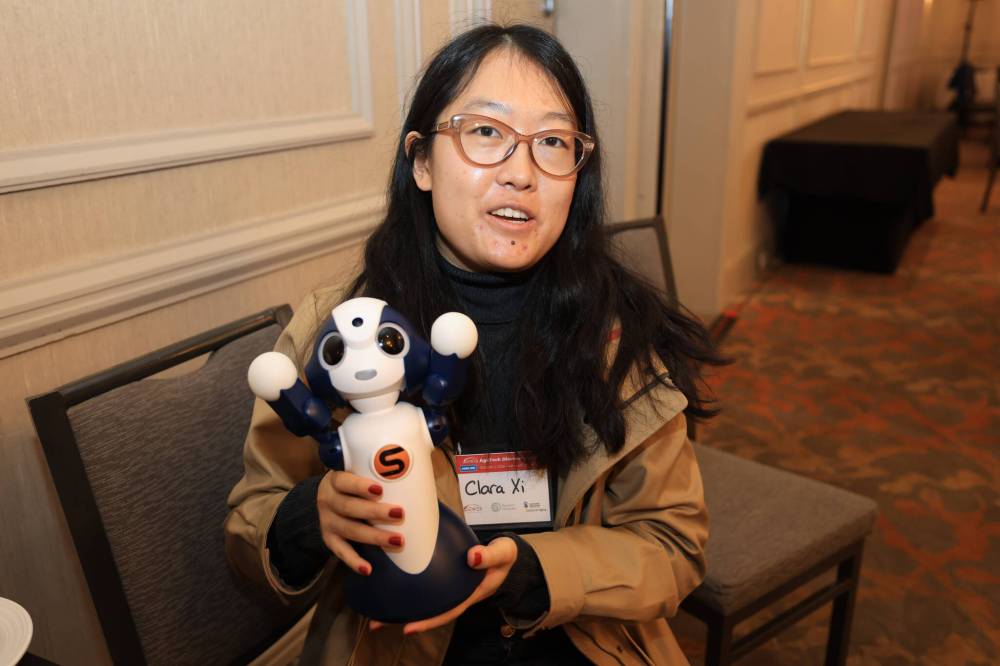
Mike Latschislaw photo
PhD student Clara Xie, a visiting researcher at the University of Manitoba, shows off a robot companion.
“We don’t know the answers. That’s why I’m running a study. It’s a participatory study with seniors,” said Clara Xie, a PhD student in computer science at the University of Calgary, who is conducting research at the University of Manitoba.
Xie will lead focus groups with seniors next month at Louis Riel Library, where they will make collages and write stories with robot companions.
Xie’s project was among several showcased Thursday at AgeTech Discovery Day at the Holiday Inn Winnipeg South. The event, held on National Seniors Day, was hosted by the U of M’s multidisciplinary Centre on Aging with AGE-WELL, a network of academic researchers, private corporations and public funders working on technologies and services for the aging.
Another highlighted project was BankBox, which simulates the online banking interfaces of Canada’s major banks so older adults can get the hang of transferring money and paying bills when the stakes are low.
“There’s going to be security concerns, low confidence or just not knowing how to navigate the interface. But that’s not a good way to learn online banking” said Mehran Hossain, a master’s student in the U of M’s computer science program who worked on BankBox’s development. “It’s really important that you have a safe platform. So that’s the motivation behind building it.”
Beyond showcasing the centre’s nifty new technologies and AgeTech research — from virtual-reality tools and directories for navigating digital legacies for deceased loved ones to fall-prevention apps and supports for socially isolated seniors — the event also invited attendees to sign up for future focus groups.
“A big tenet of this kind of work is we shouldn’t just have engineers or computer scientists in a lab saying, ‘Hey, I think we should design this for older adults,’ and then they design it, and older adults go, ‘Hey, I’m not going to use this. This is no good for me,’” said kinesiologist Michelle Porter, the Centre on Aging’s director.
“So, there’s really an attempt to make sure that older adults are very involved in the entire process.”
Porter encouraged interested participants to become a member of Voice Canada, a platform connecting older adults to researchers on the Centre on Aging’s website.

Ralph Christianson, who drove in from Steinbach to participate in the event, said he was concerned about AI-generated content he sometimes sees online and how to sort the real from the fake.
“I can’t say with 100 per cent certainty, but I (don’t think I’ve) been fooled by anybody yet,” he says. “The stories that we’ve seen recently in the last month or two about how we could destroy humanity in 10 years (with AI). That’s a little frightening — but can they really do it?”
Christianson thinks it’s important for older adults to stay up to date on everyday technologies that could most affect them.
“I try as much as possible. Although because I don’t know how to operate a smartphone, I need to learn that one day,” he says.
conrad.sweatman@winnipegfreepress.com
Conrad Sweatman is an arts reporter and feature writer. Before joining the Free Press full-time in 2024, he worked in the U.K. and Canadian cultural sectors and freelanced for outlets including The Walrus, VICE and Prairie Fire. Read more about Conrad.
Our newsroom depends on a growing audience of readers to power our journalism. If you are not a paid reader, please consider becoming a subscriber.
Our newsroom depends on its audience of readers to power our journalism. Thank you for your support.
Conrad Sweatman is an arts reporter and feature writer. Before joining the Free Press full-time in 2024, he worked in the U.K. and Canadian cultural sectors and freelanced for outlets including The Walrus, VICE and Prairie Fire. Read more about Conrad.
Our newsroom depends on a growing audience of readers to power our journalism. If you are not a paid reader, please consider becoming a subscriber.
Our newsroom depends on its audience of readers to power our journalism. Thank you for your support.
Advertisement Advertise With Us
Advertisement Advertise With Us