Brilliant legacy
Oseredok centrepiece mosaic a testament to Ukrainian heritage

Advertisement
Read this article for free:
or
Already have an account? Log in here »
To continue reading, please subscribe:
Digital Subscription
One year of digital access for only $1.44 a week*
- Enjoy unlimited reading on winnipegfreepress.com
- Read the E-Edition, our digital replica newspaper
- Access News Break, our award-winning app
- Play interactive puzzles
*Billed as $5.77 plus GST every four weeks. After 52 weeks, price increases to the regular rate of $19.95 plus GST every four weeks. Offer available to new and qualified returning subscribers only. Cancel any time.
To continue reading, please subscribe:
Add Free Press access to your Brandon Sun subscription for only an additional
$1 for the first 4 weeks*
- Enjoy unlimited reading on winnipegfreepress.com
- Read the E-Edition, our digital replica newspaper
- Access News Break, our award-winning app
- Play interactive puzzles
*Your next Brandon Sun subscription payment will increase by $1.00 and you will be charged $17.95 plus GST for four weeks. After four weeks, your payment will increase to $24.95 plus GST every four weeks.
Read unlimited articles for free today:
or
Already have an account? Log in here »
With impressionism, things can look messy when you’re eyeing the brush strikes up close. Stand back, voila, the piece comes into focus.
But with photomosaics, an image made up of hundreds of smaller photos, it’s the opposite. The closer you stand, the more images you see.
In the era of AI art, it’s all too easy to fire off a kitschy digital photomosaic. The internet is littered with mindless renderings showing, say, an image of the Statue of Liberty made up of a thousand Big Macs.
Photos by Ruth Bonneville / Free Press
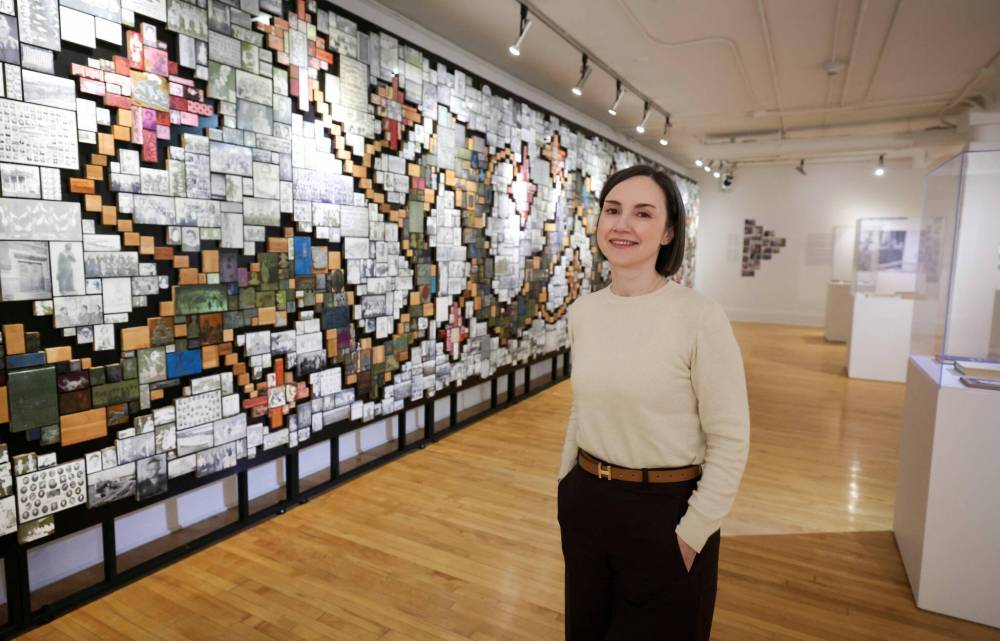
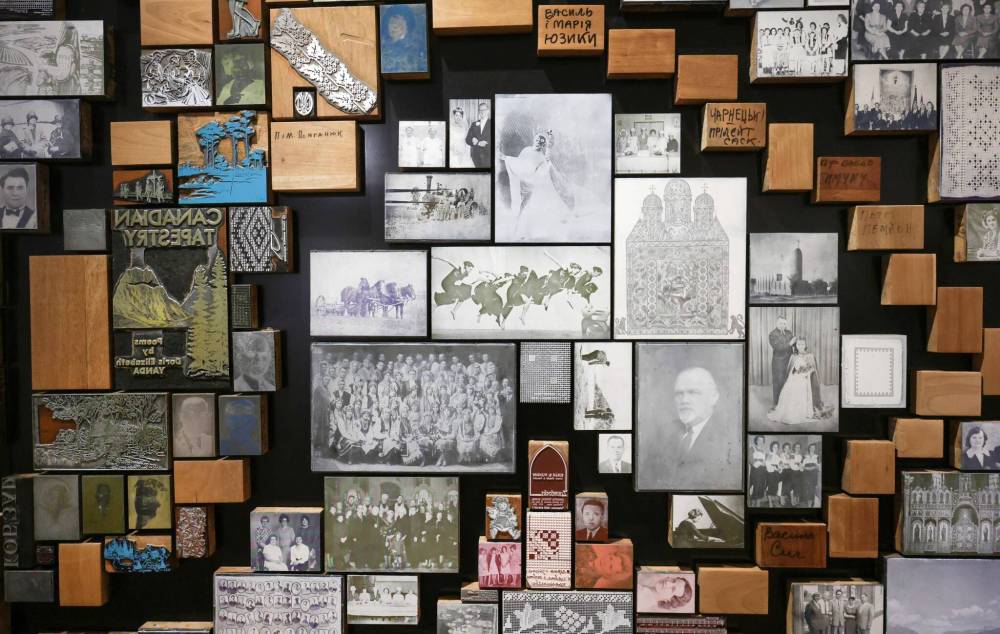
Olesia Sloboda, curator of collections, gives a tour of four exhibits at Oseredok. The Ukrainian Voice, Legacy Mosaic by artist Larisa Sembaliuk Cheladyn captures the history of Ukrainian Canadians from the early 1920s to the mid-1990s. Inspired by traditional embroidery, this tribute to Canadian photojournalism is crafted from 2,674 vintage wood-and-metal printing tiles originally used by Trident Press to publish the Ukrainian Voice newspaper. Story: Oseredok Ukrainian Cultural Centre unveils four new exhibits Reporter: Conrad OCT 14TH, 2026
It’s another and rare thing to build a photomosaic by hand, with a genuine artist’s grasp of the form’s strange double life. This is what, for the past eight years or so, a collaborative team — in particular Edmonton-based creator and curator Larisa Sembaliuk Cheladyn, sculptor Royden Mills, Theodora Harasymiw and a group of volunteers — did for Ukrainian Voice: A Legacy Mosaic, one of four new exhibitions at the Oseredok: Ukrainian Cultural and Education Centre.
From afar, the exhibition’s centrepiece resembles a winding river, branching off in several places. Look closer, and 2,674 snapshots covering the history of Canada’s Ukrainian community come into view.
Many are works of art in and of themselves; intricate illustrations by Jacques Hnizdovsky resembling embroidered rushnyky and striking photographs of folk dancers and Ukrainian Canadian community leaders such as Paul Yuzyk.
Destined for the dumpster after Trident Press’s closure in 2018 — then saved, cleaned and arranged by Chelady and her team — these are selected zinc, lead and copper printing blocks from the newspaper Ukraïns’kyi holos (Ukrainian Voice), which first appeared in 1910.
“One of its missions was popular education — recognizing that Ukrainian Canadians had to learn quickly if they wanted to get ahead. But it had something for everyone: geopolitical commentary about back home, local news, comics, even gossip,” says Olesia Sloboda, Oseredok’s curator of collections.
Sloboda recalls one issue’s story about a Ukrainian man who rode into the village on horseback, only to realize he had left his wife behind in the middle of nowhere. It may not seem like the stuff of international news, but the humour of a mishap too good not to share isn’t much different from Instagram Reels that go viral today.
She lingers on a plate showing a middle-aged photograph of painter William Kurelek (1927–1977), as famous for his Hieronymus Bosch-like visions of atomic annihilation as for his sentimental depictions of prairie life.
“Visitors can scan the image for more info, or if it’s someone lesser known, they can even add more details for the next person,” explains Sloboda.
While dozens of books have been written on the great Kurelek, Sloboda hopes that perceptive visitors may recognize deceased community and family members and help rescue their collective memory from the same historical dustbin to which Ukrainian Voice’s plates were almost cast.
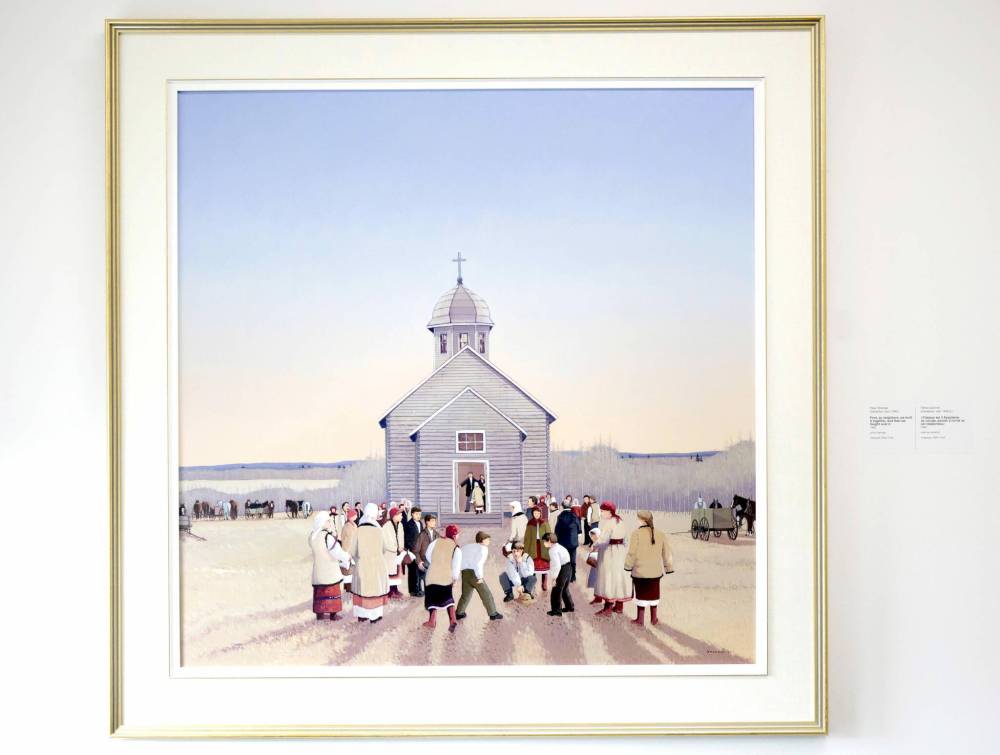
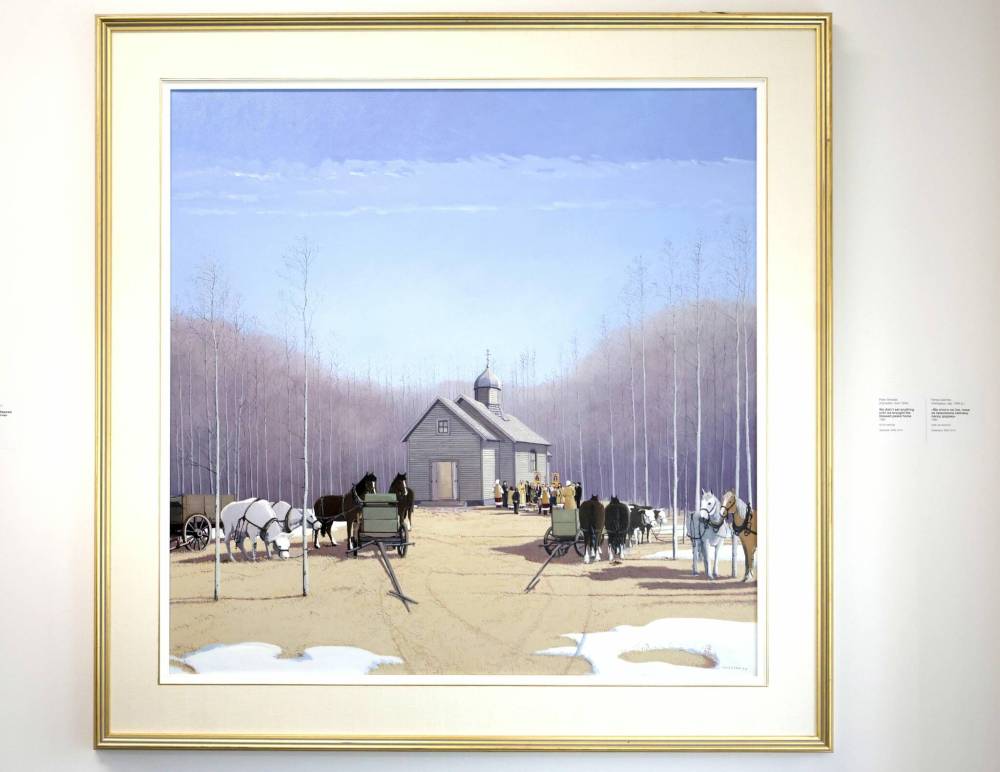
While Oseredok, one of the world’s largest Ukrainian museums outside Ukraine, has a small treasure trove of Kureleks within its collection of 50,000 artworks, artifacts and pieces, for this season it has picked another painter and chronicler of prairie Ukrainian life to highlight in Peter Shostak: Stories of a New Land.
“These depictions of Ukrainian settler life can seem very serene in their colours, but are not naive,” says Sloboda.
With their sprawling scenes of 19th-century pastoral life, showing Ukrainian Canadians working the land or attending church, the paintings of Shostak (1943–) may seem romantic or nationalist at first glance.
But these pieces’ sense of a less romantic “folk” — not quite yet rooted in the landscape, far from homogenous and yet striving to live the Canadian dream in all its opportunities and contradictions — is underlined by their cheeky titles: “Is there a place in the new land where there are no mosquitos?” “First, as neighbours, we built it together, and then we fought over it” or “In some marriages, love conquered language and cultural barriers.”
“Ukrainians may unite against a common enemy, like imperial Russia, but we also brought to Canada our old schisms and the rest. But at this point, the schisms are no longer so prominent,” says Sloboda.
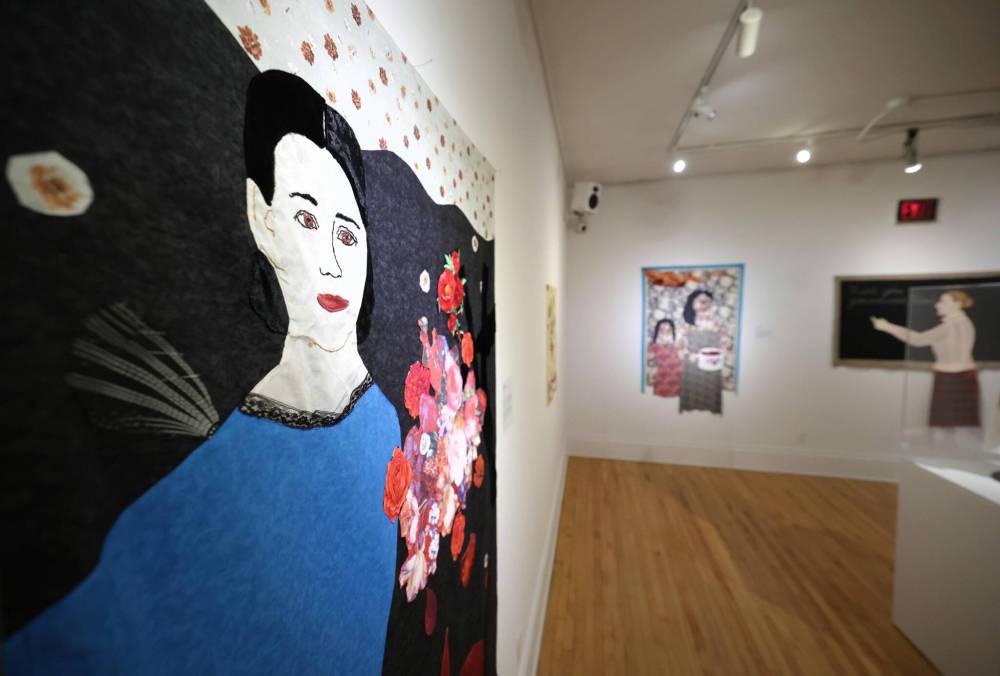
In a more contemporary vein, Oseredok’s third new exhibition, In the Name of Life, features a collection of vivid textiles by Ukrainian artist Oksana Briukhovetsk showing acts of everyday care, such as teaching children, gardening and cooking, against an ominous backdrop of war.
There’s nothing vintage or historical about the scraps of fabric used in these works, sourced from second-hand clothes and cheap souvenirs, but therein lies greater authenticity, suggests Sloboda.
“It would have been the same for our grandparents — just using what’s available,” she says. “(The message is that) you don’t have to go to fight the war with arms. You can help preserve the sanity of your children by performing these traditional cultural and daily tasks.”
On Oseredok’s fourth floor is Treasures of Our Heritage, a thoughtfully curated hodgepodge of Ukrainian or Ukrainian Canadian modernist paintings, folk art and religious iconography from Oseredok’s permanent collection.
Look closely at these religious paintings, however, and you’ll notice that they’re far too crisp to be from the Middle Ages. They are meticulous modern reimaginings of traditional Byzantine iconography by none other than Winnipegger Taras Yuri Snihurowycz.

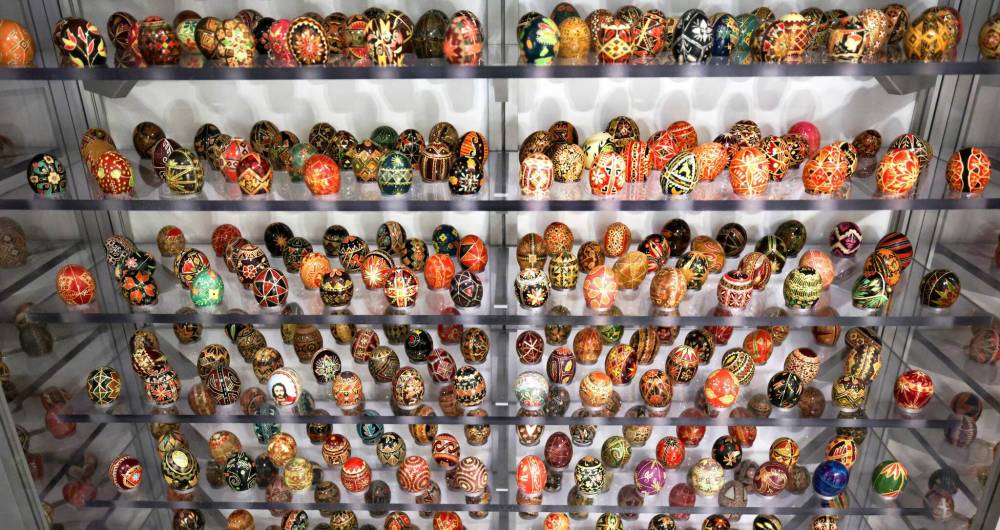
But the first thing to catch your eye will probably be the 4,000 pysanky on one wall — intricately decorated and handpainted traditional Easter eggs sourced from Ukraine and, in the majority, Canada — looking something like the czars’ Fabergé eggs in folksy miniature.
While Treasures of Our Heritage is Oseredok’s most eclectic new exhibition, Sloboda suggests it helps encapsulate the sweep of this year’s programming, with more exhibitions still to come.
“We are trying to show today almost, like 150 years of Ukrainian Canadian history, that you can have a glance at in a one-stop shop,” says Sloboda.
“If there’s a constant, it’s that Ukrainians are very resilient, but it’s also a joyful culture.”
conrad.sweatman@winnipegfreepress.com
Conrad Sweatman is an arts reporter and feature writer. Before joining the Free Press full-time in 2024, he worked in the U.K. and Canadian cultural sectors and freelanced for outlets including The Walrus, VICE and Prairie Fire. Read more about Conrad.
Our newsroom depends on a growing audience of readers to power our journalism. If you are not a paid reader, please consider becoming a subscriber.
Our newsroom depends on its audience of readers to power our journalism. Thank you for your support.
Advertisement Advertise With Us
Advertisement Advertise With Us