No longer silent, Gulf Arab citizens express anger at Israel
Advertisement
Read this article for free:
or
Already have an account? Log in here »
To continue reading, please subscribe:

Digital Subscription
One year of digital access for only $205*
- Enjoy unlimited reading on winnipegfreepress.com
- Read the E-Edition, our digital replica newspaper
- Access News Break, our award-winning app
- Play interactive puzzles
*First annual payment billed as $205.00 + GST for one year. This annual subscription will automatically renew at $233.00 + GST every 52 weeks (10% off the regular annual price of $259.35). Offer available to new and qualified returning subscribers only. Cancel any time.
To continue reading, please subscribe:
Add Free Press access to your Brandon Sun subscription for only an additional
$1 for the first 4 weeks*
- Enjoy unlimited reading on winnipegfreepress.com
- Read the E-Edition, our digital replica newspaper
- Access News Break, our award-winning app
- Play interactive puzzles
*Your next Brandon Sun subscription payment will increase by $1.00 and you will be charged $17.95 plus GST for four weeks. After four weeks, your payment will increase to $24.95 plus GST every four weeks.
Read unlimited articles for free today:
or
Already have an account? Log in here »
Hey there, time traveller!
This article was published 19/05/2021 (1947 days ago), so information in it may no longer be current.
DUBAI, United Arab Emirates (AP) — The ongoing bloodshed in the Gaza Strip has unleashed a chorus of voices across Gulf Arab states that are fiercely critical of Israel and emphatically supportive of Palestinians.
The vocal opposition to Israel, expressed in street protests, on social media and in newspaper columns, comes just months after pacts were signed to establish ties with Israel — and complicates government efforts to rally Arab citizens around full-throttle acceptance of the deals.
Analysts said the conflict will also set back Israeli efforts to secure more normalization deals with other Arab states, like Saudi Arabia.
The criticism has not only put Arab governments that signed the diplomatic accords with Israel in a difficult position with their citizens, it also affirms that the Palestinian cause continues to resonate deeply with people across the Middle East.
“No matter what your national priorities are at the moment or regional priorities are at the moment, when stuff like this happens, the Palestinian issue comes back and hits you,” Emirati political analyst Abdulkhaleq Abdulla said.
Still, the open calls for Palestinian rights and condemnation of Israel voiced by countless Gulf Arab citizens have largely mirrored official statements from their governments, all of which have condemned the violence in some form. Some have gone further, and Abdulla said he’d hoped the United Arab Emirates’ most recent statement calling “on all parties” to cease fighting had been bolder and named Israel as the aggressor.
In speaking out, Gulf citizens are challenging the official narratives around normalization with Israel.
In Bahrain, civil society groups signed a letter urging the government to expel the Israeli ambassador. In Kuwait, protesters held two rallies and are demanding permission to hold more. In Qatar, the government allowed hundreds to protest over the weekend as Hamas’ top leader delivered a speech. In the UAE, some have openly donned the black-and-white checkered Palestinian keffiyeh on Instagram while others have tweeted under hashtags supportive of Palestinians.
Last year, the UAE became the first Arab country in over two decades to establish ties with Israel, after Egypt and Jordan in 1979 and 1994, respectively. It was a brazen move that bypassed the Palestinians, who slammed it as treason and a stab in the back.
The UAE’s move paved the way for three other countries — Bahrain, Sudan and Morocco — to announce similar pacts with Israel in rapid succession.
Immediately after the UAE formalized ties with Israel in September, a tsunami of state propaganda framed it as a new era of peace, religious tolerance and security for the region.
Among the general Emirati public, there was little to no visible pushback from citizens when their government announced ties with Israel. Fiery nationalistic figures on Twitter with tens of thousands of followers aggressively cheered the pact, and throughout the current conflict have both defended ties with Israel and made posts mocking Palestinian protesters.
But unlike in Western democracies, a lack of protest in the Gulf does not mean acceptance. In the UAE, political parties are banned and political expression is heavily suppressed.
“The show of support that we saw during the early days of normalization, I think it represents something deeper in Emirati society … and that is that the vast majority support their government,” Abdulla said. “It was a show of support for the government rather than a show of support for ‘normalization’ as such.”
Mira Al-Hussein, an Emirati PhD candidate at Cambridge University, said Emiratis feel taken care of and valued by their government, which provides citizens with strong social safety nets.
“But that doesn’t mean we feel comfortable by what’s happening around us,” she said.
She changed her Twitter handle in support of Palestinians since the fighting broke out, and has used the platform to slam Israel’s policies and highlight the atrocities of the war.
“You don’t sign papers and expect a human catastrophe to go away,” she said of the accord with Israel.
Over the years, there have been changes to school curricula across Gulf Arab states to replace pan-Arab and pan-Islamic ideals with a nationalistic identity that unites people around the flag.
The UAE has been trying to mold public discourse around nationalism and a rejection of youth or Islamic movements, said Kristin Smith Diwan, a scholar at the Arab Gulf States Institute in Washington.
“I think the relation with Israel was seen as a way to even cement that further. I don’t know how that’s going to work now,” she said.
Al-Hussein said her younger brother, who is in his 20’s, never studied the Arab-Israeli conflict in school. But he “just learned about it today from social media,” she said.
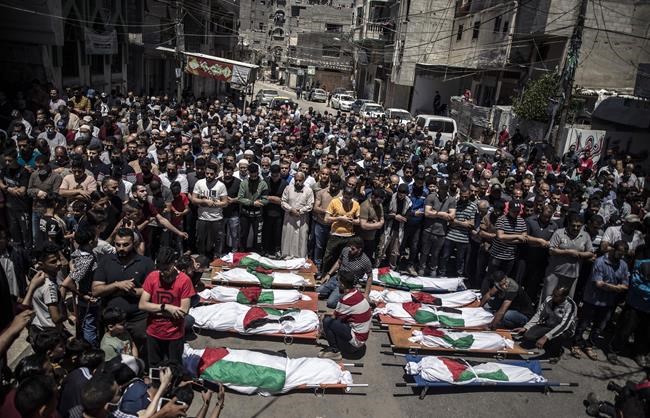
For millions of Arabs, social media is the only space where limited freedom of expression is possible. Since the war began, users have been flooded by images of dead Palestinian children being pulled from the rubble of Israeli airstrikes in Gaza.
These platforms have also been awash with images of Israeli security forces firing stun grenades and tear gas at worshippers and protesters in Al-Aqsa mosque in Jerusalem, of Palestinian families fighting eviction from their homes and of deadly protests across the occupied West Bank.
At least 217 Palestinians have been killed in Gaza, including 61 children and 36 women. More than 1,440 people have been wounded. Twelve people in Israel, including a young boy and a soldier, have been killed in Hamas rocket attacks.
Bader al-Saif, a Kuwait University professor, said “the sheer un-proportionality” of the conflict has pushed many people to speak out across the Gulf.
“For Israelis to feel secure, they need to feel that they are accepted,” al-Saif said. “That feeling of acceptance cannot be complete without them dealing with the Palestinian issue.”
U.K.-based Saudi scholar Madawi Al-Rasheed, a fierce critic of the Saudi government, said despite the kingdom’s widespread crackdown on activists — most of whom are steadfast supporters of Palestinian rights — the outrage expressed by many online reveals the gap between the cautious push by the Saudi leadership to inch closer to Israel and public sentiment in the streets.
“It shows that despite several years of adopting a normalization discourse in official Saudi media, the pulse of the people is actually not diverted from the Palestinian cause,” she said.
___
Follow Aya Batrawy on twitter at https://twitter.com/ayaelb
Related Articles
Israel, Hamas agree to cease-fire to end bloody 11-day war
Advertisement Advertise With Us
Advertisement Advertise With Us