Widow of former Egyptian President Anwar Sadat dies in Egypt
Advertisement
Read this article for free:
or
Already have an account? Log in here »
To continue reading, please subscribe:

Digital Subscription
One year of digital access for only $205*
- Enjoy unlimited reading on winnipegfreepress.com
- Read the E-Edition, our digital replica newspaper
- Access News Break, our award-winning app
- Play interactive puzzles
*First annual payment billed as $205.00 + GST for one year. This annual subscription will automatically renew at $233.00 + GST every 52 weeks (10% off the regular annual price of $259.35). Offer available to new and qualified returning subscribers only. Cancel any time.
To continue reading, please subscribe:
Add Free Press access to your Brandon Sun subscription for only an additional
$1 for the first 4 weeks*
- Enjoy unlimited reading on winnipegfreepress.com
- Read the E-Edition, our digital replica newspaper
- Access News Break, our award-winning app
- Play interactive puzzles
*Your next Brandon Sun subscription payment will increase by $1.00 and you will be charged $17.95 plus GST for four weeks. After four weeks, your payment will increase to $24.95 plus GST every four weeks.
Read unlimited articles for free today:
or
Already have an account? Log in here »
Hey there, time traveller!
This article was published 09/07/2021 (1910 days ago), so information in it may no longer be current.
CAIRO (AP) — Jehan Sadat, widow of former Egyptian President Anwar Sadat, the first Arab leader to make peace with Israel, died in Egypt on Friday. She was 87.
In recent weeks, Egyptian media press reported that she had been hospitalized and was battling cancer. Last year, she received medical treatment in the United States but was hospitalized again shortly after returning home as her condition deteriorated, her family told local newspapers. No further details about her illness were made available.
President Abdel Fattah el-Sissi’s office said she had been a role model for Egyptian women and granted her a national award posthumously. A key highway in Cairo is to be named after her. She was buried in a military funeral ceremony on Friday, attended by el-Sissi and dozens of other government officials.
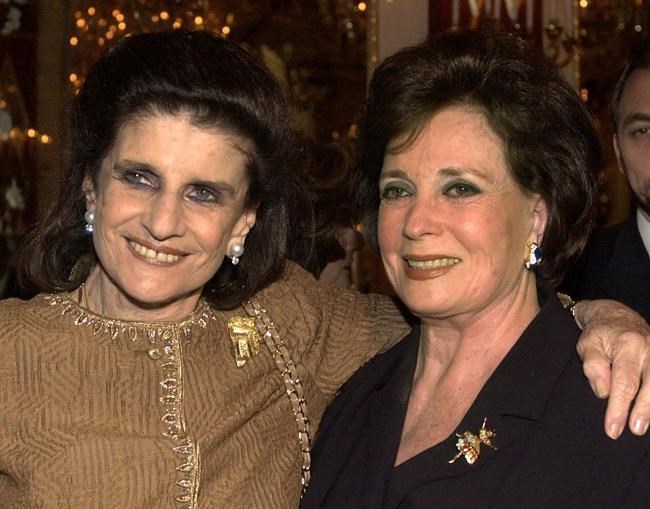
Jehan Safwat Raouf was born in August 1933 in Cairo to an Egyptian middle-class father and a British mother. In 1949, at age 15, she married Anwar Sadat, a military officer at the time who later served as Egypt’s president from 1970 until his assassination by Islamic extremists in 1981.
It was said that initially, her parents had opposed her marrying a man 15 years her senior. She later said that what attracted her to Sadat at such a young age were his revolutionary activities that challenged the British occupation in the 1940s. The couple had four children: daughters Noha, Gihan, Lobna and a son, Gamal.
Jehan Sadat consistently defended her husband’s decision to sign a peace agreement with Israel in 1979 after nearly three decades of war, a move that was controversial domestically and regionally.
After his assassination, she largely withdrew from public life. But in recent years, she emerged as a supporter of former military general el-Sissi and his government, after the country’s 2011 popular uprising forced her husband’s successor, Hosni Mubarak, to resign.
Mubarak’s ouster plunged Egypt into chaos and uncertainty, and set up a power struggle between the military and the Muslim Brotherhood group that had long been outlawed. Some two and a half years after Mubarak’s ouster, el-Sissi led a military overthrow of Egypt’s first freely elected president, who hailed from the Brotherhood, and rolled back freedoms gained in the 2011 Arab Spring uprising.
During her husband’s tenure, Sadat established herself as a staunch advocate of women’s rights by pushing for a set of laws that granted women the right to alimony and custody of children in case of divorce. She also made headlines with her volunteer work and charitable activities. Her high visibility in the 1970s drew criticism from observers who accused her of exploiting her husband’s position to gain political leverage for herself.
She also presided over several national relief agencies, including the Egyptian Red Crescent, the country’s blood bank and the Egyptian Society for Cancer Patients. During Egypt’s 1973 war with Israel, photographs of her visiting the wounded appeared on most front pages of Egyptian newspapers.
Her public visibility and political influence as Egypt’s first lady marked a complete departure from her predecessor Tahia Abdel Nasser, who had kept a low-profile during the rule of her husband Gamal Abdel Nasser.
In 1972, Sadat established the Wafa’ Wal Amal Society, ‘Faith and Hope’ in Arabic, which now operates a fully integrated city for handicapped war veterans and civilians. In 1997, she created an endowment to establish The Anwar Sadat Chair for Peace and Development at the University of Maryland in memory of her husband. On the university’s website, she is quoted as saying: “I never again want to see the face of a starving child or hear the weeping of a mother who has lost her son to war. Peace, this is what my husband gave his life for, and I want the world to know that he did not die in vain. Peace, this is what will make me very happy.”
Her husband was assassinated on Oct. 6, 1981 during a military parade in Cairo. Mubarak, who was seated next to him, escaped with a minor hand injury as gunmen sprayed the reviewing stand with bullets. Days later, Mubarak was sworn in as president.

Under Anwar Sadat, the government had sought the support of Islamic groups to counter the influence of leftists. It released hundreds of jailed Muslim Brotherhood members and backed the nascent Al Gamaa al-Islamiyya, or Islamic Group. But after the peace accord, radicals condemned Sadat for establishing relations with Israel and standing in the way of an Islamic state. The Brotherhood eventually turned on him, and the Islamic Group grew so radical that it joined forces with another militant group, Islamic Jihad, to assassinate the president. It went on to try to overthrow the Egyptian government in a campaign over many years that killed more than 1,000 people, and thrust the country under emergency law.
In 1977, Sadat graduated with an BA in Arabic literature from Cairo University. In 1986, she completed her PhD in comparative literature at the same university.
She authored two books: her autobiography “A Woman Of Egypt,” and “My Hope for Peace,” about the Arab-Israeli conflict and the rise of Islamic extremism, which she said was contrary to the true spirit of the religion. She also served as a visiting instructor at several American universities, including the University of South Carolina, Radford University and the University of Maryland.
—-
Associated Press journalist Ahmed Hatem in Cairo, Egypt contributed to this report.
The Free Press acknowledges the financial support it receives from members of the city’s faith community, which makes our coverage of religion possible.