‘New’ Van Gogh drawing to go on display in Amsterdam museum
Advertisement
Read this article for free:
or
Already have an account? Log in here »
To continue reading, please subscribe:

Digital Subscription
One year of digital access for only $205*
- Enjoy unlimited reading on winnipegfreepress.com
- Read the E-Edition, our digital replica newspaper
- Access News Break, our award-winning app
- Play interactive puzzles
*First annual payment billed as $205.00 + GST for one year. This annual subscription will automatically renew at $233.00 + GST every 52 weeks (10% off the regular annual price of $259.35). Offer available to new and qualified returning subscribers only. Cancel any time.
To continue reading, please subscribe:
Add Free Press access to your Brandon Sun subscription for only an additional
$1 for the first 4 weeks*
- Enjoy unlimited reading on winnipegfreepress.com
- Read the E-Edition, our digital replica newspaper
- Access News Break, our award-winning app
- Play interactive puzzles
*Your next Brandon Sun subscription payment will increase by $1.00 and you will be charged $17.95 plus GST for four weeks. After four weeks, your payment will increase to $24.95 plus GST every four weeks.
Read unlimited articles for free today:
or
Already have an account? Log in here »
Hey there, time traveller!
This article was published 16/09/2021 (1826 days ago), so information in it may no longer be current.
AMSTERDAM (AP) — A drawing newly attributed to Vincent van Gogh that has never been displayed publicly before is going on show at the Amsterdam museum that bears the Dutch master’s name.
The “new” Van Gogh, “Study for ‘Worn Out,’” from November 1882, is part of a Dutch private collection and was known to only a handful of people, including a few from the Van Gogh Museum.
The owner, who is remaining anonymous, asked the museum to determine if the unsigned drawing is by Van Gogh.
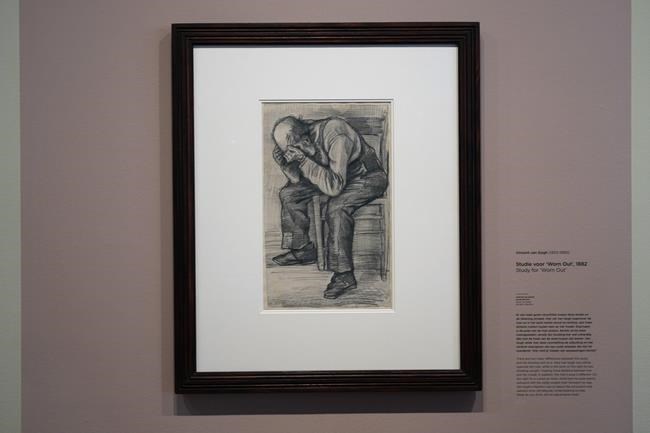
From the style, to the materials used — a thick carpenter’s pencil and coarse watercolor paper — it conforms to Van Gogh’s Hague drawings, Senior Researcher Teio Meedendorp said Thursday.
There are even traces of damage on the back linking it to the way Van Gogh used wads of starch to attach sheets of paper to drawing boards.
“It’s quite rare for a new work to be attributed to Van Gogh,” the museum’s director Emilie Gordenker said in a statement. “We’re proud to be able to share this early drawing and its story with our visitors.”
It comes from a time in the artist’s career when he was working to improve his skills as a painter of people and portraits by drawing them. Over and over again.
The museum already owns the almost identical drawing, “Worn Out.”
“It was quite clear that they are related,” Meedendorp said.
The study has been loaned to the museum and goes on show from Friday through Jan. 2.
It shows an elderly, balding man sitting, hunched forwards, on a wooden chair, his balding head in his hands. Even the model’s pants appear to conform to the English title — a patch is clearly visible on the right leg.
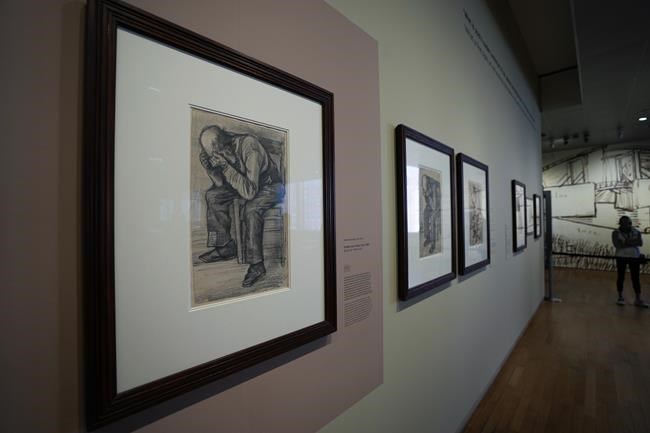
It is a far cry from the vibrant oil paintings of vases of sunflowers and French landscapes that eventually turned the tormented Van Gogh — after his death in 1890 — into one of the world’s most famous artists, whose works have garnered astronomical prices at auction.
Instead, it illustrates how as a young artist in practicing his craft in The Hague in 1882, Van Gogh had to confront an uncomfortable truth.
“He discovered that he lacked the ability to paint people. So he was already drawing them but he liked to paint,” Meedendorp said. “So in order to be able to paint people as well he went back to the drawing board.”
Van Gogh, who was famously reliant on his brother Theo’s generosity throughout his life, gave the drawings an English title in a bid to build a bit of name recognition and possibly even land a job at an illustrated magazine.
“In his mind, he had an idea that he would reach out farther than Holland in the end as an artist,” Meedendorp said.