Statue toppled in Puerto Rico before Spanish king’s visit
Advertisement
Read this article for free:
or
Already have an account? Log in here »
To continue reading, please subscribe:

Digital Subscription
One year of digital access for only $205*
- Enjoy unlimited reading on winnipegfreepress.com
- Read the E-Edition, our digital replica newspaper
- Access News Break, our award-winning app
- Play interactive puzzles
*First annual payment billed as $205.00 + GST for one year. This annual subscription will automatically renew at $233.00 + GST every 52 weeks (10% off the regular annual price of $259.35). Offer available to new and qualified returning subscribers only. Cancel any time.
To continue reading, please subscribe:
Add Free Press access to your Brandon Sun subscription for only an additional
$1 for the first 4 weeks*
- Enjoy unlimited reading on winnipegfreepress.com
- Read the E-Edition, our digital replica newspaper
- Access News Break, our award-winning app
- Play interactive puzzles
*Your next Brandon Sun subscription payment will increase by $1.00 and you will be charged $17.95 plus GST for four weeks. After four weeks, your payment will increase to $24.95 plus GST every four weeks.
Read unlimited articles for free today:
or
Already have an account? Log in here »
Hey there, time traveller!
This article was published 24/01/2022 (1689 days ago), so information in it may no longer be current.
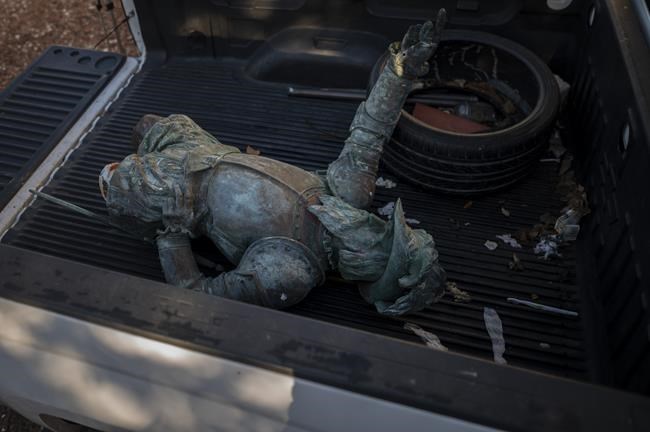
SAN JUAN, Puerto Rico (AP) — Unknown people toppled a statue of Spanish explorer Juan Ponce de León in the pre-dawn hours of Monday ahead of a visit of Spain’s King Felipe VI to the U.S. Caribbean territory of Puerto Rico.
Col. José Juan García, police commissioner for San Juan, told The Associated Press that officers patrolling the cobblestone streets of the capital’s historic district heard a loud bang at 4:30 a.m. and found the broken statue.
“It sounded like an explosion,” he said.
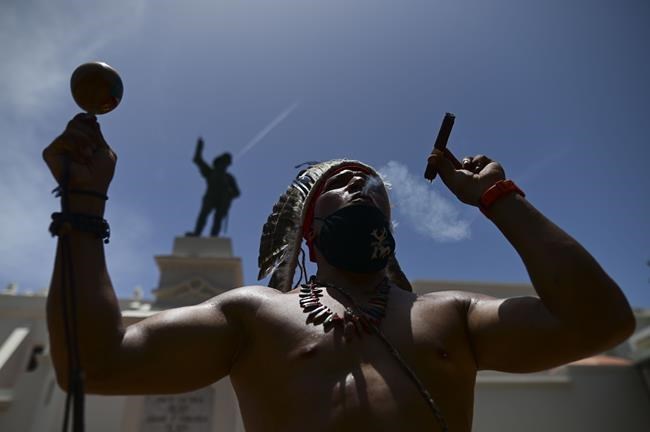
The statue was made of melted steel from British cannons and featured the Spanish explorer facing south with his left hand on his hip and right finger pointed toward the first settlement he founded, which was the island’s first Spanish capital and is a U.S. National Historic Landmark. The statue also points in the direction of the nearby San Juan Bautista Cathedral that holds Ponce de León’s remains and is a popular tourist spot.
Crews in Old San Juan reinstalled the 1,000 plus-pound (589-kilogram) statue a couple hours after the king arrived late Monday afternoon.
A handful of protesters heckled the workers and briefly interrupted their efforts, with some posting signs on the statue’s base, one of which read, “They’re not gods.” Protesters said that they would topple it again and that a Christopher Columbus statue was next.
Spain’s legacy is prominent across Puerto Rico, with a main road in San Juan named after Ponce de León and a colossal Columbus statue rising along the island’s northern coast, a 660-ton sculpture that is more than twice the size of the Statue of Liberty without its pedestal. A much smaller Columbus statue stands at the entrance of Old San Juan, just blocks from the one that was toppled.
San Juan Mayor Miguel Romero defended the reinstallation in an interview with Telemundo Puerto Rico, saying, “The Spaniards from 500 years ago are not the same ones of today.”
He later told reporters after the king arrived: “Freedom of expression is protected, but what cannot be protected is vandalism. I believe vandalism is the most cowardly form of expression.”
Two years ago, activists marched through the streets of Old San Juan as they joined a U.S. movement to eradicate symbols of oppression and demanded that Spain’s legacy in Puerto Rico be erased. While some statues have been defaced with graffiti, police said this is the first time such a statue was toppled.
The statue was in the Plaza San José, near the second oldest surviving Spanish church in the Americas, whose construction began by 1532 on land donated by Ponce de León and whose base was erected atop an Indigenous settlement.
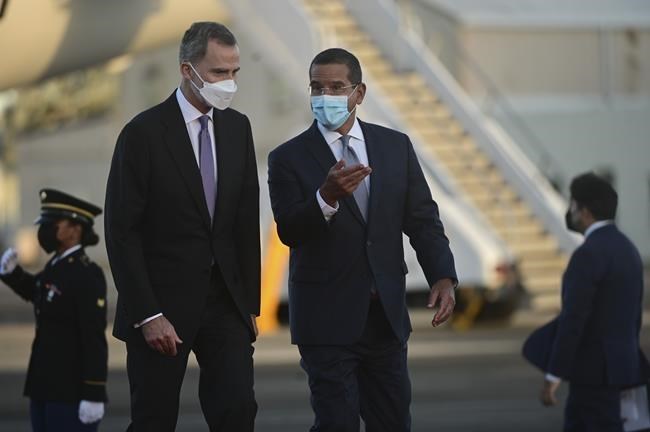
King Felipe was scheduled to meet with Puerto Rico Gov. Pedro Pierluisi and other officials to celebrate the 500th anniversary of the founding of San Juan.
Columbus landed in Puerto Rico in 1493 accompanied by Ponce de León, who became the island’s first governor and quelled an uprising by the native Tainos, a subgroup of the Arawak Indians, after forcing them into labor. Puerto Rico remained a Spanish colony until 1898, when Spain transferred the island to the United States at the end of the Spanish-American war.