BEIJING SNAPSHOT: Olympic press can grab high-tech naps
Advertisement
Read this article for free:
or
Already have an account? Log in here »
To continue reading, please subscribe:

Digital Subscription
One year of digital access for only $205*
- Enjoy unlimited reading on winnipegfreepress.com
- Read the E-Edition, our digital replica newspaper
- Access News Break, our award-winning app
- Play interactive puzzles
*First annual payment billed as $205.00 + GST for one year. This annual subscription will automatically renew at $233.00 + GST every 52 weeks (10% off the regular annual price of $259.35). Offer available to new and qualified returning subscribers only. Cancel any time.
To continue reading, please subscribe:
Add Free Press access to your Brandon Sun subscription for only an additional
$1 for the first 4 weeks*
- Enjoy unlimited reading on winnipegfreepress.com
- Read the E-Edition, our digital replica newspaper
- Access News Break, our award-winning app
- Play interactive puzzles
*Your next Brandon Sun subscription payment will increase by $1.00 and you will be charged $17.95 plus GST for four weeks. After four weeks, your payment will increase to $24.95 plus GST every four weeks.
Read unlimited articles for free today:
or
Already have an account? Log in here »
Hey there, time traveller!
This article was published 08/02/2022 (1675 days ago), so information in it may no longer be current.
BEIJING (AP) — With nowhere really to go, journalists inside the Beijing Olympics bubble are encouraged to sleep on the job.
They can’t visit the village rooms where competitors are staying, but they can try out the high-tech beds athletes are sleeping in. Several corridors at the main media center are lined with “sleep rest cabins,” small pods that open with a QR code and contain beds.
The beds can be adjusted by remote control and even have a “zero-gravity mode” meant to reduce stress on the body — you don’t quite float, but it’s pretty comfortable.
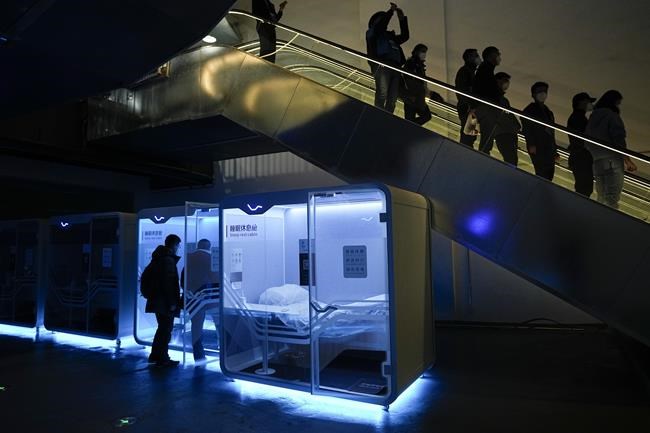
Some journalists nap in the cabins, while others in search of a quiet — and private — place to write bring their computers.
Zhao Yufeng, a spokesperson for cabin manufacturer Keeson Technology Corp., said 30 to 40 people a day have been using them so far.
“We’ve placed sleeping cabins here for journalists to give an environment to work, rest and get relaxed,” she said.
Not everyone was excited about napping in a see-through box in full view of anyone walking by, though.
Guido Santevecchi, an Italian journalist, said the pods reminded him of something you might find in a psychiatric ward.

Given the already heavy potential mental health toll of living inside the Olympic bubble with major restrictions on movement, “I would rather avoid entering there,” he said.
___
Associated Press journalist Chisato Tanaka contributed to this story.
___
More AP Olympics: https://apnews.com/hub/winter-olympics and https://twitter.com/AP_Sports
Related Articles
Olympic couple hopes to give speedskating a boost in Britain



Advertisement Advertise With Us