Review: America’s racist past haunts horror film ‘Master’
Advertisement
Read this article for free:
or
Already have an account? Log in here »
To continue reading, please subscribe:

Digital Subscription
One year of digital access for only $205*
- Enjoy unlimited reading on winnipegfreepress.com
- Read the E-Edition, our digital replica newspaper
- Access News Break, our award-winning app
- Play interactive puzzles
*First annual payment billed as $205.00 + GST for one year. This annual subscription will automatically renew at $233.00 + GST every 52 weeks (10% off the regular annual price of $259.35). Offer available to new and qualified returning subscribers only. Cancel any time.
To continue reading, please subscribe:
Add Free Press access to your Brandon Sun subscription for only an additional
$1 for the first 4 weeks*
- Enjoy unlimited reading on winnipegfreepress.com
- Read the E-Edition, our digital replica newspaper
- Access News Break, our award-winning app
- Play interactive puzzles
*Your next Brandon Sun subscription payment will increase by $1.00 and you will be charged $17.95 plus GST for four weeks. After four weeks, your payment will increase to $24.95 plus GST every four weeks.
Read unlimited articles for free today:
or
Already have an account? Log in here »
Hey there, time traveller!
This article was published 16/03/2022 (1660 days ago), so information in it may no longer be current.
You want ghosts? Check. How about doors inexplicably opening and closing, creepy moaning in dark corners, and sudden sickening swarms of maggots? Check, check and check.
But “Master,” a new horror film by Mariama Diallo with themes of race and social justice at its core, is most frightening when dealing not with the supernatural, but with the real — the depressingly real, as in the indignities that three Black women face while trying to fit into an overwhelmingly white academic institution.
Diallo, who proves a talent to watch with this compelling if overpacked debut film, has said that “Master,” featuring a trio of terrific performances from Regina Hall, Zoe Renee and Amber Gray, stems partly from her own experiences as a Black student at Yale. The title, for example: It refers to the heads of residential colleges at Yale, called “masters” until the school finally dropped the term in 2016. Diallo realized only a few years after graduating how strange it was that she called a white man “master.”
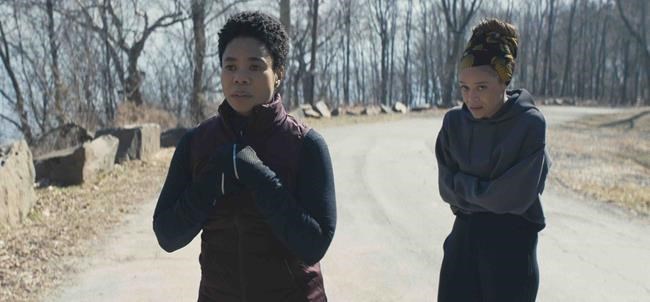
But in her film, it is a Black woman, faculty member Gail Bishop, who has achieved the honor — the first Black “master” at Ancaster College, an elite school in Salem, Massachusetts, home of course to the historic witch trials. (The imposing 19th-century campus of Vassar College in New York, with its Gothic-style library, serves nicely here.) Portraits of masters past line the walls, but now Gail – impeccably played by Hall in a poignant, sometimes heartbreaking performance — is having her own portrait painted. Even at Ancaster, a school so elite that it rejected FDR when he applied, change is in the air.
Or is it? Gail is one of only a handful of Black professors — and there are only eight Black students, for that matter. One is Jasmine, an incoming freshman (Renee, appealing and thoughtful) who seems confident and enthusiastic and ready to take on life at Ancaster.
Except.
On the very first day, Jasmine finds out from a (white) student welcoming committee that she’s been assigned to “the room.” It’s the room believed to be haunted. Back in the ’60s, the first Black female student at Ancaster came to a tragic end in that room. Also, there’s a sinister connection to the Salem witch trials, and legend holds that a woman executed for witchcraft still haunts the place.
But ghosts exist only on one level of “Master,” despite its categorization as a horror film. The other level is the daily microaggressions of being a Black student in lily-white environment.
Jasmine is not welcomed by fellow students. Her white roommate, Amelia, wears a “Hamptons” sweatshirt and fills the room with her own friends, who seem to regard Jasmine as a curiosity at best (they call her Beyoncé). These entitled kids talk about the “sick after-prom” they had in tony beach houses or joke about fellow New York City private school kids. Worse, the white girls treat Jasmine with disdain. One of them tosses her a rag to clean up a spill they made. When she buys everyone a pizza and asks to be paid their share of the $20, they ignore her.
At a campus party, the white kids get in while Jasmine is stopped by the collegiate bouncer and told the event is “at capacity.” Once she makes it inside, she starts to dance with the others, enjoying it until she realizes they’re happily singing a hip-hop song filled with racial epithets.
Meanwhile, Gail is fighting her own battle, removing dust and grime from the musty old house she’s so proud to occupy, discovering doors opening and closing by themselves and sickening swarms of maggots popping up in the worst places. On campus she is subjected to subtle disdain from fellow faculty members. One describes her as like Barack Obama.
It comes to head at a tenure meeting, where Gail is called upon to judge the tenure of Liv Beckman (a note-perfect Amber Gray), a friend and fellow Black teacher with a complicated family history and a contentious way of teaching. One white faculty member opines that Liv, because of her race, is the perfect tenure applicant “for right now.” Another argues Liv hasn’t proven her publishing prowess. “Gail, can you be impartial?” this teacher asks.
Complicating matters is that one of Liv’s students has filed an appeal of a failing grade on a paper about “The Scarlet Letter”; Liv insists a critical race analysis be applied. The student says the book isn’t about race. And yes — the student is Jasmine.
The horror gets more, well, horrible — a shocking sight appears one day where Jasmine lives, with the message she should leave. Yet Jasmine stays – even opting to remain on an isolated campus during Thanksgiving break. And things get even worse.
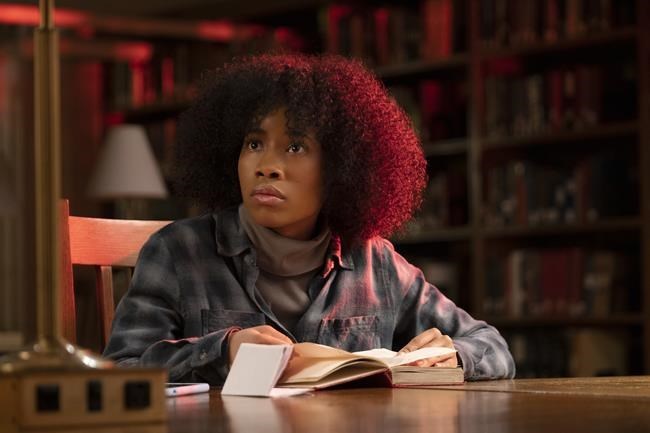
It is two-thirds of the way into the movie that Jasmine meets another Black student and is told about a Black affinity group. How it could have taken three months for this to happen is one of the odder wrinkles of a plot that seems to get overcrowded late in the film.
“Master” ultimately suffers the fate of many promising films with many good ideas and not enough time to develop them — some paring down would have improved the latter part of the film. As Gail says to a new character who emerges late in the movie: “This is a lot.”

But the most poignant line comes deep into the film when a character tries to sum up what is happening. It’s not ghosts, this person says. It’s America.
In Diallo’s compelling tale, turns out the scariest ghosts are not the ones that go bump in the night. They’re the ones that haunt a nation’s history.
“Master,” an Amazon Studios release, has been rated R by the Motion Picture Association of America “or language and some drug use.” Running time: 98 minutes. Two and a half stars out of four.
___
MPAA definition of R: Restricted. Under 17 not admitted without parent or adult guardian.