Russian sanctions hurting small Italian fashion producers

Advertisement

Advertise with us

BRESCIA, Italy (AP) — Fine Italian knitwear packed in boxes addressed to retailers in Moscow, St. Petersburg and Kursk sit stacked in a Lombardy warehouse awaiting dispatch. Although not subject to sanctions to punish Russia for invading Ukraine, the garments are not likely to ship any time soon.

Read this article for free:


or

Already have an account? Log in here »

To continue reading, please subscribe:

Subscribe and receive a limited-edition Free Press branded hat or tote.

Digital Subscription

One year of digital access for only $205*

  • Enjoy unlimited reading on winnipegfreepress.com
  • Read the E-Edition, our digital replica newspaper
  • Access News Break, our award-winning app
  • Play interactive puzzles

*First annual payment billed as $205.00 + GST for one year. This annual subscription will automatically renew at $233.00 + GST every 52 weeks (10% off the regular annual price of $259.35). Offer available to new and qualified returning subscribers only. Cancel any time.

To continue reading, please subscribe:

Add Free Press access to your Brandon Sun subscription for only an additional

$1 for the first 4 weeks*

  • Enjoy unlimited reading on winnipegfreepress.com
  • Read the E-Edition, our digital replica newspaper
  • Access News Break, our award-winning app
  • Play interactive puzzles
Start now

*Your next Brandon Sun subscription payment will increase by $1.00 and you will be charged $17.95 plus GST for four weeks. After four weeks, your payment will increase to $24.95 plus GST every four weeks.

Hey there, time traveller!
This article was published 16/06/2022 (1571 days ago), so information in it may no longer be current.

BRESCIA, Italy (AP) — Fine Italian knitwear packed in boxes addressed to retailers in Moscow, St. Petersburg and Kursk sit stacked in a Lombardy warehouse awaiting dispatch. Although not subject to sanctions to punish Russia for invading Ukraine, the garments are not likely to ship any time soon.

Missing payments from the Russian retailers who ordered the garments are piling up due to restrictions tied to the banking sector, putting pressure on small fashion producers like D. Exterior, a high-end knitwear company with 50 workers in the northern city of Brescia.

“This is very painful. I have 2 million euros worth of merchandise in the warehouse, and if they cannot pay for it, I will be on my knees,” said D. Exterior owner Nadia Zanola, surveying the warehouse for the brand she founded in 1997 from the knitwear company created by her parents in 1952.
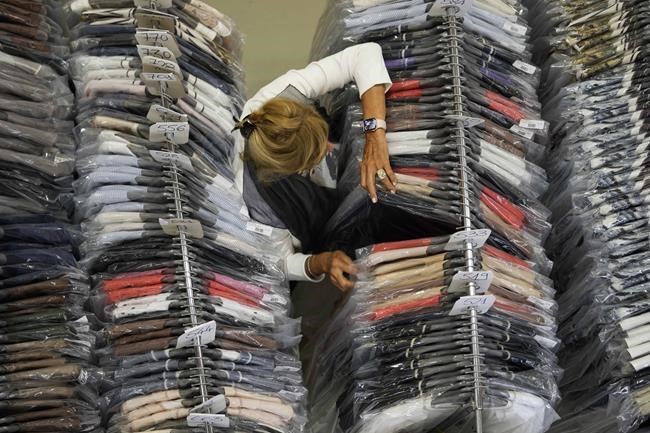
Nadia Zanola, chairman of the 'Cose di Maglia' factory, goes through racks of clothing at a warehouse section of unsold clothes, in Brescia, Italy, Tuesday, June 14, 2022. Small Italian fashion producers are still allowed to export to Russia, despite sanctions, as long as the wholesale price is under 300 euros. But they are having a hard time getting paid, due to restrictions tied to the financial sector. (AP Photo/Luca Bruno)

Italy is the largest producer of global luxury goods in the world, making 40% of high-end apparel, footwear and accessories. While Russia generates just about 3% of Italian luxury’s 97 billion euros ($101 billion) in annual revenue, it is a significant slice of business for some of the 80,000 small and medium companies that make up the backbone of Italian fashion, according to industry officials.

“We are talking about eliminating 80% to 100% of revenues for these companies,’’ said Fabio Pietrella, president of the Confartigianato fashion craftsman federation.

Districts producing footwear in the Marche and Veneto regions, and knitwear makers in Umbria and Emilia-Romagna have grown particularly reliant on Russia.

“These are districts that connect the supply chain, and if it is interrupted, not only is the company that closes harmed, but an entire system that help make this country an economic powerhouse,’’ Pietrella said.

The Italian fashion world is best known for luxury houses like Gucci, Versace and Armani, which unveil their menswear collections in Milan this week. And some of the biggest names appear on a list compiled by Yale University professor Jeffrey Sonnenfeld of major companies doing business in Russia since the war in Ukraine began.

“There are companies that kept selling to Nazi Germany after the outbreak of World War II — we don’t celebrate them for that,” Sonnenfeld said, labeling as “greedy” any enterprise that continues to do business in Russia today.

He also underlined that fashion companies don’t have the grounds to make humanitarian appeals to bypass sanctions, voluntary or otherwise, as has been the case with agricultural firms and pharmaceutical companies.

Among those receiving a failing grade from Sonnenfeld is Italy’s Benetton, which in a statement condemned the war but said it would continue its commercial activities in Russia, including longstanding commercial and logistic partnerships and a network of stores that sustain 600 families.

French conglomerate LVMH, meanwhile, has temporarily closed 124 stores in Russia, while continuing to pay its 3,500 employees in Russia. The Spanish group Inditex, which owns the fast-fashion chain Zara, also temporarily closed 502 stores in Russia as well as its online sales, accounting for 8.5% of group pre-tax earnings.

Pietrella fears a sort of Russia-phobia is taking hold that is demonizing business owners for trying to keep up ties with a longer-term vision.
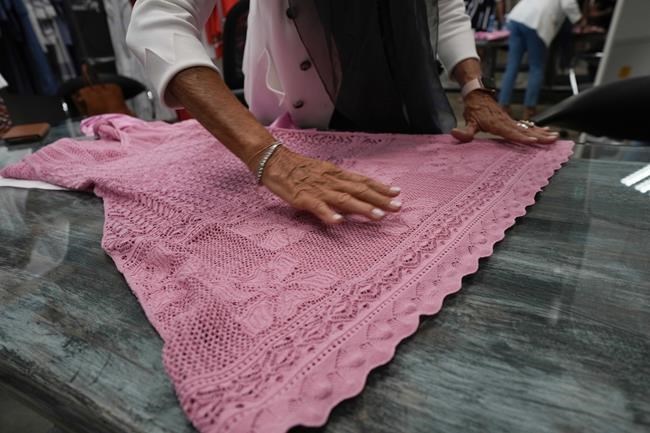
Nadia Zanola, chairman of the 'Cose di Maglia' factory, shows the quality of a dress in Brescia, Italy, Tuesday, June 14, 2022. Small Italian fashion producers are still allowed to export to Russia, despite sanctions, as long as the wholesale price is under 300 euros. But they are having a hard time getting paid, due to restrictions tied to the financial sector. (AP Photo/Luca Bruno)

He characterized as a “witch-hunt” criticism of some 40 shoe producers from the Marche region on Italy’s Adriatic coast for traveling to Russia for a trade fair during the war.

European Union sanctions against Russia sharpened after the Ukraine invasion, setting a 300-euro wholesale maximum for each item shipped, taking super-luxury items out of circulation but still targeting the upper-middle class or wealthy Russians.

“Without a doubt, we as the fashion federation have expressed our extreme concern over the aggression in Ukraine,’’ Pietrella said. “From an ethical point of view, it is out of discussion. But we have to think of our companies. Ethics are one thing. The market is another. Workers in a company are paid by the market, not by ethics.”

He said the 300-euro limit on sales was a gambit by European politicians that on paper allows trade with Russia despite accompanying bureaucratic and financial hurdles, while also shielding governments from having to provide bailout funds to the industry. He also dismissed as overly facile government suggestions to find alternative markets to Russia.

“If there was another market, we would be there already,’’ Pietrella said.

At D. Exterior, exposure to Russia grew gradually over the years to now represent 35% to 40% of revenue that hit 22 million euros before the pandemic, a stream that is also under new pressure from higher energy and raw material costs.

The company was already delivering its summer collection and taking orders for winter when Russia invaded on Feb. 24. By March, Russian retailers were having trouble making payments.

Not only is Zanola stuck with some 4,000 spring and summer garments that she has little hope of shipping to Russian clients, she said she was contractually required to keep producing the winter orders, risking 100,000 euros in labor and materials costs if those are unable to ship.

Over the years, her Russian clients have proven to be ideal customers, Zanola said. Not only do they pay on time, but they are appreciative of the workmanship in D. Exterior’s knitwear creations.
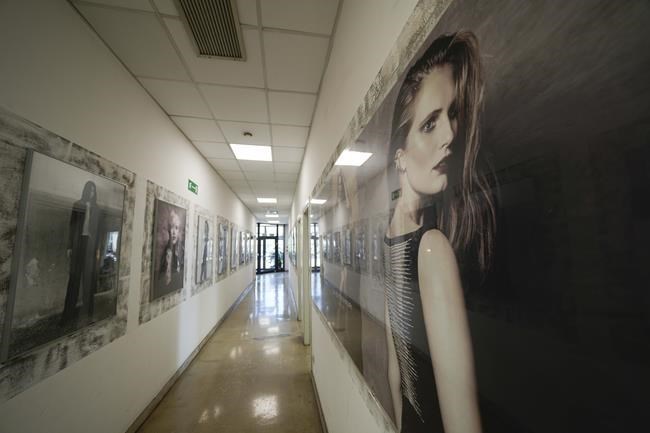
A view of the corridor at the 'Cose di Maglia' factory, in Brescia, Italy, Tuesday, June 14, 2022. Small Italian fashion producers are still allowed to export to Russia, despite sanctions, as long as the wholesale price is under 300 euros. But they are having a hard time getting paid, due to restrictions tied to the financial sector. (AP Photo/Luca Bruno)

After working so hard to build up her Russian customer base, she is loathe to give it up and doesn’t see a quick long-term replacement.

“If Russia were Putin, I wouldn’t go there. But since Russia is not only Putin, one hopes that the poor Russians manage to raise themselves up,” she said.

____

AP reporter Ciaran Giles contributed from Madrid.

____

This story was first published on June 16, 2022. It was updated on June 17, 2022 to correct the name of a Yale professor. It is Jeffrey Sonnenfeld, not Jeffrey Sonnenberg.

Report Error Submit a Tip

More Stories

Living the dream

Ken Wiebe 7 minute read Preview

Living the dream

Ken Wiebe 7 minute read Yesterday at 4:48 PM CDT

DETROIT – As Tyrel Bauer took a left turn out of the tunnel from the Winnipeg Jets dressing room and into the stands, he was met with a hearty round of applause from the 25 friends and family members who had made the trek from various points around North America.

Bauer had just realized a childhood dream and the significance of the moment was not lost on some of his biggest supporters.

“It was a special walk, for sure. A special walk,” Bauer said on Saturday afternoon before the Jets departed for a two-game road trip that begins on Sunday in Detroit against the Red Wings. “Those people who came – and many more that weren’t there and were cheering on from afar – they’ve always been there.

“I wanted that for my family, maybe even more than I wanted it for me. They’ve been through thick and thin. I’ve stressed mom out quite a bit over the years doing my job. That meant a lot for them and I’m really happy they could be there for it.”

Read
Yesterday at 4:48 PM CDT

Province looks to seize notorious drug den

Erik Pindera 5 minute read Preview

Province looks to seize notorious drug den

Erik Pindera 5 minute read Yesterday at 12:00 PM CDT

Provincial justice officials are trying to seize a Dominion Street drug den that has been the source of trouble in the West End for years.

The owner of 982 Dominion St., 45-year-old Robert Edward Johnson, was most recently arrested in June along with several others after a lengthy Winnipeg Police investigation into thefts and illicit drug sales connected to the house.

“The residence has a reputation within the neighbourhood as being a location where individuals habitually attend for the purpose of purchasing and/or consuming controlled substances,” reads a statement of claim filed by the province’s director of civil forfeiture in the Court of King’s Bench last week.

“For several years, the residence has been associated with criminal activity, violence, and disorder, resulting in numerous police attendances and complaints from members of the surrounding community.”

Read
Yesterday at 12:00 PM CDT

Brandonmeat packer thriving on its own

Abiola Odutola 3 minute read Preview

Brandonmeat packer thriving on its own

Abiola Odutola 3 minute read Yesterday at 2:01 AM CDT

BRANDON — Canada Packers has strengthened its business and laid the foundation for future growth during its first year as an independent company, its president says.

The Brandon-based pork producer, separated from Maple Leaf Foods in October 2025, established its own leadership, strategy, systems, culture and identity while continuing operations across its hog production farms and regional hog barns in southern and eastern Manitoba.

The company’s first year was focused on building a successful standalone business while continuing to serve customers, communities and shareholders, president Dennis Organ said.

“Market conditions over the past year have been more challenging than we anticipated when we became a separate entity,” he said in an email. “Despite that, we continued to execute against our priorities, including increasing processing volumes, maintaining disciplined operations and strengthening the business.”

Read
Yesterday at 2:01 AM CDT

Letters, Oct. 3

7 minute read Yesterday at 2:01 AM CDT

A morning in the life …

My very first lesson does not start when I walk into that lecture hall, oh no — it starts long before. It begins when I walk to my car, check the estimated arrival time to the University of Manitoba and hope that Winnipeg traffic agrees with it.

A drive that appears completely manageable changes almost immediately when I’m greeted by a tsunami of orange pylons and a line of cars that appears to go on forever. Traffic moves by the inch, lanes magically disappear and the detour I took yesterday now has a detour of its own. These factors make me do a calculation that I have become all too familiar with. How late can I arrive and still find parking, run to my class across campus and get to class with enough time left to make it worth it?

I have grown used to people saying, “Why not just leave earlier?” I do. But when I’m already leaving for my 8:30 a.m. class at 7 a.m., there’s only so much I can do. This drive that some would think is relaxing is one that feels like an assignment that I didn’t know I had to complete and is due at 8:30 a.m.

Moving drama at MTYP gives voice to boy who changed law

Holly Harris 5 minute read Preview

Moving drama at MTYP gives voice to boy who changed law

Holly Harris 5 minute read Yesterday at 2:37 PM CDT

The heroic true tale of Norway House Cree Nation-born Jordan River Anderson came home Friday night, as Manitoba Theatre for Young People presented Yvette Nolan’s Jordan.

The touring production, a collaboration with Geordie Theatre, runs weekends through Oct. 11, with additional stops in Toronto, Vancouver and Ottawa’s National Arts Centre.

Having several of Anderson’s family members witness the local première underscored the evening with poignancy. Elder and Pine Creek First Nation member Barbara Nepinak added her own dignified presence and prayers following MTYP artistic director Pablo Felices-Luna’s welcoming remarks.

The season-opener also marks the Winnipeg-raised playwright’s homecoming; the Algonquin playwright, director, dramaturg, actor and educator was a fixture in our local theatre community for many years before going on to serve as artistic director for Native Earth Performing Arts from 2003 to ‘11, among other contributions.

Read
Yesterday at 2:37 PM CDT

Khan should’ve taken high road: Goertzen

Carol Sanders 5 minute read Preview

Khan should’ve taken high road: Goertzen

Carol Sanders 5 minute read Friday, Oct. 2, 2026

The veteran Progressive Conservative who championed Obby Khan’s leadership bid says the former Blue Bomber dropped the ball by dissing his Tory teammates before he stepped down.

“I wouldn’t recommend it, and I didn’t recommend it,” Kelvin Goertzen (Steinbach) said in an interview Friday.

Khan resigned as PC leader and quit the caucus Monday saying some members were secretly plotting his ouster, even after he won a confidence vote on Sept. 25.

On Tuesday, Khan lashed out in a CJOB interview, naming the alleged plotters, saying constituents deserved to know which of their elected representatives “lacked moral integrity.” Khan told the Free Press he was “deeply emotionally hurt,” and felt stabbed in the back.

Read
Friday, Oct. 2, 2026