This metaphor is a window into the art of science

Advertisement
Read this article for free:
or
Already have an account? Log in here »
To continue reading, please subscribe:

Digital Subscription
One year of digital access for only $205*
- Enjoy unlimited reading on winnipegfreepress.com
- Read the E-Edition, our digital replica newspaper
- Access News Break, our award-winning app
- Play interactive puzzles
*First annual payment billed as $205.00 + GST for one year. This annual subscription will automatically renew at $233.00 + GST every 52 weeks (10% off the regular annual price of $259.35). Offer available to new and qualified returning subscribers only. Cancel any time.
To continue reading, please subscribe:
Add Free Press access to your Brandon Sun subscription for only an additional
$1 for the first 4 weeks*
- Enjoy unlimited reading on winnipegfreepress.com
- Read the E-Edition, our digital replica newspaper
- Access News Break, our award-winning app
- Play interactive puzzles
*Your next Brandon Sun subscription payment will increase by $1.00 and you will be charged $17.95 plus GST for four weeks. After four weeks, your payment will increase to $24.95 plus GST every four weeks.
Read unlimited articles for free today:
or
Already have an account? Log in here »
Hey there, time traveller!
This article was published 24/01/2023 (1323 days ago), so information in it may no longer be current.
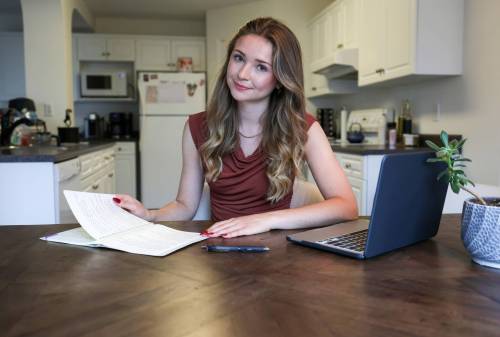
When she lowers herself to the ground, Jessica B. Hill takes the form of a human pretzel, tying her legs one over the other and wrapping her loping fingers through the looped arm of her coffee mug.
As soon as she starts talking, the pretzel unwinds.
Hill, who has played the passive Lady Anne in Richard III at the Stratford Festival, the vengeful Tamora in Titus Andronicus, and the icy Constance in The Madwoman of Chaillot, uses her whole body to tell stories, and in doing so, to understand her position in two universes: the theatrical world, and the world that exists outside the lines.

Making art, to Hill, 36, is a constant surveyal of self-image and of others’ image of her own self. However, the way Hill is seen by others is not within her control; external perception is by definition up to the whims of those who know less about us than we do ourselves. The uncontained universe exists in a constant state of entropy, which inevitably leads to pain, confusion, surprise, and ultimately, blame.
Hill’s new work, Pandora, which she started writing as the pandemic started raging, carves open that box with a playwright’s pen that also serves as an X-ACTO knife. It starts Jan. 25 at the Prairie Theatre Exchange.
“Anybody who has worked in live performance had to stop everything and take stock of what was lost,” says Hill, extending her hands to draw in midair the vastness of the domestic vacuum of lockdown. “The lines around what the thing is become sharper once that thing is gone.
Hill is describing the intangibility of the shroud of grief, which in the spring of 2020 felt hermetic. From the confines of a bubble, Hill dug deep into internet worm holes. All questions were existential, and like bodies in shock often do, hers attempted to regain balance by searching for answers.
“Our poor brains,” she says. “That’s how they work. If you give them a problem, they try to fix it.” If they’re proactive, that is.
However, a more frequent response is to search for a farm animal to push off the edge of a cliff as the bearer of human suffering: a scapegoat.
“We need to blame something to make us feel better,” Hill explains. “And my brain started toward myth. When big disasters happen, we tend to reach to something larger, and toward stories that are more overarching.”
From her wormhole, Hill constructed a mountain: a one-woman show about the one woman who bore the sins of all humankind: Pandora, “the Greek version of Eve.”
In writing the show, her second produced work, Hill delved into myth — imagined worlds created to explain life — and quantum mechanics, a field which through fact dispels the possibility of certain fictions, but also presents the potential existence of worlds beyond, within, and beneath our own.
“In quantum mechanics, nothing exists until it is actually viewed, measured, or interacted with,” she says.
Hill did not study quantum mechanics in university, but that does not mean she wouldn’t have excelled. In high school, she had to break away from her scientific self, branching off into the arts and leaving chemistry and biology behind along her evolutionary trail.
“My heart was in art, and in working on Pandora, I really began to think more about the fact that we have split these two things. If you go back in time, the greatest scientists were artists as well.”
Antonie van Leeuwenhoek, a contemporary of Vermeer, needed an artistic mind to further the field of microscopy. Einstein swore by his violin. Rosalind Franklin’s contributions to our understanding of DNA’s helical, stranded structure are often pushed to the margins, but are certainly artistic in their elegance.
“Both art and science are in pursuit of the same thing, really,” Hill says, using her hands to shrink the gap between the two. “They ask what is our place in the world, and how do we explain the world around us? And they manifest answers in completely different ways, but I think there’s something to be said of how they complement each other.”
It is Hill’s intention for those dual expressions to experience collision in her latest work. Having already been grounded in theatrical language, Hill found herself reading both popular and academic missives on quantum theory, notably the work of the Italian scientist Carlo Rovelli.
“Curiosity led me to the study of physics,” Rovelli told the Guardian in 2021. “People like to distinguish between the arts and science, but my work is endlessly creative. I read and read, converse for hours, and then sit scribbling away in my notebooks. It’s just that my goal is understanding some of nature’s greatest secrets.”

Each performance of the show is an experiment, with the Colin Jackson Theatre at PTE serving as the laboratory setting. The scientific method requires observation, hypotheticals, experimentation, and analysis. That sounds not too dissimilar from theatre, in Hill’s estimation.
“In quantum mechanics, nothing exists until it’s actually viewed, measured, observed and interacted with,” she says. “(Once that happens) you have the nature of an audience and a performer.” Each show is its own premiere.
In scientific testing, repetition is considered an ultimate goal. In experimental theatre, Hill might say that the first signs of replicability, or of an exact formula, portend a necessary return to the chalkboard.
A little bit of entropy can be a dangerous and thought-provoking thing when opening up a mysterious container for the first time.
ben.waldman@winnipegfreepress.com
If you value coverage of Manitoba’s arts scene, help us do more.
Your contribution of $10, $25 or more will allow the Free Press to deepen our reporting on theatre, dance, music and galleries while also ensuring the broadest possible audience can access our arts journalism.
BECOME AN ARTS JOURNALISM SUPPORTER
Click here to learn more about the project.
Ben Waldman is a National Newspaper Award-nominated reporter on the Arts & Life desk at the Free Press. Born and raised in Winnipeg, Ben completed three internships with the Free Press while earning his degree at Ryerson University’s (now Toronto Metropolitan University’s) School of Journalism before joining the newsroom full-time in 2019. Read more about Ben.
Every piece of reporting Ben produces is reviewed by an editing team before it is posted online or published in print — part of the Free Press‘s tradition, since 1872, of producing reliable independent journalism. Read more about Free Press’s history and mandate, and learn how our newsroom operates.
Our newsroom depends on a growing audience of readers to power our journalism. If you are not a paid reader, please consider becoming a subscriber.
Our newsroom depends on its audience of readers to power our journalism. Thank you for your support.
THEATRE PREVIEW
Pandora
● Prairie Theatre Exchange
● Jan. 25 to Feb. 12
● Starring: Jessica B. Hill
● Director: Rodrigo Beilfuss
● Running time: approx. 60 minutes
If you value coverage of Manitoba’s arts scene, help us do more.
Your contribution of $10, $25 or more will allow the Free Press to deepen our reporting on theatre, dance, music and galleries while also ensuring the broadest possible audience can access our arts journalism.
BECOME AN ARTS JOURNALISM SUPPORTER
Click here to learn more about the project.
Ben Waldman is a National Newspaper Award-nominated reporter on the Arts & Life desk at the Free Press. Born and raised in Winnipeg, Ben completed three internships with the Free Press while earning his degree at Ryerson University’s (now Toronto Metropolitan University’s) School of Journalism before joining the newsroom full-time in 2019. Read more about Ben.
Every piece of reporting Ben produces is reviewed by an editing team before it is posted online or published in print — part of the Free Press‘s tradition, since 1872, of producing reliable independent journalism. Read more about Free Press’s history and mandate, and learn how our newsroom operates.
Our newsroom depends on a growing audience of readers to power our journalism. If you are not a paid reader, please consider becoming a subscriber.
Our newsroom depends on its audience of readers to power our journalism. Thank you for your support.
Advertisement Advertise With Us
Advertisement Advertise With Us