Ambitious amphibians
Musical brings humanistic truths to lily pad

Advertisement
Read this article for free:
or
Already have an account? Log in here »
To continue reading, please subscribe:

Digital Subscription
One year of digital access for only $205*
- Enjoy unlimited reading on winnipegfreepress.com
- Read the E-Edition, our digital replica newspaper
- Access News Break, our award-winning app
- Play interactive puzzles
*First annual payment billed as $205.00 + GST for one year. This annual subscription will automatically renew at $233.00 + GST every 52 weeks (10% off the regular annual price of $259.35). Offer available to new and qualified returning subscribers only. Cancel any time.
To continue reading, please subscribe:
Add Free Press access to your Brandon Sun subscription for only an additional
$1 for the first 4 weeks*
- Enjoy unlimited reading on winnipegfreepress.com
- Read the E-Edition, our digital replica newspaper
- Access News Break, our award-winning app
- Play interactive puzzles
*Your next Brandon Sun subscription payment will increase by $1.00 and you will be charged $17.95 plus GST for four weeks. After four weeks, your payment will increase to $24.95 plus GST every four weeks.
Read unlimited articles for free today:
or
Already have an account? Log in here »
Hey there, time traveller!
This article was published 10/12/2024 (659 days ago), so information in it may no longer be current.
In 1973, during a filmed interview for Temple University’s Profiles in Literature series, writer-illustrator Arnold Lobel was asked whether books should be primarily entertaining or realistic for children.
The author didn’t hesitate: “I think they can do both.”
In A Year With Frog and Toad, swimmingly directed for the Manitoba Theatre for Young People by Pablo Felices-Luna and Sara Topham, with tremendous design from Jackie Chau (sets, props and costumes), the audience becomes completely immersed in Lobel’s biome.
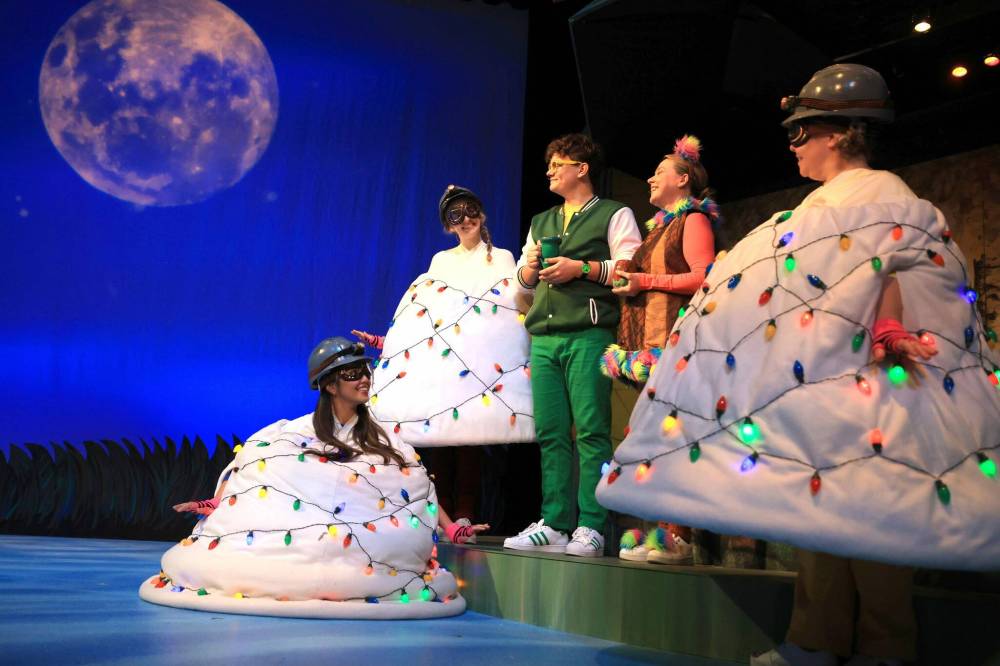
RUTH BONNEVILLE / FREE PRESS
A Year With Frog and Toad tracks the characters’ friendship from its springtime awakening to its wintry rest.
It’s a pop-up wonderland that doesn’t necessarily reflect reality, but engages with it imaginatively — an accessible, expansive collection that shrinks human stories down to friendly amphibian scale.
Is it realistic that an overly ambitious snail (Jillian Willems) be hired by a tea-sipping frog (Jayden Fraser) to deliver a pressing piece of written correspondence to the pom-pommed toad (Jennifer Lyon) who lives across the pond? Maybe not in our world. But is it absolutely hilarious — the type of patient comedy that rewards tadpoles, bullfrogs and polliwogs for simply sitting down in the theatre? You bet your lily pad.
A musical written by the Tony-nominated brothers Robert and Willie Reale, A Year With Frog and Toad is by definition an annual classic, tracing the titular characters’ friendship from its springtime awakening to its wintry rest.
The performances are well-rounded and deserving of heaps of praise, but the seamless choreography of the cast and Chau’s multi-faceted design are nearly enough to merit a rave review on their own.
When the audience enters the theatre, they see two houses separated by a gleeful expanse. At stage right is the wooden, oaky dwelling where Fraser’s Frog croaks in hibernatory rest. Across the way is the leafy abode of Frog’s good friend, Toad, with a roof topped by crayons and surrounded by flexible plant walls.
Before the action even begins, Toad’s roof glows like electric Crayola — guiding the audience to pay attention to the potential for subtle seasonal changes as time flies by.
Then, the show starts, with a trio of snowbirds (Willems, Hazel Wallace and Emily Meadows — a heck of an ensemble that enables Fraser and Lyon to provide stage magic) twittering through a jazzy number about heading south for the winter, pushing personalized rolling luggage across a boggy concourse.
The music — especially Snail’s repeated postal interludes, a toe-tapping tribute to baked goods and a song about bathing suits — is solid and the way the production flows from scene to scene is a testament to the directors’ attention to unity of design, costuming and choreography, a term which in this show has less to do with spectacular dance than it does with having a firm grasp on how to suggest where to look next.
While Snail’s punctuations might be characterized as solos, that would be a misnomer because Willems — a choreographer herself — is actually engaging in a duet with lighting designer Dean Cowieson, who turns a too-quick spotlight into one of the production’s best sight gags. Snail chases the light, and the light chases Snail.
During a scene in which Frog recounts a childhood run-in with a terrible monster, a pair of glowing eyeball lanterns drops from the rafters. As Fraser — excellent in his professional debut — narrates from home, the ensemble, now dressed in green jumpsuits, plays the part of a froggy family.
As Wallace, playing a younger Frog, goes in circles on her scooter, the eyeballs dangle and her parents (Meadows and Willems) have already changed costumes, controlling two giant leaves as the monster’s feet flop up and down in a simulated game of jump rope. It’s all so smooth and unexpected you forget Fraser is voicing the monster as you nod in agreement with the co-ordinated storytelling.
That storytelling would be moot without actors of this calibre injecting it with a sense of total commitment. Fraser holds his own with the wonderful Lyon, one of the city’s most highly regarded musical theatre performers, which says a great deal about the actorly harmony required to portray the natural rhythms and flows of an empathetic, mutualistic friendship.
The characters disagree, they nudge and they fret. They try, in their own ways, to help one another without making the effort too obvious or too patronizing. They shine when they stand together, and when they drift apart, they always find a way to not simply be a best friend, but to become a better one.
The production is aimed at young audiences, although it’s a timeless reminder that the stories we tell to children are the stories that shape us in both past and present tenses.
Should those stories educate or entertain? Should they be written for children or for adults?
This production does both for both.
ben.waldman@winnipegfreepress.com
If you value coverage of Manitoba’s arts scene, help us do more.
Your contribution of $10, $25 or more will allow the Free Press to deepen our reporting on theatre, dance, music and galleries while also ensuring the broadest possible audience can access our arts journalism.
BECOME AN ARTS JOURNALISM SUPPORTER
Click here to learn more about the project.
Ben Waldman is a National Newspaper Award-nominated reporter on the Arts & Life desk at the Free Press. Born and raised in Winnipeg, Ben completed three internships with the Free Press while earning his degree at Ryerson University’s (now Toronto Metropolitan University’s) School of Journalism before joining the newsroom full-time in 2019. Read more about Ben.
Every piece of reporting Ben produces is reviewed by an editing team before it is posted online or published in print — part of the Free Press‘s tradition, since 1872, of producing reliable independent journalism. Read more about Free Press’s history and mandate, and learn how our newsroom operates.
Our newsroom depends on a growing audience of readers to power our journalism. If you are not a paid reader, please consider becoming a subscriber.
Our newsroom depends on its audience of readers to power our journalism. Thank you for your support.
Theatre review
A Year with Frog and Toad
● Manitoba Theatre for Young People
● Runs to Dec. 29
★★★★1/2 out of five
If you value coverage of Manitoba’s arts scene, help us do more.
Your contribution of $10, $25 or more will allow the Free Press to deepen our reporting on theatre, dance, music and galleries while also ensuring the broadest possible audience can access our arts journalism.
BECOME AN ARTS JOURNALISM SUPPORTER
Click here to learn more about the project.
Ben Waldman is a National Newspaper Award-nominated reporter on the Arts & Life desk at the Free Press. Born and raised in Winnipeg, Ben completed three internships with the Free Press while earning his degree at Ryerson University’s (now Toronto Metropolitan University’s) School of Journalism before joining the newsroom full-time in 2019. Read more about Ben.
Every piece of reporting Ben produces is reviewed by an editing team before it is posted online or published in print — part of the Free Press‘s tradition, since 1872, of producing reliable independent journalism. Read more about Free Press’s history and mandate, and learn how our newsroom operates.
Our newsroom depends on a growing audience of readers to power our journalism. If you are not a paid reader, please consider becoming a subscriber.
Our newsroom depends on its audience of readers to power our journalism. Thank you for your support.
Related Articles
It’s so easy being green for Frog and Toad performers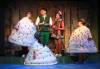
Advertisement Advertise With Us
Advertisement Advertise With Us