Gov. Gen. Mary Simon reflects on five years of reconciliation, Indigenous diplomacy
Advertisement
Read this article for free:
or
Already have an account? Log in here »
To continue reading, please subscribe:

Digital Subscription
One year of digital access for only $205*
- Enjoy unlimited reading on winnipegfreepress.com
- Read the E-Edition, our digital replica newspaper
- Access News Break, our award-winning app
- Play interactive puzzles
*First annual payment billed as $205.00 + GST for one year. This annual subscription will automatically renew at $233.00 + GST every 52 weeks (10% off the regular annual price of $259.35). Offer available to new and qualified returning subscribers only. Cancel any time.
To continue reading, please subscribe:
Add Free Press access to your Brandon Sun subscription for only an additional
$1 for the first 4 weeks*
- Enjoy unlimited reading on winnipegfreepress.com
- Read the E-Edition, our digital replica newspaper
- Access News Break, our award-winning app
- Play interactive puzzles
*Your next Brandon Sun subscription payment will increase by $1.00 and you will be charged $17.95 plus GST for four weeks. After four weeks, your payment will increase to $24.95 plus GST every four weeks.
Read unlimited articles for free today:
or
Already have an account? Log in here »
OTTAWA –
Nunavik, where Gov. Gen. Mary Simon grew up, is a long way from Ottawa and farther still from Buckingham Palace.
That never stopped her mother Nancy May, a unilingual Inuk, from keeping a photo of Queen Elizabeth on prominent display in their family home, or from filling young Mary Simon’s mind with stories about the Queen’s activities and travels.
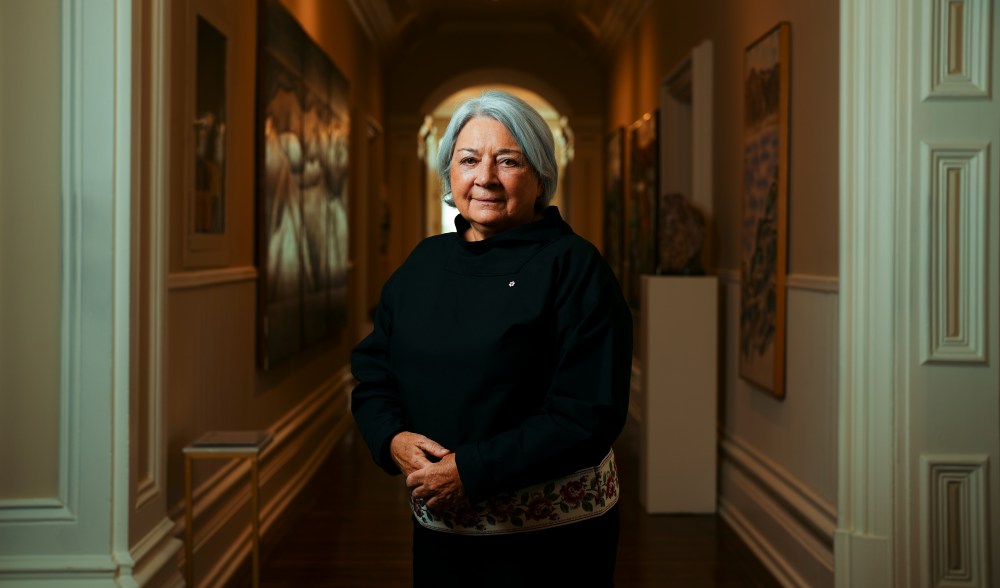
In 2021, at the age of 73, Simon’s relationship with the Queen became something more personal when she was named her official representative in Canada — making her the first Indigenous person to be appointed to the role.
“I really always loved the Queen,” Simon told The Canadian Press in the drawing room of Rideau Hall.
“The Queen was always there.”
Simon, who has for years championed Canada’s reconciliation with Indigenous Peoples, is nearing the end of her tenure, having served both Queen Elizabeth and her son King Charles. Louise Arbour, a former Supreme Court justice and United Nations high commissioner for human rights, is set to replace her as governor general on June 8.
Reflecting on her five years living at 1 Sussex Drive, Simon said she’ll always remember how her elevation from distant admirer of the Queen to viceregal servant gave her a chance to forge relationships with people across Canada — to pursue reconciliation one conversation at a time.
“Making connections that help foster the relationship between Indigenous Peoples and other Canadians has been a big part, because sometimes the trust isn’t always there if you don’t get to know someone that is not from your own culture. It takes time, I think,” she said.
“That requires a lot more work, and I think just supporting Canadians with kindness, with empathy, during some of the more difficult periods of the last five years was really important.”
She took on the job at a time when Canada was just beginning to grapple with the legacy of residential schools and as then-prime minister Justin Trudeau was making reconciliation a priority for his government.
She said while she didn’t feel conflicted as an Inuk stepping into the viceregal role, she worried about the reaction from Indigenous people, who have distinct relationships with the Crown through treaties that have yet to be fully implemented.
At the same time, Simon said, she saw where she could help to strengthen relationships between Indigenous Peoples and Canadians.
“I think that’s what I saw in me in this role, that I would be that bridge-builder,” she said.
Simon said she mourned when Queen Elizabeth died in 2022. But as King Charles’ coronation was approaching, she seized another opportunity to build bridges by helping to organize meetings between the King and the leaders of the three national Indigenous organizations in Canada.
“From that point on, there’s been a lot of visits by First Nations and Inuit to meet with King Charles,” she said.
“Those are the more joyous moments.”
Five years after her appointment, the conversations around reconciliation on the domestic front are changing. Some politicians have openly questioned whether the effort has gone too far in favour of Indigenous rights, while the federal government and provincial governments in B.C. and Ontario have pushed major project development in ways critics say undermine Indigenous rights under the Constitution.
Simon said she wouldn’t use the word “discouraging” to describe the current landscape.
“I think what it means is to stay consistent in our messaging and moving-forward approach that Canada has had since I’ve been at Rideau Hall,” she said.
“It’s a way of life. It’s a lifelong journey. It doesn’t finish.”
Simon currently lives some 2,000 kilometres away from her birthplace, in a 159-year-old national historic site that has served as the official residence for governors general since 1867.
She uses Facebook to keep in touch with her relatives up North, as many Indigenous people do.
“A lot of people, some of my nieces and nephews, I wouldn’t know them if we didn’t have Facebook,” she said. “So when I go back home I know who they are. There’s a plus side to social media, but there’s also a real negative side to it.”
For Simon, the dark side of social media emerged soon after she took the job — when the comment sections on her online posts suddenly overflowed with remarks she called and racist and sexist. Two years later, the pressure on Simon and her family became so unbearable that her office decided to turn off comments on her social media pages.
“My family was reacting, my kids and my grandkids were reacting,” she said. “So I decided to make it public; that I would address it publicly.”
Simon was also criticized during her tenure for not being fluent in French, as she is in English and Inuktitut.
When asked if she thinks those critiques were fair, Simon said, “No, they weren’t fair, I don’t think.”
Nearly all Indigenous languages spoken in Canada are deemed by UNESCO to be at risk or endangered, and Simon’s service at Rideau Hall coincided with the United Nations’ official decade of Indigenous languages.
In 2011, Statistics Canada reported that just 10.5 per cent of Indigenous people spoke both English and French, compared to 17.9 per cent of the broader Canadian population.
The number of people who can speak an Indigenous language, meanwhile, is plummeting. A 2021 Statistics Canada report said roughly 240,000 Indigenous people could speak conversationally in an Indigenous language, a drop of 4.3 per cent since 2016. That’s part of the legacy of residential schools and other government policies which sought to force the assimilation of Indigenous people by preventing them from speaking their own languages.
While Simon was born and raised in Quebec, she did not receive a French language education. She attempted to learn on the job through private lessons.
“As much as Canada reminds us that we have two official languages, nevertheless Indigenous languages are equally important,” she said.
“And I have made an effort throughout my mandate to speak Inuktitut in my speeches, even if there’s no Inuit in the audience. I feel it’s important for Canadians to hear an Indigenous language.”
She even taught Ukrainian President Volodymyr Zelenskyy a word in Inuktitut when they met at Rideau Hall during his 2023 visit to Ottawa.
“She taught me a word from her mother tongue,” Zelenskyy later told members of Parliament during an address to the House of Commons.
“Ajuinnata. She said the meaning of this word is, don’t give up. Don’t give up. Stay strong against all odds.”
Simon said Zelenskyy, who has led his country through four years of war with Russia, “was so interested” in the meaning of that word.
“It’s a word that I used to hear when I was growing up, when we had very little, really, in our very small community,” she said. “It’s my favourite word.”
She also taught the word to Queen Elizabeth during a visit to Windsor Castle in 2022 and used it to praise Indigenous delegates who received an apology that same year from Pope Francis for the role the Roman Catholic Church played in the residential school system.
Simon, who was born in Kangiqsualujjuaq, was no stranger to international relations when she took up the viceregal role. She served as Canada’s ambassador in Copenhagen two decades ago, a role that involved relations with Greenland — a Danish territory with a population that is overwhelmingly Inuit. She also served two terms as president of Inuit Tapiriit Kanatami, which represents Inuit in Canada.
As Governor General, she made frequent trips to Nordic countries and visited with Indigenous Peoples from across the region. She oversaw the opening of a new consulate in Greenland earlier this year.
“Inuit and other Indigenous people are the permanent residents of the northern part of this country. And they have to not just be recognized as being permanent residents, but they also have to be part of the whole evolution of how the North is being developed,” she said.
“Not just in terms of the economy — and that’s critical — but also in terms of how well the communities are doing in terms of their health care, in terms of education. And that should all be part of what we call a ‘foreign policy.'”
Simon recently went to Tumbler Ridge, B.C., where a mass shooter took the lives of eight people in February, including five students at the local school. She said it reminded her of the vital role community plays in healing — and how isolation makes healing harder.
“When I was at Tumbler Ridge, it showed that many of these northern, remote communities don’t have regular access to support in their communities,” she said, adding she’s considering taking on a role connected with mental health after she leaves office.

“All of us in the North have lost loved ones,” she said.
“But I’m probably going to take a break first, maybe over the summer. I’ve done so many different things in my 50-year career. There’s a lot of areas that I could contribute my time.”
Asked if she has any advice for Arbour, Simon said their conversations are ongoing.
“I know that she’s committed to continuing the work on reconciliation, so I’m very pleased about that,” she said.
This report by The Canadian Press was first published May 9, 2026.
Related Articles
Someone call the PM: next governor general doesn’t speak a single Indigenous language
Advertisement Advertise With Us
Advertisement Advertise With Us