Halifax’s oldest cemetery offers student researchers a glimpse into buried history
Advertisement
Read this article for free:
or
Already have an account? Log in here »
To continue reading, please subscribe:

Digital Subscription
One year of digital access for only $205*
- Enjoy unlimited reading on winnipegfreepress.com
- Read the E-Edition, our digital replica newspaper
- Access News Break, our award-winning app
- Play interactive puzzles
*First annual payment billed as $205.00 + GST for one year. This annual subscription will automatically renew at $233.00 + GST every 52 weeks (10% off the regular annual price of $259.35). Offer available to new and qualified returning subscribers only. Cancel any time.
To continue reading, please subscribe:
Add Free Press access to your Brandon Sun subscription for only an additional
$1 for the first 4 weeks*
- Enjoy unlimited reading on winnipegfreepress.com
- Read the E-Edition, our digital replica newspaper
- Access News Break, our award-winning app
- Play interactive puzzles
*Your next Brandon Sun subscription payment will increase by $1.00 and you will be charged $17.95 plus GST for four weeks. After four weeks, your payment will increase to $24.95 plus GST every four weeks.
Read unlimited articles for free today:
or
Already have an account? Log in here »
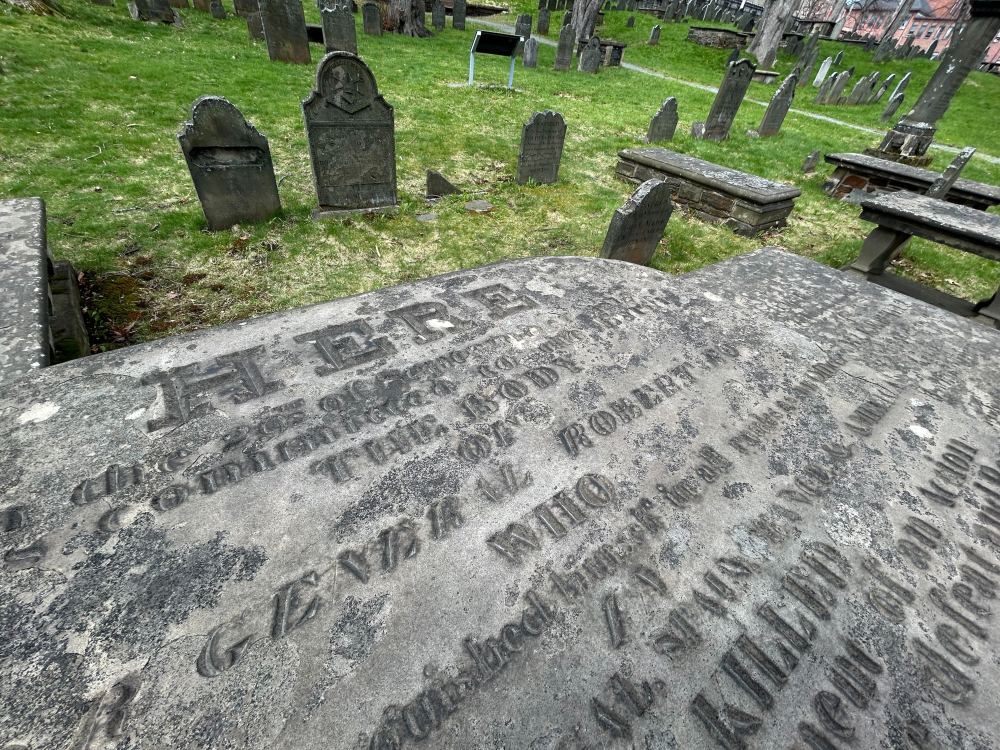
HALIFAX – The gravestones in Halifax’s oldest cemetery mark the final resting place of judges, privateers and even the British commander who had the White House set on fire two centuries ago.
Now, anthropology students at Saint Mary’s University are using 21st-century technology to scan underground and into the lives of the estimated 10,000 people buried there with no grave markers at all.
“I’ve walked past this site, the cemetery, a million times and never once really looked twice at it,” Kye Felix, an undergraduate anthropology student studying the city’s Old Burying Ground, said in an interview.
She’s one of a dozen students who recently spent a week using ground-penetrating radar over a section of the cemetery, experiencing field work at a real archeological site. Meanwhile, the data they collect will give partners like the Nova Scotia Museum and the non-profit foundation that manages the cemetery additional insights into what’s underground. That information could eventually find its way onto interpretive panels or online portals allowing people to explore one of the oldest parts of Halifax.
Created just outside the walls of the original Halifax settlement in 1749 as a common cemetery for almost all religions, the Old Burying Ground now sits on the corner of Barrington Street and Spring Garden Road, one of the busiest areas of downtown.
The site, originally covering 0.4 hectares but expanded to more than double its original size in 1762, was closed to burials in 1844. Interred there are privateers, soldiers, sailors, First Nations members, the city’s first ferryman, the first chief justice of the province’s supreme court, the wife of shipping magnate Samuel Cunard and the first president of the Bank of Nova Scotia.
One famous grave houses the remains of Maj.-Gen. Robert Ross, who led the British attack on Washington D.C. in 1814 that resulted in the burning of the White House and inspired The Star-Spangled Banner, the U.S. national anthem. He was killed at the Battle of Baltimore less than a month later, his remains shipped to Halifax embalmed in a barrel of rum.
While the site’s 1,200 grave markers help tell the city’s history, there’s also believed to be between 10,000 and 12,000 unmarked graves buried under the soil. Brain MacDonald, vice-chair of the non-profit Old Burying Ground Foundation, says something like a mass grave can point to a major event like an epidemic, for example.
He says research from the project will help the foundation confirm theories on what’s underground, and better tell the site’s story.
“It helps you fill in the blanks for a lot of history that was never written,” he said.
Jonathan Fowler, archeologist and Saint Mary’s anthropology professor, says large numbers of unmarked graves are fairly typical of old burial sites.
“Not everyone had the means to afford one of these big stereotypical, elaborately carved stones,” Fowler said in an interview. “A lot of people just didn’t have any kind of marker at all or maybe they had a wooden marker that has since rotted away.”
Fowler says the team started from the site’s southern wall, painstakingly covering 20 metres with ground-penetrating radar machines, one of which was borrowed from the Sipekne’katik First Nation north of Halifax.
After a week in the field, students spent another week crunching data. Fowler says the early results suggest graves from different time periods are buried over each other at various depths.
“One of the first things that’s standing out in the data is that the gravel paths we see today are obviously not the only pathways that existed here, and there are different alignments that we’re detecting from previous generations of paths,” said Fowler.
“So you put all that together and more and you’re dealing with a very chaotic environment below ground. So we’re seeing a lot.”
The Saint Mary’s University anthropology department has an emphasis on field-based learning, says Fowler, and the work at the downtown cemetery is a great example. He says it not only helps satisfy the school’s own research interests, but also helps answer community questions about what’s underground.
The foundation will use the data to help manage the site as it installs information plaques, restores monuments, rebuilds old walls and realigns pathways, says Fowler. There’s tentative plans to study other areas of the grounds, but in some sections the stones are too close together for ground-penetrating radar.
All the grave markers have been mapped with surveying equipment; eventually, the information will be tied to digital photos from the 1980s — when the stones were better preserved — and uploaded to an online portal for the public to explore.
MacDonald says the Old Burying Ground is not a nice, neat cemetery that you would find today. He says it predates the so-called cemetery movement of the 19th century, when the concept of graveyards as well-manicured and sacred places emerged.
For example builders plowed through several graves around 1860 when they built the Sebastopol Monument, a triumphal arch near the main gate created to honour Nova Scotian soldiers who died in the Crimean War. Bones were found scattered about when the monument’s foundations were repaired in the late 1980s, says MacDonald.
Fowler says the Old Burying Ground isn’t the only historic cemetery in the area, which he calls the “necropolis of Halifax.” Directly across the street is Saint Mary’s Cathedral Basilica, the oldest Catholic cathedral in the province and one of the first in Canada, with its old cemetery now underneath a record store parking lot.
Nearby is the Halifax Memorial Library, which has been closed since 2014 and remains undeveloped, in part because it sits on the site of the city’s former poor house and more unmarked graves. The city says the space, home to a public park known for its statue of a striding Winston Churchill, could contain the burials of more than 4,500 people including soldiers and epidemic victims dating back to the 1760s.
Behind the library is the Presbyterian Church of St. David, built directly over a Methodist cemetery with a few grave markers still visible on the south side. Fowler says there’s also historical records referencing a small Jewish cemetery in the area, but the exact location has been lost.
“There are probably about 20,000 or so burials just in that part of the city,” said Fowler.
This report by The Canadian Press was first published May 12, 2026.