

‘Minotaur,’ about murder and corruption in Putin’s Russia, jolts the Cannes Film Festival
Advertisement
Read this article for free:
or
Already have an account? Log in here »
To continue reading, please subscribe:
Digital Subscription
One year of digital access for only $1.44 a week*
- Enjoy unlimited reading on winnipegfreepress.com
- Read the E-Edition, our digital replica newspaper
- Access News Break, our award-winning app
- Play interactive puzzles
*Billed as $5.77 plus GST every four weeks. After 52 weeks, price increases to the regular rate of $19.95 plus GST every four weeks. Offer available to new and qualified returning subscribers only. Cancel any time.
To continue reading, please subscribe:
Add Free Press access to your Brandon Sun subscription for only an additional
$1 for the first 4 weeks*
- Enjoy unlimited reading on winnipegfreepress.com
- Read the E-Edition, our digital replica newspaper
- Access News Break, our award-winning app
- Play interactive puzzles
*Your next Brandon Sun subscription payment will increase by $1.00 and you will be charged $17.95 plus GST for four weeks. After four weeks, your payment will increase to $24.95 plus GST every four weeks.
Read unlimited articles for free today:
or
Already have an account? Log in here »
CANNES, France (AP) — Russian director Andrey Zvyagintsev sent shock waves through the Cannes Film Festival with a soberly damning crime film about murder and corruption in Russia, set against the conscription of young men into President Vladimir Putin’s war with Ukraine.
“Minotaur,” which debuted Tuesday night at the French festival, was one of the most anticipated selections at this year’s Cannes. The film rewarded those expectations, receiving one of the festival’s most enthusiastic responses and putting the Russian filmmaker squarely in the mix for the Palme d’Or.
While “Minotaur” is outwardly centered around a married couple, its story has obvious political reverberations. Dmitriy Mazurov plays the chief executive of a large shipping company who, as Russia’s military mobilizes for the all-out invasion of Ukraine in February 2022, is asked to contribute a quota of 150 workers to the mounting war effort.
At the same time, Mazurov begins investigating the suspected infidelity of his wife, played by Iris Lebedeva. As “Minotaur” evolves, their family drama takes on darker symbolism for the deceptions and savagery of Putin’s war.
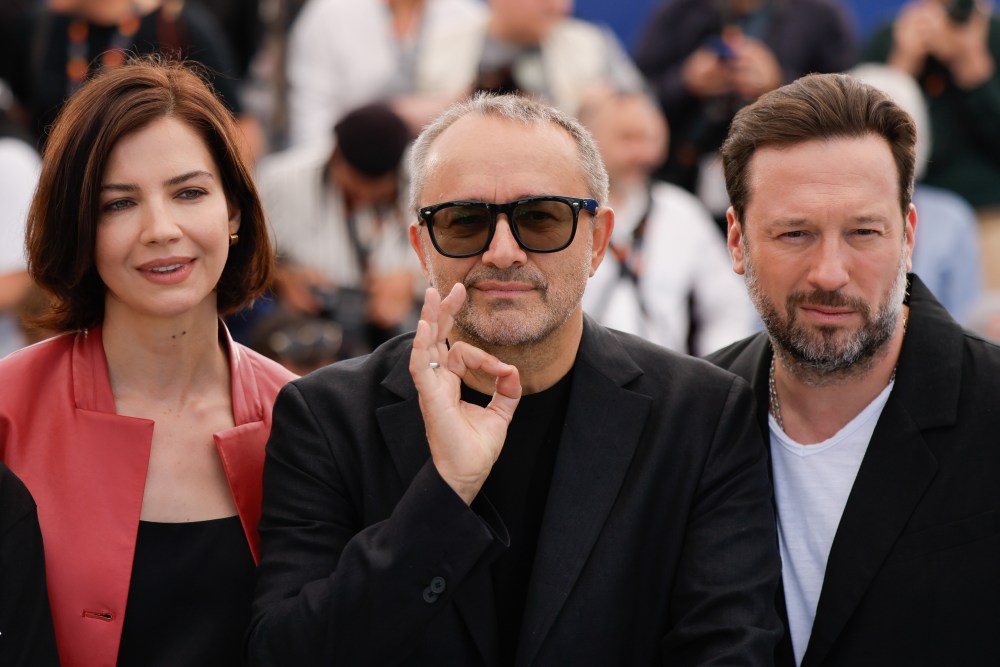
“It was important for me to make this film given the current Russian context,” Zvyagintsev told reporters on Wednesday. “It was a perfect pretext to say some important things.”
For Zvyagintsev, it was a long-in-coming triumph. His previous two films — “Leviathan” (2014) and “Loveless” (2017) — were both critically acclaimed Oscar nominees. But during the pandemic, illness forced Zvyagintsev into an induced coma for 40 days. Recovering in a German clinic, he had to relearn how to walk and hold utensils. A year later, in 2022 and still in a wheelchair, he moved his family to Paris.
“It’s one of the greatest things that’s happened to me over these last nine years,” Zvyagintsev said of returning to Cannes, where his previous two films debuted. “Coming back after such a lengthy absence to the Cannes Film Festival is an absolutely incomparable event.”
Zvyagintsev had previously worked in Russia, and while his films resisted overt political statement, their critiques of Putin’s government weren’t hard to infer. Russia’s Cultural Ministry, which had partly funded “Leviathan,” was highly critical of the movie, saying it “openly spit on” the government.
“Minotaur” is the first film made by Zvyagintsev outside Russia. He shot it in Latvia.
“I perhaps lost a link when I left Russia six years ago, but I know what I’m talking about,” he said. “I know how the people think, how they react, how they go about things. I know a lot about corruption, too, which has developed in the country.”
While Zvyagintsev didn’t make many direct statements about Russia on Wednesday, he explained how he sees politics filtering into his filmmaking.
“I didn’t want to make the most of the politics because that would discredit what you hear,” the director said. “It was better to indulge in silence and rely on gestures.”
The broad outlines of “Minotaur” were inspired by Claude Chabrol’s 1969 film “The Unfaithful Wife.” Zvyagintsev first began working on it years ago. But after the full-scale invasion of Ukraine transpired during his recovery, the film began to shift. As in his previous movies, geopolitics seeped into a family drama.
“There’s nothing more interesting than studying a couple,” he said. “Each member of a couple have to make choice, choices which call the relationship in the family into question. A family is like a battlefield.”