ITK president says Indigenous languages office’s mandate needs to be re-examined
Advertisement
Read this article for free:
or
Already have an account? Log in here »
To continue reading, please subscribe:

Digital Subscription
One year of digital access for only $205*
- Enjoy unlimited reading on winnipegfreepress.com
- Read the E-Edition, our digital replica newspaper
- Access News Break, our award-winning app
- Play interactive puzzles
*First annual payment billed as $205.00 + GST for one year. This annual subscription will automatically renew at $233.00 + GST every 52 weeks (10% off the regular annual price of $259.35). Offer available to new and qualified returning subscribers only. Cancel any time.
To continue reading, please subscribe:
Add Free Press access to your Brandon Sun subscription for only an additional
$1 for the first 4 weeks*
- Enjoy unlimited reading on winnipegfreepress.com
- Read the E-Edition, our digital replica newspaper
- Access News Break, our award-winning app
- Play interactive puzzles
*Your next Brandon Sun subscription payment will increase by $1.00 and you will be charged $17.95 plus GST for four weeks. After four weeks, your payment will increase to $24.95 plus GST every four weeks.
Read unlimited articles for free today:
or
Already have an account? Log in here »
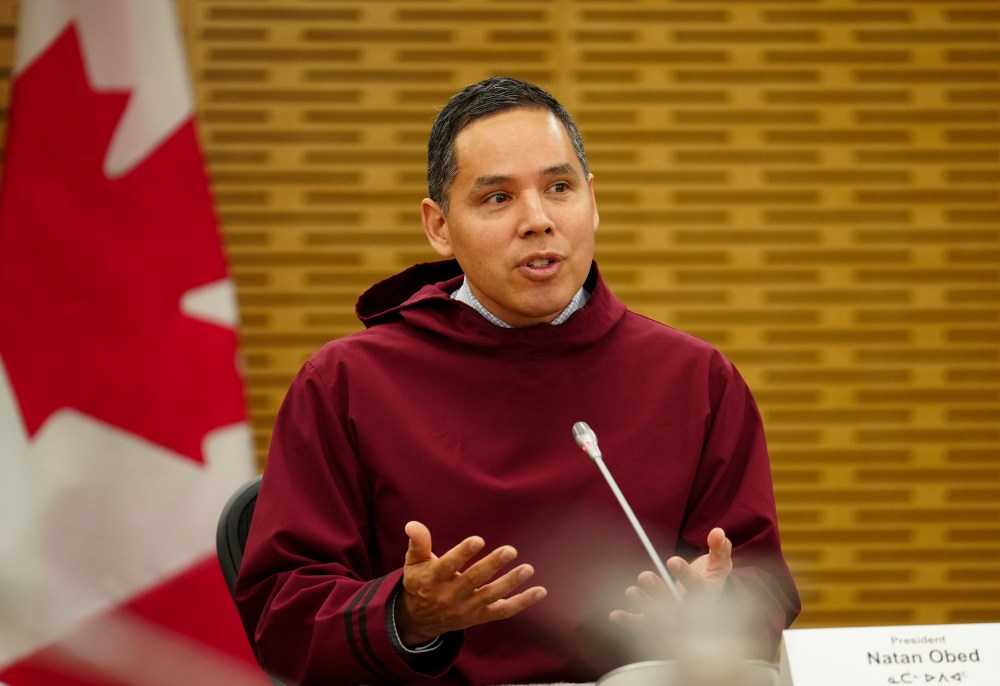
OTTAWA – Inuit Tapiriit Kanatami President Natan Obed says allegations of financial mismanagement and a toxic workplace at the Office of the Commissioner for Indigenous Languages are disheartening, and he hopes the federal government seizes the moment to reform the institution.
“Any negativity around Indigenous Peoples — especially in this moment — and the funding that is allocated for things like language and culture is a deep risk to the ability for us to continue receiving funding,” Obed told The Canadian Press on Thursday.
“So I am quite concerned about this and I do hope that the federal government, from the prime minister to ministers, can understand the difference between dysfunction within a federal structure, which this is, and then the larger picture of language and culture that we are all trying to work better on.”
Half a dozen sources, including former employees, have told The Canadian Press that over the five years of its existence, the arm’s-length Office of the Commissioner of Indigenous Languages has failed to move the needle on strengthening Indigenous languages and supporting research.
Instead, they say, the office has focused on extensive travel and hosting a large conference in Ottawa that cost $10 million. They also allege a toxic work environment, bullying, projects left uncompleted and staff quitting in frustration.
The sources spoke on the condition they not be named due to fear of reprisals.
The Canadian Heritage department told The Canadian Press it has launched a financial audit into the office. Heritage Minister Marc Miller called the allegations serious and said that people need to be held accountable.
“But part of holding people to account is giving people the benefit of the doubt, and that includes making sure the due process is respected,” he said Wednesday.
The department also launched a separate review of the Indigenous Languages Act, which is required after five years.
Commissioner of Indigenous Languages Ronald Ignace and directors Robert Watt, Georgina Liberty and Joan Greyeyes have not been made available for interviews.
Ignace said in a media statement that the office’s evolution has faced challenges but he is proud of the work done to establish it and advance its mandate.
His office said it received three formal complaints of bullying, which were investigated last year. Personnel changes were made, it said, and there have been no new complaints since.
Obed said the Indigenous languages office has not reached out to him or ITK since the allegations were made public. He said that’s not surprising, as the commissioner and director’s terms are set to end in July.
“I’m not necessarily surprised then that they are not looking for a solution, or looking to have further dialogue about the findings or the information that has come to light,” he said.
Obed raised concerns about the office when members of Parliament debated its creation in 2019. He warned at the time the office would lack the ability to preserve and revitalize Indigenous languages and that it would not be properly equipped to help communities hold the federal government accountable.
Obed said ITK’s involvement with the office has been limited over the past five years. He said ITK, which represents Inuit, didn’t have a “foundational relationship” with the office largely because it is doing its own work on preserving and revitalizing the Inuktut language.
“We didn’t bring any of our language concerns formally through that office because we didn’t feel as though there was any point,” he said.
Obed and ITK have for years been calling on Ottawa to designate Inuktut as an official language in Inuit Nunangat, the Inuit homeland.
He said that would give it more protections and funding on par with English and French.
“There is no other scenario in the country where a majority population of a jurisdiction has no right to receive government services in the dominant language of the society,” Obed said.
“I’m not sure there are many other places in the world where that’s the case, other than in occupied territories, in spaces where there are brutal regimes that don’t have democracy.”
Obed said ITK is formalizing specific recommendations to reform both the languages office and the Indigenous Languages Act as part of the mandatory five-year review of the act. Those recommendations could include another call for official language status for Inuktut.

He is also calling for the office to take on a complaints mechanism with actual authority to adjudicate complaints about the federal government’s approach to Indigenous languages, and to direct solutions or findings back to relevant federal institutions.
“Without that ability of enforcement, they are really relegated to language promotion, or just basically articulating the concerns of First Nations, Inuit and Métis in relation to language,” he said.
“ITK wants every dollar spent on Indigenous languages to be productive … So when there are funds that are spent, they have to be spent wisely, for the best interests of the preservation, and the promotion, and the use of our languages. I think we just have to get back to that.”
— With files from Brittany Hobson in Winnipeg
This report by The Canadian Press was first published June 5, 2026.
Related Articles
Thousands celebrate Indigenous Peoples Day
Advertisement Advertise With Us
Advertisement Advertise With Us