Why some B.C. farmers stay to fight, despite wildfire evacuation orders
Advertisement
Read this article for free:
or
Already have an account? Log in here »
To continue reading, please subscribe:

Digital Subscription
One year of digital access for only $205*
- Enjoy unlimited reading on winnipegfreepress.com
- Read the E-Edition, our digital replica newspaper
- Access News Break, our award-winning app
- Play interactive puzzles
*First annual payment billed as $205.00 + GST for one year. This annual subscription will automatically renew at $233.00 + GST every 52 weeks (10% off the regular annual price of $259.35). Offer available to new and qualified returning subscribers only. Cancel any time.
To continue reading, please subscribe:
Add Free Press access to your Brandon Sun subscription for only an additional
$1 for the first 4 weeks*
- Enjoy unlimited reading on winnipegfreepress.com
- Read the E-Edition, our digital replica newspaper
- Access News Break, our award-winning app
- Play interactive puzzles
*Your next Brandon Sun subscription payment will increase by $1.00 and you will be charged $17.95 plus GST for four weeks. After four weeks, your payment will increase to $24.95 plus GST every four weeks.
Read unlimited articles for free today:
or
Already have an account? Log in here »
When Tom Davison’s son-in-law invested in firefighting equipment for their orchard near Vernon, B.C., after a wildfire swept past in 2021, Davison wasn’t sure the hoses would get much use.
He figured the blaze, which caused smoke damage to the property, would be a once-a-century experience.
But after high winds pushed flames up to the fence line of Davison Orchards’ property on Aug. 1, Davison said he was grateful for his son-in-law’s foresight that helped protect the orchard that has been in the family for five generations.
“The fact that he had the proper equipment on site was really a big part of why we were able to do what we did that night,” he said.
After evacuating staff, Davison’s son and son-in-law stayed behind and trained the hoses on the flames at the property’s edge, protecting the orchards and helping a neighbour who lost some outbuildings. But his home was saved.
They are among a number of farmers and ranchers in B.C. defying wildfire evacuation orders in order to protect their homes and livelihoods built over generations.
The evacuation order covering the Davison Orchards has since lifted but B.C.’s Ministry of Agriculture said that as of Thursday there were 221 registered agricultural premises in the province under evacuation order due to wildfire activity.
Kaylee Jameson is one of nine people who stayed behind at Sweet Pea Farms near Vernon, despite an evacuation order, to protect more than 100 animals on the property, ranging from pigs and ducks to horses and dogs.
A wildfire engulfed the property in 2021 and the group — who included the farm’s owner and their family — didn’t want that to happen again.
“They’ve been through this before. And this time they wanted to stay and fight for their house, fight for the farm, fight for the animals. You know, just keep all of us safe since we were unable to get the trucks and trailers through the roads in time to get all of our animals out,” she said in a phone interview.
Jameson, who rents on the property and considers the farmers like her family, said they tried to get the animals out but when the winds picked up, roads closed and they ran out of time.
So they stayed to fight.
“I’m not leaving without my horses and my dog and my cats,” she said.
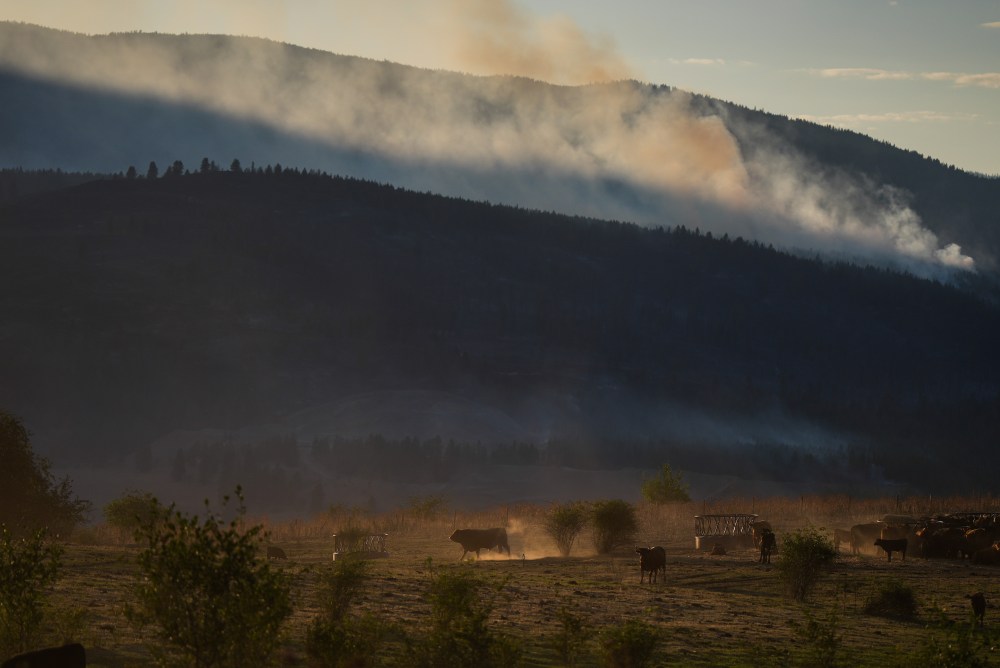
Multiple wildfires are burning in southern British Columbia, including the Bradley Creek fire which spread quickly last week around Okanagan Lake as heavy winds pushed flames over drought-parched lands.
Officials have remained adamant that evacuation orders should be taken seriously.
The Central Okanangan emergency management centre said Friday that some residents had chosen to remain in evacuation zones due to the Quilpituk Creek wildfire, south of the Bradley Creek blaze.
It told them to “leave now.”
“An evacuation order is not a suggestion. It is a life-safety measure,” the centre said.
But Premier David Eby has acknowledged that farmers faced tough choices.
“I can’t think of anything more difficult for a farmer than being faced with an evacuation notice while knowing that your animals are potentially in distress,” he said at a news conference on Thursday, adding that the top priority is protecting human life
A provincial program allows farmers at risk to temporarily move animals to stockyards, feedlots, “buddy farms”, and rodeo grounds.
The ministry doesn’t track how many animals have been relocated but said those from the Bradley Creek fire have been moved to other Interior communities.
But that doesn’t work for all animals.
Kevin Boon, the general manager of the BC Cattlemen’s Association, said it can be very stressful for cattle to be moved by truck and some ranchers have chosen to stay in part because it is easier to move large herds over land to safety.
The association has liaisons who work with BC Wildfire Service’s incident commanders on major fires to help out where they can.
“We are able to talk to that commander about where there are ranches and where there our cattle in the path,” he said.
Boon said if a wildfire is moving toward someone’s ranch or pasture, they are alerted and need to move their herd.
He said ranchers on the land can also help firefighters by relaying information on how fires are behaving.
“Some of these old guys, I think that they were there since God himself, but they get to know which way the wind blows up a valley or through a certain area,” he said of longtime ranchers.
Boon said ranchers and farmers accept risk at a different level than others but are also often more prepared to stay during wildfires.
They reduce risk by keeping grass trimmed and trees away from structures, for example.
“Also, most of these guys have got pretty good equipment for protection and for fighting. Most will have an excavator or a Caterpillar or at the very least a water truck sort of deal,” he said.
“They, for the most part, are concentrating during a fire of keeping cattle out of harm’s way or the livestock out of harm’s way.”
He said ranchers will often put out small fires on their own before they become larger threats and will leave when the risk gets too high.
“The vision I would like people to understand is, fires are unpredictable but you can watch them and you can see them, and paying attention to them allows you to know when to leave and when you can still stay,” he said.
“And for the most part, 99.9 per cent of them are gonna leave well in front of that fire.”
Adrian Arts, the executive director of the BC Fruit Growers’ Association, said it’s the organization’s position that a farmer has the right to try to protect their property during an emergency where it’s not putting anyone else in harm’s way.
“We’re coming into gala season,” he said of the popular red-green apple. “Those trees are there year-round, so if they burn down, we’re looking at a replant that takes seven years for a tree to produce fruit again, and then a return on investment for those trees is anywhere between 15 to 20 years.”
“The lifespan of an orchard is 20 to 30 years. So, people are very invested in making sure that that investment is protected.”
While Arts knows some farmers who stayed, others who followed orders to evacuate could be coming back to a different type of devastation.
Cherry farmers, in the middle of their harvest season, only have a handful of days to pick the fruit before it goes bad, while others may have missed the window for spraying the crops to protect them from insects.
It is too early to say what the full impact will be, he said.
At Sweetpea Farms, Jameson said they set up sprinklers, cut back brush, and the flames didn’t make it to the property but they are still waiting for the evacuation order to lift.

She works for the nearby Okanagan Indian Band and knows that many others were not as fortunate; the chief of the First Nation has estimated 230 homes were lost to the fire.
“Seeing my community burn and seeing homes of people I care about, including my clients, go up in flames have been very heartbreaking,” Jameson said.
Arts said it can be difficult for people who don’t farm to understand the connection to the land.
“So, when it seems like (staying behind) is irrational, It’s really not. You put everything into it, that really is a part of you. And then you see these wildfires coming up and it’s crushing. It’s losing a part of you.”
This report by The Canadian Press was first published Aug. 8, 2026.
Related Articles
B.C. wildfire evacuees told to brace for devastation, as RCMP launch criminal probe
Advertisement Advertise With Us
Advertisement Advertise With Us