The trial over Tupac Shakur’s murder ended with a guilty verdict. But did it bring closure?
Advertisement
Read this article for free:
or
Already have an account? Log in here »
To continue reading, please subscribe:

Digital Subscription
One year of digital access for only $205*
- Enjoy unlimited reading on winnipegfreepress.com
- Read the E-Edition, our digital replica newspaper
- Access News Break, our award-winning app
- Play interactive puzzles
*First annual payment billed as $205.00 + GST for one year. This annual subscription will automatically renew at $233.00 + GST every 52 weeks (10% off the regular annual price of $259.35). Offer available to new and qualified returning subscribers only. Cancel any time.
To continue reading, please subscribe:
Add Free Press access to your Brandon Sun subscription for only an additional
$1 for the first 4 weeks*
- Enjoy unlimited reading on winnipegfreepress.com
- Read the E-Edition, our digital replica newspaper
- Access News Break, our award-winning app
- Play interactive puzzles
*Your next Brandon Sun subscription payment will increase by $1.00 and you will be charged $17.95 plus GST for four weeks. After four weeks, your payment will increase to $24.95 plus GST every four weeks.
Read unlimited articles for free today:
or
Already have an account? Log in here »
LOS ANGELES (AP) — For nearly 30 years, the story of Tupac Shakur’s killing existed somewhere between an unsolved murder and hip-hop mythology.
His death became intertwined with the killing of Christopher Wallace, better known as The Notorious B.I.G., six months later. Together, the deaths of two of rap’s biggest stars came to symbolize a combustible era commonly reduced to three words: East versus West. The mystery was compounded by reluctant witnesses, distrust of law enforcement and questions about why police in Las Vegas and Compton hadn’t pursued charges until now.
Now, a Las Vegas jury has delivered something that seemed elusive for decades: a conviction.
Duane “Keffe D” Davis was found guilty Monday of first-degree murder with use of a deadly weapon in Shakur’s 1996 killing. Jurors deliberated for less than three hours. Davis was the only person ever charged in the case.
The verdict provides a legal answer to one of hip-hop’s most enduring mysteries. But after decades of books, documentaries and podcasts on theories about Shakur’s death, another question remains: Can a conviction bring closure — and if so, for whom?
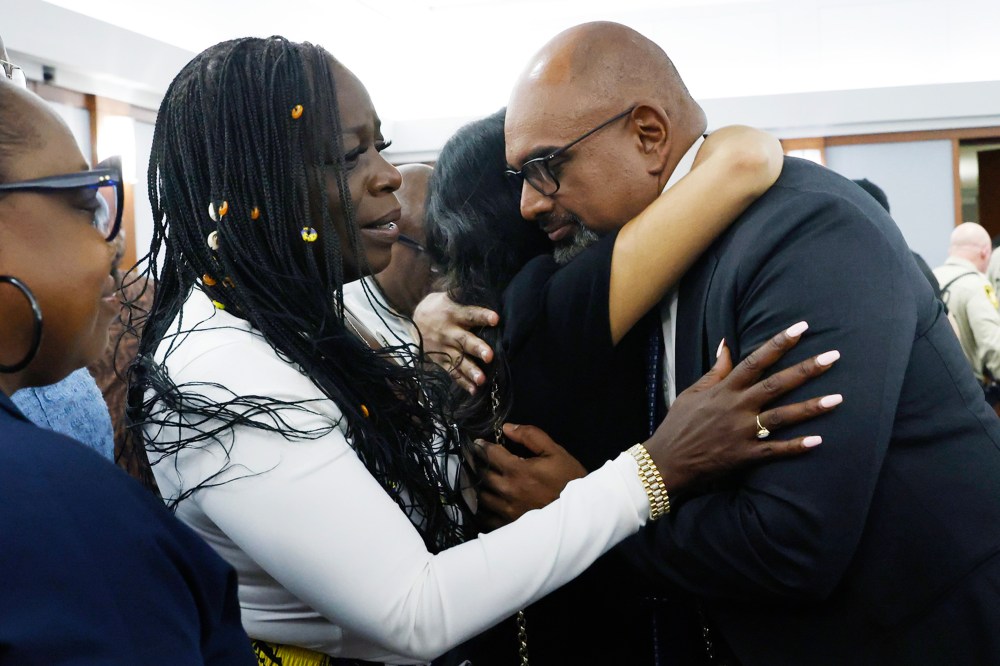
The emotion of that long wait was visible in the courtroom on Monday. Shakur’s sister, Sekyiwa “Set” Shakur, cried after the verdict was read and reached back toward someone sitting behind her. She and other members of Shakur’s family later embraced prosecutors.
When Davis was charged in 2023, Shakur’s sister called the development “a pivotal moment,” while making clear that accountability remained the goal.
“It’s important to me that the world, the country, the justice system, and our people acknowledge the gravity of the passing of this man, my brother, my mother’s son, my father’s son,” she said at the time.
Prosecutor Binu Palal echoed that distinction after Monday’s verdict.
“To all of us, to me, Tupac Shakur was an icon or an idea,” Palal said. “But to the family, Tupac Shakur was a brother, a son, a cousin, a loved person ripped from them 30 years ago.”
Can a verdict bring closure?
Chuck Creekmur, co-founder of the hip-hop website AllHipHop, said he believes Shakur’s family may finally find some measure of closure, but he expects questions and theories surrounding the rapper’s death to persist.
“I thought it was a closing chapter,” he said. “But now, I realize I’m pretty convinced it’s just opening another chapter.”
For some, the verdict may provide a sense of resolution — or at least accountability — but closure might still be out of reach.
On “The Breakfast Club” Tuesday, Charlamagne tha God also reflected on what the verdict could mean for Shakur’s family.
“Nothing brings your loved one back,” he said. “All you think about is what his life would have been like the past 30 years, and you’re constantly reminded of him because he’s such an iconic figure. So you’ll never truly have, you know, peace.”
It was never simply about East vs. West
The prosecution’s case against Davis centered on an individual act of retaliation rather than a sweeping, coast-to-coast battle between gangs and their associated record labels.
Hours before Shakur was shot on Sept. 7, 1996, he and members of his entourage were captured on surveillance video beating Davis’ nephew, Orlando “Baby Lane” Anderson, inside the MGM Grand after a Mike Tyson fight. Prosecutors said Davis then obtained a gun, gathered a group that included Anderson and went looking for Shakur and Death Row Records co-founder Marion “Suge” Knight.
Davis was not accused of firing the fatal shots. Prosecutors argued he provided the weapon and helped orchestrate the attack.
For Creekmur, the trial exposed how inadequate the familiar East-West label has always been. He pointed to the fractured friendships, gang affiliations, street politics, business interests and media amplification.
“This trial really peeled back the layers on how deep this really goes, and how far from hip-hop it really was,” he said. “It just really wasn’t about hip-hop at all.”
Creekmur said that if the conflict had truly been about hip-hop, the rivalry would have played out through diss records rather than escalating into street violence.
“If it was hip-hop, it would have ended with a few songs,” he said.
‘They just happened to be on two different coasts’
For those who lived through the era, the reality was more complicated than the East-West label suggested. Shakur was born in New York, maintained friendships there and had close relationships that didn’t fit neatly along geographic lines.
“That was Bad Boy and Death Row,” said veteran hip-hop journalist Dave “Davey D” Cook, who wrote about Shakur during his years in Oakland. “They just happened to be on two different coasts.”
The trial presented a collision of personal feuds, record-label allegiances and evolving street-gang relationships. Shakur and Death Row had associations with Mob Piru, while Davis was a leader in the South Compton Crips.
“I think the public missed the nuance and the accuracy of what was really going on,” he said. “It was being sensationalized on radio and in magazines.”
He remembers how charged the atmosphere became in the ’90s. After Shakur’s death, Wallace appeared on a Bay Area radio program and said, “We’re not that powerful, yo.” Some listeners heard the last word as “yet,” Cook recalled, interpreting the remark as provocative.
Years later, he listened again and heard it differently.
“Tensions were so high, and there was so much angst in the air that we didn’t even hear him clearly,” he said.
Keffe D’s own words caught up with him
Davis, 63, spent years publicly talking about a killing that was never prosecuted — and those words ultimately became central to the case against him.
Prosecutors pointed to his accounts in interviews with investigators, documentaries, online appearances and his 2019 memoir, “Compton Street Legend.” His defense argued the stories were exaggerated or fabricated for money and notoriety.
“The strength of our case was Mr. Davis … and his mouth,” Clark County District Attorney Steve Wolfson said after the verdict.
Charlamagne made a similar point while giving Davis “Donkey of the Day” on the popular radio show.
“If you give a man enough microphones, he’ll create Exhibit A,” Charlamagne said. “There was a time when investigators had to interrogate suspects. Now all you gotta do is give a brother a podcast setup.”
But Charlamagne saw a larger lesson in Davis’ decades of public storytelling.
“Sometimes surviving consequences for too long convinces you that consequences no longer exist,” he said.
What mysteries remain after the verdict?
Wallace’s 1997 killing remains unsolved, while speculation about who else might have been involved in Shakur’s killing persists, along with more outlandish theories questioning whether he died at all.
For prosecutors, the verdict closes the case — at least for now.
“At this point, we don’t believe we have sufficient evidence to charge anyone else with the death of Tupac Shakur,” Wolfson said.

Creekmur expects it to be harder to put some larger questions to rest.
“The fact that there were no convictions, it allowed conspiracy theories to fester,” he said, “just like an open wound.”
Creekmur said the verdict may provide “a certain kind of closure,” though he doubts it will settle all of the questions surrounding Shakur’s death.
Cook offered a similar assessment.
“I think that’s one chapter in this larger narrative that has been closed,” he said.