Only known woolly dog pelt returns to B.C. after more than 160 years

Advertisement

Advertise with us

VANCOUVER - When Coast Salish artist Atheana Picha ran a gloved hand through the thick white pelt of an extinct woolly dog that has returned to British Columbia for the first time in more than 160 years, her thoughts turned to how her ancestors might have used the fur.

Read this article for free:


or

Already have an account? Log in here »

To continue reading, please subscribe:

Subscribe and receive a limited-edition Free Press branded hat or tote.

Digital Subscription

One year of digital access for only $205*

  • Enjoy unlimited reading on winnipegfreepress.com
  • Read the E-Edition, our digital replica newspaper
  • Access News Break, our award-winning app
  • Play interactive puzzles

*First annual payment billed as $205.00 + GST for one year. This annual subscription will automatically renew at $233.00 + GST every 52 weeks (10% off the regular annual price of $259.35). Offer available to new and qualified returning subscribers only. Cancel any time.

To continue reading, please subscribe:

Add Free Press access to your Brandon Sun subscription for only an additional

$1 for the first 4 weeks*

  • Enjoy unlimited reading on winnipegfreepress.com
  • Read the E-Edition, our digital replica newspaper
  • Access News Break, our award-winning app
  • Play interactive puzzles
Start now

*Your next Brandon Sun subscription payment will increase by $1.00 and you will be charged $17.95 plus GST for four weeks. After four weeks, your payment will increase to $24.95 plus GST every four weeks.

VANCOUVER – When Coast Salish artist Atheana Picha ran a gloved hand through the thick white pelt of an extinct woolly dog that has returned to British Columbia for the first time in more than 160 years, her thoughts turned to how her ancestors might have used the fur.

Perhaps they would have made a blanket or maybe a headband.

“And I thought, oh, it’s so amazing because this delicate material could make such beautiful blankets with the right hands,” said Picha. “As a weaver, that really resonated with me.”

The pelt belonged to Mutton, a canine companion of American naturalist George Gibbs, and had been in the Smithsonian Institution in Washington, D.C., since Mutton died in 1859.

It’s now on display at the Museum of Anthropology at the University of British Columbia in Vancouver until next summer.

Known for their cloud-like coats, woolly dogs were bred by Coast Salish peoples for thousands of years, and were shorn like sheep for ceremonial blankets and textiles.

Debra Sparrow, a Musqueam weaver and artist, said her grandfather told her every village used to have them. The dogs were treated as though they were as valuable as gold because of their hair, which was spun after being mixed with mountain goat wool, she said in a statement.

It’s unclear how Gibbs obtained Mutton, but Jordan Wilson, curator of Pacific Northwest and Contemporary Indigenous Art at the museum, said Mutton is thought to have come from B.C.’s Lower Mainland.

Gibbs had participated in the four-year-long northwest boundary survey expedition in late 1850s to map out the international land boundary between the American Pacific Northwest and B.C.

“We know that (Mutton) came from the Chilliwack area, and we know that is part of Sto:Lo First Nation Chilliwack peoples’ territories, and so it’s close to home,” said Wilson, who is a member of the Musqueam First Nation.

Weavers and members of local Coast Salish communities had a chance to spend time with Mutton’s pelt on Friday before the display was opened to the public.

Wilson said seeing the pelt for the first time left him emotional, especially when he noticed Mutton’s little paws and nose.
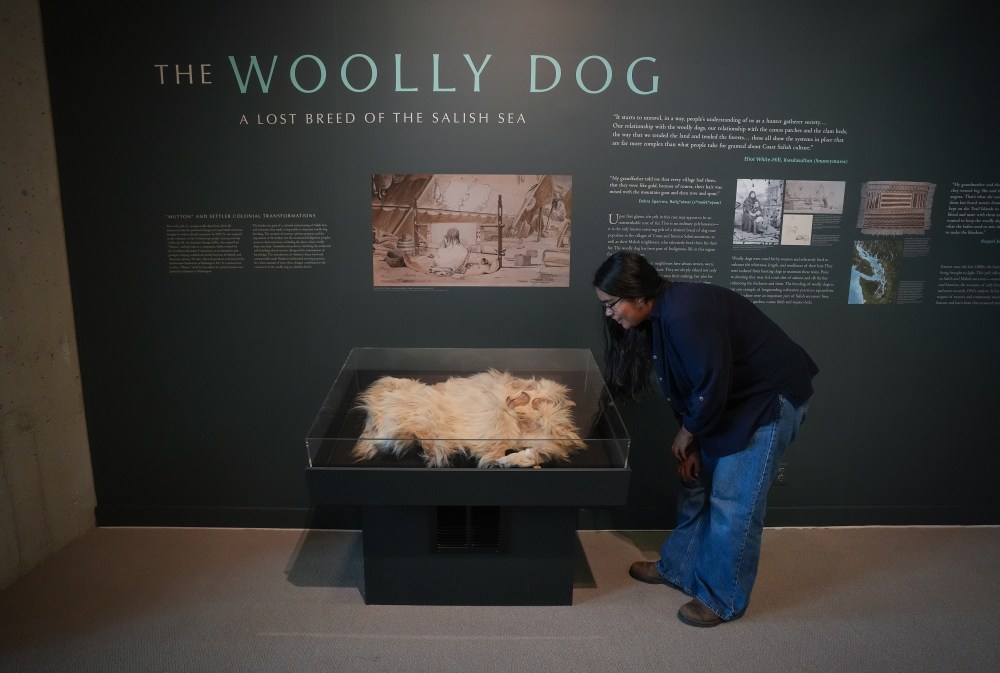
Atheana Picha, a member of the Kwantlen First Nation who is a weaver, views the pelt of a distinct breed of woolly dog that was once raised by Coast and Interior Salish peoples, while posing for a photograph at the Museum of Anthropology at the University of British Columbia, in Vancouver, on Friday, Sept. 4, 2026. THE CANADIAN PRESS/Darryl Dyck

“We had a lot of community members from different nations that were here this morning to visit with this pelt, and you can feel the intensity in the room and the emotion of being able to reconnect with this species that was so important to our ancestors,” Wilson said. “People were sharing stories and sharing teachings.”

Wilson said early historical accounts from explorers and fur traders described woolly dogs being transported in canoes, sometimes 10 at a time.

“Just the fact of taking these dogs with them where they went, I think underscores their importance,” said Wilson.

Wilson said Mutton’s pelt reflects a species’ extinction, one of many profound impacts of settler colonialism.

“It also speaks to the lives of our ancestors, their relationship with the more-than-human world, and their teachings and knowledge that continue to be passed forward,” he said.

A number of factors contributed to the decline and eventual extinction of woolly dogs, Wilson said, including the dispossession of land from Indigenous Peoples and the potlatch ban, implemented by the Canadian government from 1885 to 1951, to force cultural assimilation. It had a major effect on the transmission of cultural practices and knowledge, said Wilson.

But he said even though woolly dogs no longer exist, the Indigenous cultures and values can still be carried on.

A statement from the University of B.C. said interest in woolly dogs is booming as Salish weaving experiences a resurgence, prompting researchers to study the textiles to understand the dogs’ role in Salish and Makah weaving traditions.

Picha said it was a beautiful experience to touch Mutton’s fur.
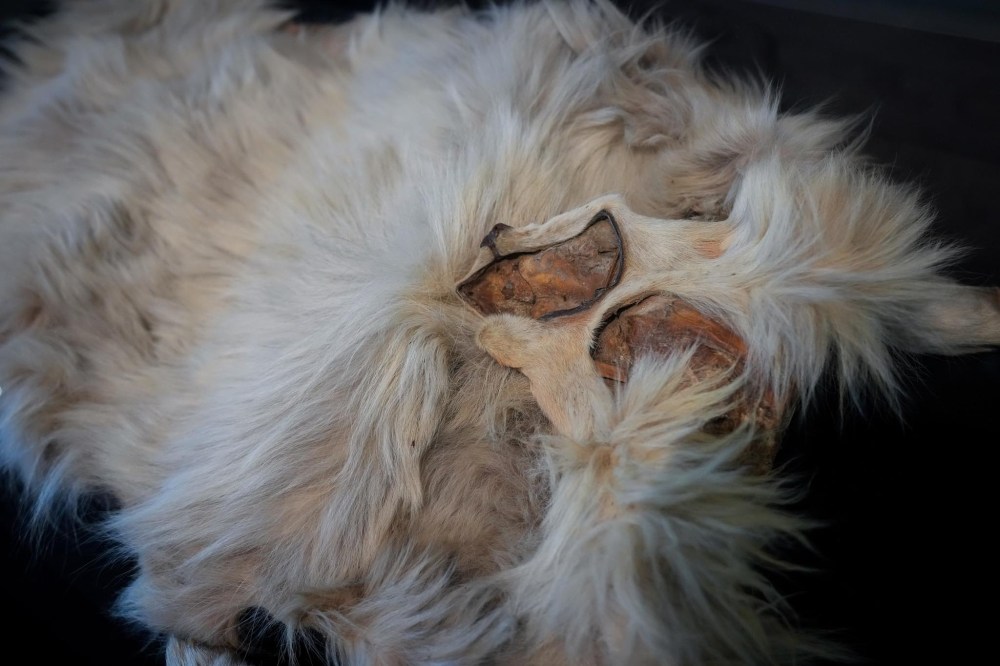
The pelt of a distinct breed of woolly dog that was once raised by Coast and Interior Salish peoples is displayed at the Museum of Anthropology at the University of British Columbia, in Vancouver, on Friday, Sept. 4, 2026. THE CANADIAN PRESS/Darryl Dyck

“Very honestly, the first thing I thought was, ‘Oh, it’s bigger than I imagined.’ But then I think about when it’s wrapped around the body of a dog, it would be a cute little thing,” said Picha.

She said the fur felt a little brittle, given its age, but even through a glove she could feel it was soft, “a little bit squishy … It was nice.”

Picha said she had heard stories from her parents and grandparents about the important role in their community played by woolly dogs, which were tended “very carefully.”

“We nourished them with a very specific diet (consisting of salmon and elk) so that their hair would get long and smooth and soft. And I think about how much care and love was put into these dogs, but how much they also gave to us,” she said.

This report by The Canadian Press was first published Sept. 8, 2026.

Report Error Submit a Tip

More Stories

Khan should’ve taken high road: Goertzen

Carol Sanders 5 minute read Preview

Khan should’ve taken high road: Goertzen

Carol Sanders 5 minute read Yesterday at 6:39 PM CDT

The veteran Progressive Conservative who championed Obby Khan’s leadership bid says the former Blue Bomber dropped the ball by dissing his Tory teammates before he stepped down.

“I wouldn’t recommend it, and I didn’t recommend it,” Kelvin Goertzen (Steinbach) said in an interview Friday.

Khan resigned as PC leader and quit the caucus Monday saying some members were secretly plotting his ouster, even after he won a confidence vote on Sept. 25.

On Tuesday, Khan lashed out in a CJOB interview, naming the alleged plotters, saying constituents deserved to know which of their elected representatives “lacked moral integrity.” Khan told the Free Press he was “deeply emotionally hurt,” and felt stabbed in the back.

Read
Yesterday at 6:39 PM CDT

A day on the campaign trail: Winnipeg's mayor, seeking a second term, does double duty

Malak Abas 12 minute read Preview

A day on the campaign trail: Winnipeg's mayor, seeking a second term, does double duty

Malak Abas 12 minute read Updated: Yesterday at 5:56 PM CDT

In the weeks leading up to the civic election, Scott Gillingham has been performing a juggling act: he’s running to be Winnipeg’s 45th mayor, while still serving as its 44th.

“If someone asks me about the campaign, I’m going to answer them. But I think for most people, I’m the mayor of Winnipeg, even if I’m showing up as a candidate,” Gillingham, 58, says. “I try to do all I can to maintain that distinction.”

The Free Press joined Gillingham on a recent rainy September Saturday on the campaign trail, where he served in both roles during an event-laden day. City council’s final meeting before the Oct. 28 election was days earlier.

In Winnipeg, it’s rare for an incumbent to be defeated. But Gillingham knows his win in 2022 wasn’t exactly a landslide — he won with 27.5 per cent of the vote — and he’s been thinking about his second term ever since.

Read
Updated: Yesterday at 5:56 PM CDT

Retired guidance counsellor defends explicit 2025 sex-ed presentation to high school football team in disciplinary hearing

Maggie Macintosh 7 minute read Preview

Retired guidance counsellor defends explicit 2025 sex-ed presentation to high school football team in disciplinary hearing

Maggie Macintosh 7 minute read Updated: Yesterday at 12:26 PM CDT

Gus Watanabe, a former employee of Oak Park High School in Winnipeg, was the subject of a public disciplinary hearing on Thursday.

Read
Updated: Yesterday at 12:26 PM CDT

Letters, Oct. 3

7 minute read 2:01 AM CDT

A morning in the life …

My very first lesson does not start when I walk into that lecture hall, oh no — it starts long before. It begins when I walk to my car, check the estimated arrival time to the University of Manitoba and hope that Winnipeg traffic agrees with it.

A drive that appears completely manageable changes almost immediately when I’m greeted by a tsunami of orange pylons and a line of cars that appears to go on forever. Traffic moves by the inch, lanes magically disappear and the detour I took yesterday now has a detour of its own. These factors make me do a calculation that I have become all too familiar with. How late can I arrive and still find parking, run to my class across campus and get to class with enough time left to make it worth it?

I have grown used to people saying, “Why not just leave earlier?” I do. But when I’m already leaving for my 8:30 a.m. class at 7 a.m., there’s only so much I can do. This drive that some would think is relaxing is one that feels like an assignment that I didn’t know I had to complete and is due at 8:30 a.m.

A spiritual vision will help anchor a health civic outlook

John Longhurst 5 minute read 2:01 AM CDT

We have an election coming up. With that in mind, the Free Press asked some of their columnists to write about the challenges ahead and how the city can become better.

For Tom Brodbeck, the main challenge is finances — and how candidates will pay for their many promises for fixing roads, improving public safety and making transit better.

Rebecca Chambers said that the concerns of inner-city residents need to be taken seriously by those who aspire to work at city hall.

Niigaan Sinclair said the most pressing issue in Winnipeg isn’t construction projects, light-rail transit, public safety, taxes or social services. For him, it’s the city’s relationship with Indigenous people.

Dynacare workers provide essential services that must be maintained during strike, labour board rules

Nicole Buffie 5 minute read Preview

Dynacare workers provide essential services that must be maintained during strike, labour board rules

Nicole Buffie 5 minute read Thursday, Oct. 1, 2026

The Manitoba Labour Board has ruled Dynacare workers are essential employees and their services must be maintained during a labour dispute.

Read
Thursday, Oct. 1, 2026