Élections Québec asked government to change French-language laws in 2023
Advertisement
Read this article for free:
or
Already have an account? Log in here »
To continue reading, please subscribe:

Digital Subscription
One year of digital access for only $205*
- Enjoy unlimited reading on winnipegfreepress.com
- Read the E-Edition, our digital replica newspaper
- Access News Break, our award-winning app
- Play interactive puzzles
*First annual payment billed as $205.00 + GST for one year. This annual subscription will automatically renew at $233.00 + GST every 52 weeks (10% off the regular annual price of $259.35). Offer available to new and qualified returning subscribers only. Cancel any time.
To continue reading, please subscribe:
Add Free Press access to your Brandon Sun subscription for only an additional
$1 for the first 4 weeks*
- Enjoy unlimited reading on winnipegfreepress.com
- Read the E-Edition, our digital replica newspaper
- Access News Break, our award-winning app
- Play interactive puzzles
*Your next Brandon Sun subscription payment will increase by $1.00 and you will be charged $17.95 plus GST for four weeks. After four weeks, your payment will increase to $24.95 plus GST every four weeks.
Read unlimited articles for free today:
or
Already have an account? Log in here »
MONTREAL – Élections Québec knew it would not be allowed to send voter information in English over a year before the election campaign, The Canadian Press has learned.
The provincial election authority had tried to pressure the government to amend its language legislation — and even provided proposed wording of an amendment — but the government refused, according to correspondence sent between April 2023 and June 2025 and released through an access to information request.
On Wednesday, a Quebec Superior Court judge suspended Quebec’s language legislation and ordered the agency to mail voting reminder cards in English and French.
The former head of an anglophone rights advocacy group, Geoffrey Chambers, triggered the ruling after taking the agency to court over the unilingual mailouts.
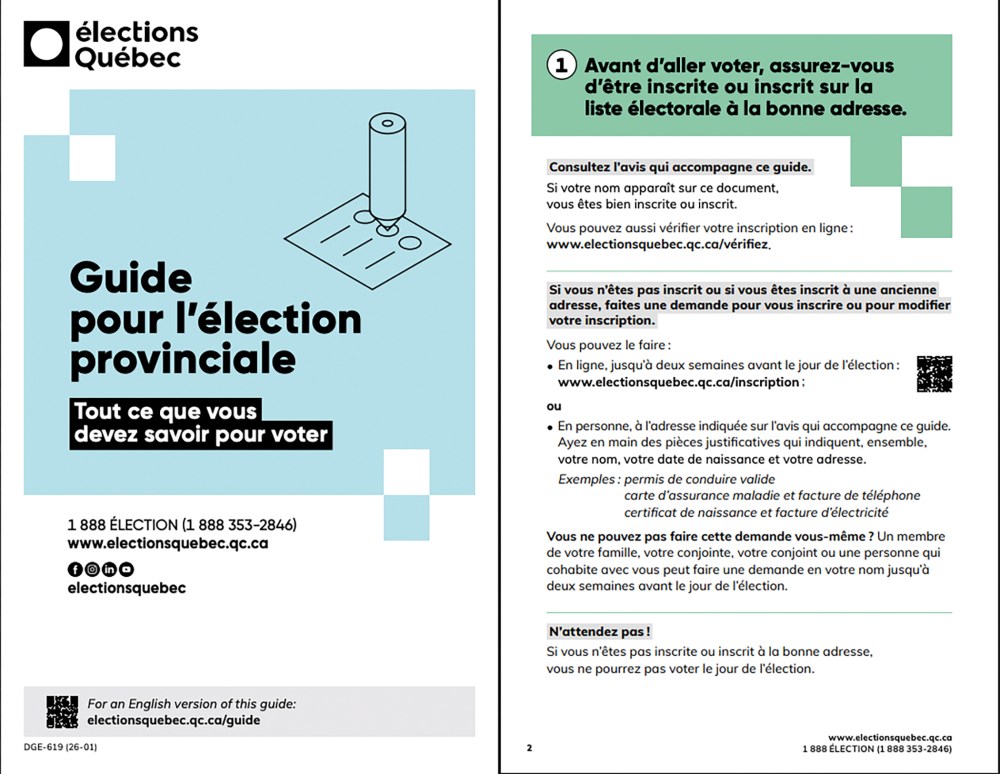
The agency sent out the unilingual voter documents earlier this month. It was the first year in its history that it didn’t send out bilingual information by mail, but said it did this to comply with 2022 language legislation making French the sole language of communication for public institutions.
Justice Sylvain Lussier’s ruling temporarily suspended those provisions of the Charter of the French Language.
The ruling reflects concerns raised in writing by the director of Élections Québec, Jean-François Blanchet, in April 2023. At the time, he wrote to Quebec’s language commissioner and suggested the updated law could encroach on Charter rights and the agency’s core mission.
Over two years, Élections Québec, the commissioner and staffers from the provincial department responsible for the French language pursued correspondence and meetings to discuss the matter, without resolving it.
In the courtroom last week, Henrick Lavoie, the lawyer representing Élections Québec, confirmed the agency would be able to send out a voter reminder card in English since it planned to print these cards when candidate lists were finalized after 2 p.m. on Sept. 17.
Here is a timeline of the conversations that led to the case.
April 6, 2023:
About a month after Benoît Dubreuil became Quebec’s French-language commissioner in March 2023, Blanchet sent him an email requesting a meeting. In his letter dated April 6, 2023, Blanchet wrote that Élections Québec was working to ensure it met its responsibilities under the Charter of the French language.
“This work raises questions that we would like to discuss, particularly in light of our institution’s mission, which is to ensure that all voters can exercise their right to vote,” wrote Blanchet.
Dubreuil’s assistant wrote back that same day to organize a meeting to brief Blanchet on the latest guidelines.
Subsequent correspondence indicates there were at least two meetings held in May, with Dubreuil and the heads of various government institutions, including Blanchet, in attendance.
June 15, 2023:
Dubreuil suggested those who attended those meetings name a representative to form a committee to discuss the implementation of the Charter of the French language in their institutions.
The law says the commissioner of the French language “must support and assist the parliamentary institutions to which the state’s language policy applies in fulfilling their obligations,” wrote Dubreuil.
According to his agenda, the committee would also discuss possible exceptions to the rules.
Blanchet happily agreed and reiterated his concerns surrounding the right to vote and the right to representation.
“How can we reconcile the application of the provisions of the Charter of the French language while ensuring that citizens can fully exercise their rights to vote or run for office?” he wrote.
Aug. 30, 2023:
While discussions were underway, a byelection was scheduled for Oct. 2, 2023, in the riding of Jean-Talon, located in Quebec City. Blanchet once again wrote to Dubreuil, telling him Élections Québec would use temporary provisions in the legislation that would allow it to mail bilingual documents.
“All voters must be able to understand the information they need to fully exercise those rights,” Blanchet wrote.
He added he hoped to discuss exempting Élections Québec from some provisions of the law to “balance the fulfilment of our mission with the provisions of the Charter of the French language” in the coming months.
Oct. 21, 2024:
An adviser for the commissioner emailed the members of the committee, reminding them that the ministry of the French language was seeking their input on draft regulations.
The ministry was looking to amend the language regulation for government agencies and so the commissioner had sent a form for them to fill out on Oct. 4.
Oct. 31, 2024:
Blanchet sent his form back to Dubreuil. The ministry redacted most of the content of the form, before releasing it to The Canadian Press in response to the access to information request.
But unredacted portions show that Blanchet requested the ministry permanently exempt the elections agency from its laws forcing it to communicate in French only. A temporary provision allowing it to send bilingual documents was set to expire in June 2025, but was later extended.
Blanchet suggested the ministry amend its regulation to allow government agencies to deviate from the Charter of the French language “to ensure respect for the right to vote and the right to run for office in a provincial, municipal, or school election or a referendum.”
Nov. 1, 2024:
Dubreuil forwarded Blanchet’s form to the ministry responsible for the French language.
Blanchet also requested a meeting with Jean-François Roberge, the minister of the French language. Later correspondence indicates Blanchet met with representatives of the ministry on March 11, 2025.
April 8, 2025:
Blanchet reached out to Roberge directly to discuss an update to language regulations that the government introduced a few weeks earlier. The modified regulations would not exempt Élections Québec from having to issue all communications in French only.
The temporary provisions allowing it to send bilingual documents expired in December 2025 — after the Montreal municipal election and before the 2026 provincial election.
In his email, Blanchet said he anticipated “significant consequences” that could affect Quebec’s democracy. He worried that anglophones and allophones may not show up at the ballot “because of the extra efforts and steps they would have to take” to obtain and understand crucial information.
“Encouraging the public to exercise their right to vote is already a challenge,” he wrote.
He added that there could be legal challenges regarding the validity of the election as a result.
June 26, 2025:
Blanchet received an answer from Roberge’s deputy ministers, saying he would not extend the temporary provisions allowing it to provide bilingual voter information. Those expired in December.
“Elections can no longer be conducted in both French and English, as was previously the case,” wrote deputy minister Nathaly Marcoux. “This is a decision made by the legislature.”
She said the government and Élections Québec would continue discussions to find solutions that would respect French-language legislation.
Jan. 30, 2026:

After a byelection was triggered in Chicoutimi, Élections Québec put out a news release saying that “for the first time, information documents for voters are available exclusively in French” due to requirements laid out in the Charter of the French language.
According to data from the 2021 census, less than one per cent of residents in the Saguenay region — which includes Chicoutimi — speak English at home.
Sept. 1, 2026:
Élections Québec announced it would mail out voter information for the general election in French only, and that those eligible to receive English education and Indigenous people could contact the agency for English information.
This report by The Canadian Press was first published Sept. 16, 2026.