‘It really does not feel like one country’: Emily St. John Mandel on living in a divided America
Advertisement
Read this article for free:
or
Already have an account? Log in here »
To continue reading, please subscribe:

Digital Subscription
One year of digital access for only $205*
- Enjoy unlimited reading on winnipegfreepress.com
- Read the E-Edition, our digital replica newspaper
- Access News Break, our award-winning app
- Play interactive puzzles
*First annual payment billed as $205.00 + GST for one year. This annual subscription will automatically renew at $233.00 + GST every 52 weeks (10% off the regular annual price of $259.35). Offer available to new and qualified returning subscribers only. Cancel any time.
To continue reading, please subscribe:
Add Free Press access to your Brandon Sun subscription for only an additional
$1 for the first 4 weeks*
- Enjoy unlimited reading on winnipegfreepress.com
- Read the E-Edition, our digital replica newspaper
- Access News Break, our award-winning app
- Play interactive puzzles
*Your next Brandon Sun subscription payment will increase by $1.00 and you will be charged $17.95 plus GST for four weeks. After four weeks, your payment will increase to $24.95 plus GST every four weeks.
Read unlimited articles for free today:
or
Already have an account? Log in here »
Canadian-American author Emily St. John Mandel has been hailed as a prognosticator since the onset of the COVID-19 pandemic, which some described as bearing an eerie similarity to her book “Station Eleven.”
The novel, which at that point was more than five years old, was about a pandemic that ravages the world. Her descriptions of societal collapse — from empty grocery store shelves to supply chain disruptions — had many of the hallmarks of the early lockdowns in March and April 2020.
It was that time period that inspired her latest novel, “Exit Party,” published earlier this month by HarperCollins, Mandel said on a video call from New York City.
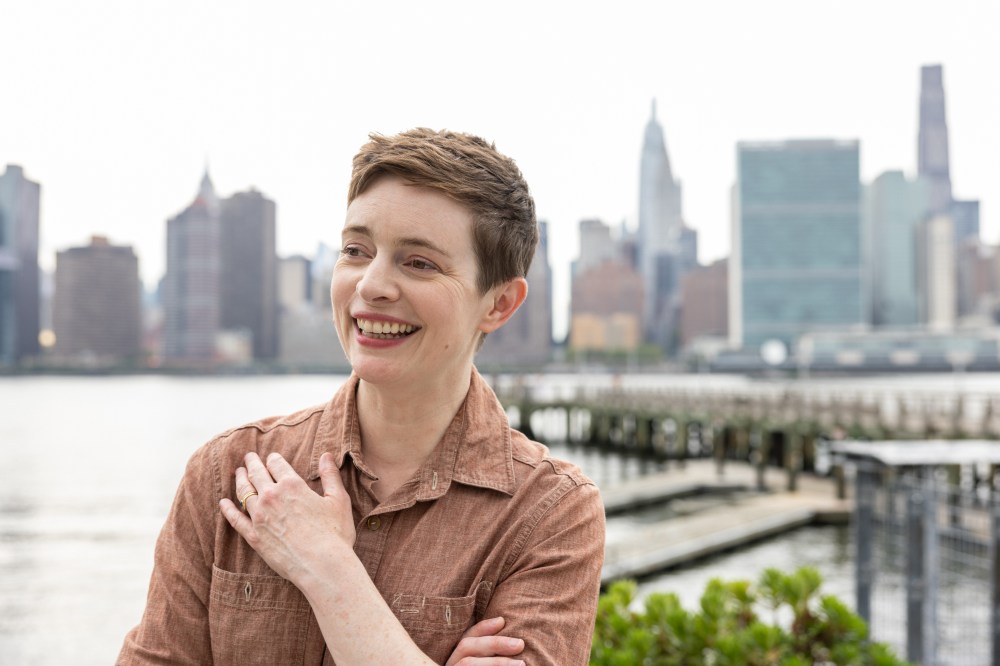
The book is about characters who cross into parallel universes, and the two versions of the United States that exist in each world. Split into two sections — an “A Side” and a “B Side” — the novel explores how people cope in the aftermath of collapse.
Already, she said, she’s seeing shades of that collapse play out in the United States. She found herself trying to “stay ahead of the news cycle” as she wrote the book.
Last month, St. John Mandel spoke to CP about how the current political climate in the United States inspired the novel.
The Canadian Press: There are two kinds of collapse in the book — in one universe, the United States breaks apart; in the other, it is crushed. Where did that duality come from?
Mandel: Way back at the beginning of the COVID-19 pandemic … there was initially a real lack of availability of PPE, personal protective equipment. It was incredibly hard to get a mask. The New York Times was publishing sewing patterns, which is so dystopian, for how to sew your own masks since you could not buy them in stores.
Part of the problem was that there was of course a total vacuum of leadership at the federal level in the United States, so a number of northeastern American states banded together to get better PPE deals from international vendors. This sounds kind of wonkish and boring, but stay with me for a second. It was this consortium of states. They’re contiguous on a map. New York state, New Jersey, Connecticut, Massachusetts, I want to say Rhode Island, (and Pennsylvania and Delaware), all these little states down here.
I remember looking at a map and looking at this band of contiguous states, this defined territory, banding together toward a common goal — ideologically different from the neighbouring states — and thinking, huh, this kind of looks like a country. That was when I began really thinking about what a fracturing might look like down here.
There’s such a deep philosophical division at this point in the U.S. And I think in fairness, a lot of it comes down to very successful disinformation campaigns over the years, but it really does not feel like one country. It feels like two countries with not just different ideologies and different approaches to common problems, but this feeling that we live in two separate realities with completely different sets of facts.
When I started writing the book I was working through my anxieties around this, my political anxieties, extrapolating our current situation forward by a few years and then I guess there was comfort in thinking, well, what if we’d been through the worst and now we’re in the aftermath? That’s why the novel is set in the immediate aftermath of a civil war, not in the thick of it.
By the time I finished the book, I felt like I was struggling to stay ahead of the news cycle on the B side, the authoritarian state, where if you look at what happened in Los Angeles and Minneapolis and what’s still happening, the condition of civilians being disappeared by masked government agents is no longer fictional in the United States. That literally happens. So it’s begun to feel lately like we’ve kind of got both. It’s a very dark moment. And I do sometimes fear that we’re headed toward elements of both the dystopias here.
This is going to sound like a stretch after everything I just said. But I do think of it as being a hopeful book. People are retaining their humanity and their resilience in incredibly difficult times. And we have seen that too. The way people have stood up to ICE in places like Minneapolis has been extraordinary and incredibly brave. So there is a lot of hope in all the darkness here.
CP: Tell me more about the hope, and what that can look like for people.
Mandel: The question posed in the book is who will you be at the end of the world? And I don’t mean to suggest that the collapse of a given country is the end to the world. I do mean to suggests that it can feel that way. So who will you be at end of world? And one of the characters, Kareem, his response to that for himself is, well, I tried to be a good parent. I tried to be a good friend. It’s the little actions. It’s getting your kids to school with brushed hair and a lunch, and being there for your friends when they need you. These little human moments I think are where the hope can lie.
CP: Art is another throughline in your work, and it shows up in this book too. Tell me about that.
Mandel: This goes back to ideas that I really got deep into in “Station Eleven” years and years ago and they’ve stayed with me. I think that art is incredibly important. Just reminding us that there is more than mere survival, that there’s more than just food, water, shelter, and a modicum of physical safety; that we do as a species aspire to something a little bit more elevated than that. And that’s why we have art and why we have sports. We don’t have to contain it just to art, but why we do those things that can feel quite extraneous to the basics of being alive. But I think that they’re actually essential. They remind us of our humanity rather, in extremely difficult times.
CP: You’re a dual citizen. You were born and raised in Canada, but you’ve lived in the United States for a long time. Does that change your perception of what’s happening in the United States right now, or do a lot of Americans share your perception?
Mandel: I think it’s a bit of both. I think that there’s a popular misconception in Canada that all Americans are incredibly patriotic and believe that we’re living in the best country in the world. We don’t. For the last year, or maybe even two at this point, something that’s really changed is that every time I get together with American friends, the conversation turns to the exit strategy.
People are literally talking in terms of “I hear it’s still possible to get a work visa for Portugal.” That’s how people are thinking. Per the Wall Street Journal in 2025, America had net negative migration. People are leaving. I think that the people I know, the people that I surround myself with, who I think are very representative of probably half the population, we can see what’s going on. We know exactly how much trouble we’re in. We’re trying to get out. That’s a very common sentiment. I think my fears and my pessimism don’t make me particularly unique. At the same time, I think growing up in another country gives you a kind of distance where it can be easier to see a country from the outside. So I think both those things are true.
This interview was edited for length and clarity.
This report by The Canadian Press was first published Sept. 29, 2026.