How the Smithsonian is using AI to connect artifacts from the American Revolution
Advertisement
Read this article for free:
or
Already have an account? Log in here »
To continue reading, please subscribe:

Digital Subscription
One year of digital access for only $205*
- Enjoy unlimited reading on winnipegfreepress.com
- Read the E-Edition, our digital replica newspaper
- Access News Break, our award-winning app
- Play interactive puzzles
*First annual payment billed as $205.00 + GST for one year. This annual subscription will automatically renew at $233.00 + GST every 52 weeks (10% off the regular annual price of $259.35). Offer available to new and qualified returning subscribers only. Cancel any time.
To continue reading, please subscribe:
Add Free Press access to your Brandon Sun subscription for only an additional
$1 for the first 4 weeks*
- Enjoy unlimited reading on winnipegfreepress.com
- Read the E-Edition, our digital replica newspaper
- Access News Break, our award-winning app
- Play interactive puzzles
*Your next Brandon Sun subscription payment will increase by $1.00 and you will be charged $17.95 plus GST for four weeks. After four weeks, your payment will increase to $24.95 plus GST every four weeks.
Read unlimited articles for free today:
or
Already have an account? Log in here »
WASHINGTON (AP) — The distance in the march from the American Revolution to the age of artificial intelligence is almost beyond comprehension. But leaders of the Smithsonian Institution are using AI to bridge the divide.
As the United States celebrates its 250th anniversary of independence, Smithsonian leaders are turning to AI to better understand items in its collection tied to the fight that led to the country’s founding.
The goal is to allow the public and scholars to both search the institution’s collection and draw connections across the Smithsonian and other organizations, such as the Library of Congress, to gain a deeper sense of how communities formed and functioned at the nation’s birth.
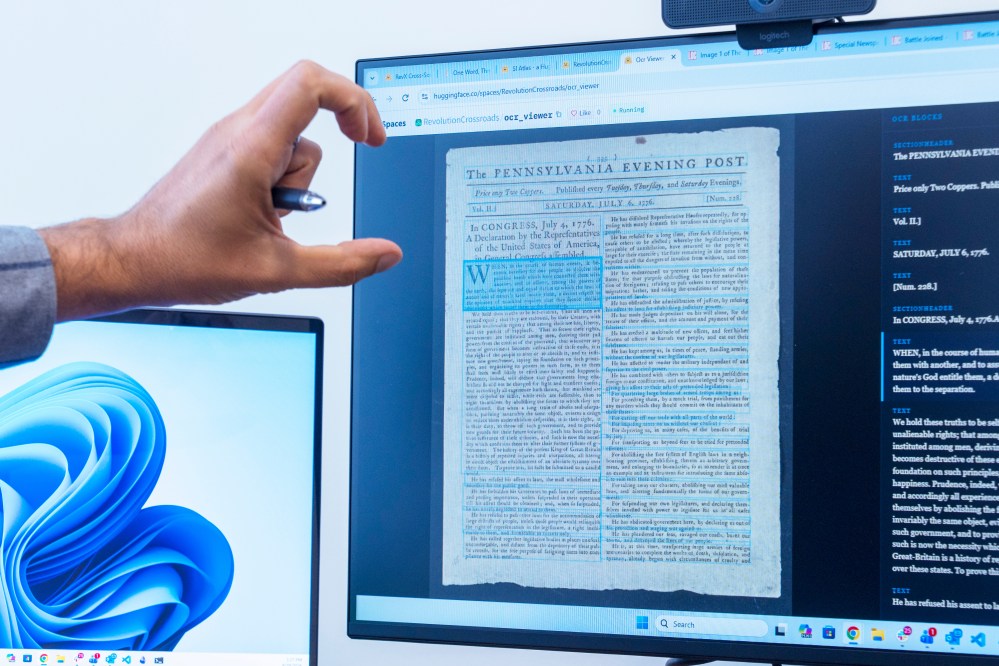
Since researchers on the project, known as Revolution Crossroads, began applying AI models in the spring, they have quickly drawn links that would have previously required extensive manual searches across multiple catalogs. They located, for instance, a silversmith who was running newspaper advertisements for a creamer around 1774, similar to one held at the Smithsonian’s National Museum of American History.
The ultimate ambition is to scour records and surface new stories about people whose lives have faded away over the centuries.
“An ideal scenario is that we get to a place where we’re actually adding to the public record,” said Becky Kobberod, the chief digital and innovation officer at the Smithsonian. “Maybe they’re not Thomas Jefferson or George Washington, but they did live in a community and build that community, and that name is now known.”
Since its founding in 1846, the Smithsonian has curated the nation’s history and culture across an operation that now spans 21 museums and galleries, including the National Zoo. It’s a role that’s taken on new significance as Republican President Donald Trump has questioned some of the institution’s portrayals.
Kobberod’s team has identified about 10,000 objects centered on people who lived during the 40-year period from 1770 to 1810. They have had to digitize — and in some cases redigitize — the objects to make them more accessible to AI. The public can search the records online.
For Natalie Buda Smith, the director of digital strategy at the Library of Congress, the project is a reminder that these institutions are deeply engaged in rapidly evolving technology. This work, she said, can help people researching materials who don’t know whether to begin at the Smithsonian, the Library of Congress or somewhere else.
The creamer example “illustrates that there’s a richness out there and you might find part of the story at the Smithsonian and part of the story at the library,” she said. “Open up those doors to people so they can understand, because they found it in the Smithsonian doesn’t mean it’s the end of the story.”
The work is unfolding at a sensitive time in the debate over how to properly harness AI. Some of the industry’s top leaders have issued increasingly dire warnings about the technology’s potential harm. Many were in Washington this week, where they met with Trump and signed a voluntary accord for reviews. Democrats and some Republicans are calling for a more robust response, including stronger regulation of AI.
Kobberod, the first person to hold her role at the Smithsonian, acknowledged a “healthy fear” of AI. She said the Smithsonian is not using any of the current frontier models that have received much of the scrutiny in recent weeks. She also emphasized the importance of human oversight in the research, noting that trained historians review the data and can recognize nuance that would be lost on an AI agent.
“What they might say is, ‘actually that is a known nickname for so-and-so’ or ‘that is a generic term that’s used for X, Y, Z,” she said. “That is the nuance that a historian or someone who’s spent their whole career studying that time period is going to know that a machine is not.”
Still, she said it is important to embrace the possibilities that surround AI.
“It’s not going away,” she said. “We do believe we need to lean in and figure out the part that this technology plays in our work.”