Who’s afraid of a 6-hour documentary about exiled Russian journalists?

Advertisement

Advertise with us

Julia Loktev’s new documentary begins almost like a tense Hollywood spy thriller. The journalists she’s filming on her iPhone scramble to get out of Russia, many without a plan or lodging and with only a carry-on suitcase full of hastily packed things, hoping they’re not held up at the border.

Read this article for free:


or

Already have an account? Log in here »

To continue reading, please subscribe:

Subscribe and receive a limited-edition Free Press branded hat or tote.

Digital Subscription

One year of digital access for only $205*

  • Enjoy unlimited reading on winnipegfreepress.com
  • Read the E-Edition, our digital replica newspaper
  • Access News Break, our award-winning app
  • Play interactive puzzles

*First annual payment billed as $205.00 + GST for one year. This annual subscription will automatically renew at $233.00 + GST every 52 weeks (10% off the regular annual price of $259.35). Offer available to new and qualified returning subscribers only. Cancel any time.

To continue reading, please subscribe:

Add Free Press access to your Brandon Sun subscription for only an additional

$1 for the first 4 weeks*

  • Enjoy unlimited reading on winnipegfreepress.com
  • Read the E-Edition, our digital replica newspaper
  • Access News Break, our award-winning app
  • Play interactive puzzles
Start now

*Your next Brandon Sun subscription payment will increase by $1.00 and you will be charged $17.95 plus GST for four weeks. After four weeks, your payment will increase to $24.95 plus GST every four weeks.

Julia Loktev’s new documentary begins almost like a tense Hollywood spy thriller. The journalists she’s filming on her iPhone scramble to get out of Russia, many without a plan or lodging and with only a carry-on suitcase full of hastily packed things, hoping they’re not held up at the border.

At nearly six hours, “My Undesirable Friends: Part II — Exile,” which opens in select theaters this weekend, is the second half of Loktev’s portrait of Russian journalists and the culmination of a five-year project. It began with Loktev filming a group of independent journalists in Moscow in the fall of 2021 as Vladimir Putin was starting to declare some reporters “foreign agents.”

Four months later, the situation changed dramatically: Russia launched a full-scale invasion of Ukraine and many journalists fled the country on only a few hours’ notice. Loktev kept filming, following her subjects as they reported on the war in exile.
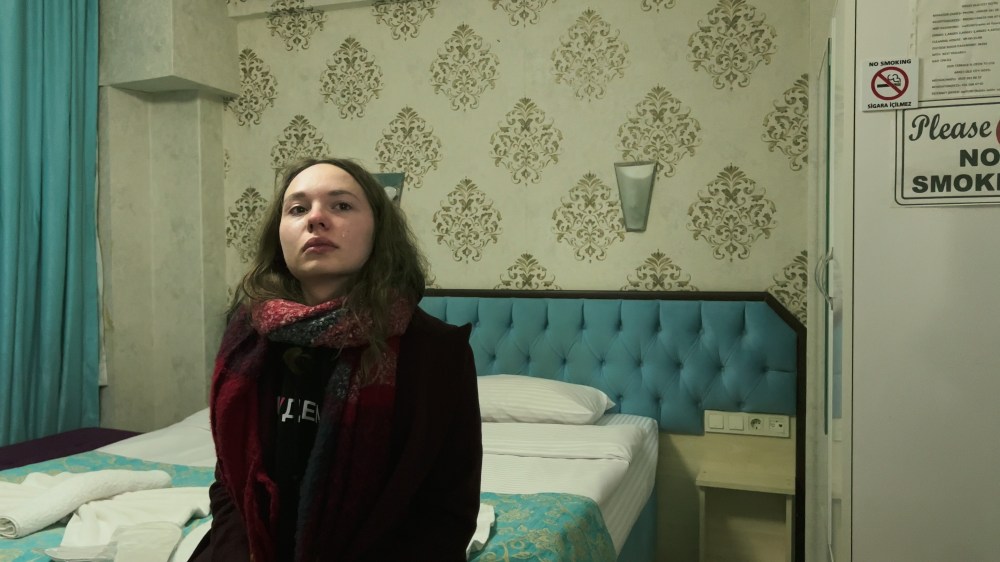
Valeria Ratnikova appears in a scene from
Valeria Ratnikova appears in a scene from "My Undesirable Friends: Part II - Exile." (Julia Loktev via AP)

“People hear, they’re like, ‘Oh my god a six-hour film about journalists? That’s really scary.’ But it’s actually not,” Loktev told The Associated Press in a recent interview. “It’s kind of a hangout film. It’s a friendly film.”

The film is long, but it’s not a slog

In the attention economy, a nearly six-hour documentary about anything might sound like a hard sell. Loktev knows this.

She went through it with the first film, “My Undesirable Friends: Part I — Last Air in Moscow,” which was shortlisted for an Oscar nomination and is currently streaming on MUBI. That documentary — a portrait of journalists working in a society on the verge of shutting down all press freedoms — is nearly 5 1/2 hours long.

Now she is doing it again, and neither time with the help of a traditional theatrical distributor. A publicist even recently told her that she’s hearing that people don’t want to watch it because they’re “kind of tired about hearing about press freedoms and authoritarianism.”

“I’m like, that’s really interesting, because authoritarianism isn’t tired of them,” Loktev said.

But the thing about the “My Undesirable Friends” movies is that somehow, despite the heavy subject matter, the sprawling runtime and the many characters, they don’t feel like homework. You also don’t need to see “Part I” to dip into “Part II.”

The main reason is that her subjects, most of whom are in their 20s and 30s, are so engaging and relatable despite being in extraordinary circumstances. It’s also why she didn’t tire of filming them.

“This is a film about very ordinary people who are just trying to do something good in an awful time,” Loktev said. “The film is so much about perseverance and how do you keep telling the story when attention moves away? … How you maintain optimism, or at least enough optimism, to get up the next morning and do your job?”

Since 2021, Russian authorities have labeled dozens of outlets and journalists as “foreign agents” — a designation aimed at discrediting them that also prevents them from selling advertising. They have also outlawed and imprisoned journalists. Many outlets have moved their newsrooms abroad since the first weeks of the war in Ukraine and are accessible in Russia via virtual private networks, or VPNs.

Loktev speaks Russian and filmed her subjects on an iPhone

Loktev was born in the former Soviet Union in 1969 and immigrated to the U.S. with her family when she was 9 years old. She continued speaking Russian with her mother, which made it easier to parachute into this world. Her entry point was Anna Nemzer, who worked for the independent television news network TV Rain.

Loktev filmed everyone with her iPhone, which helped her almost disappear into the background. Part II had her traversing European countries constantly as everyone had dispersed.

After the invasion, Loktev left Russia a little later than her subjects: She wanted to make sure she had uploaded her footage to the cloud before attempting to exit the country with her tourist visa. She’d been warned that when an official is looking at a passport a little longer than usual and says that the “computer is hanging” that it means “they’re checking you out.”

Julia Loktev poses for a portrait on Tuesday, Sept. 22, 2026, in New York. (Photo by Andy Kropa/Invision/AP)

“I was standing there … at the airport in Moscow and I’m like, ‘Is there an issue?’ and they’re like, ‘No, no our computer’s just hanging,’” she said. “It was hanging for a good 20 minutes. I tried not to pee my pants.”

The fantasy of making a ‘Part III’

Several of the subjects, including Nemzer, joined Loktev at the Venice Film Festival for the film’s world premiere. Many still work as journalists from afar. But one switches focus midway through the second film: Peter Ruzavin, a former Russian journalist who is married to a Ukrainian journalist, decided to enlist in the Ukrainian army. He said he realized that although his journalism was showing reality, it wasn’t changing it.

“We need not to run away from Putin. We need to fight him,” Ruzavin, who has served in the Ukrainian army for over two years, said in Venice. “That’s why I made my decision. I left the best work. I miss it every day.”

In the past few days, Loktev has seen some interesting headlines about her film, like one in The Daily Beast that reads “Vladimir Putin’s ‘War Crimes’ Exposed in Shocking New Film.” While hers is not an exposé on war crimes, it is a reminder, she said, of what the journalists in the film are trying to do when everyone else’s attention has shifted.

“I think that’s something that we’re struggling with now in a way with the film, I’ll be honest, is that everybody moves on to the next thing,” Loktev said. “But the last thing hasn’t changed.”

The fantasy, she said, would be to make a “Part III” — “if ever the political situation in Russia changes.”

“But I think we might be very old by then.”

___

Associated Press reporter Dasha Litvinova in Tallinn, Estonia, contributed to this story.
Report Error Submit a Tip

More Stories

A Rocky day on the mayoral campaign trail for Kevin Klein

Malak Abas 12 minute read Preview

A Rocky day on the mayoral campaign trail for Kevin Klein

Malak Abas 12 minute read 12:00 PM CDT

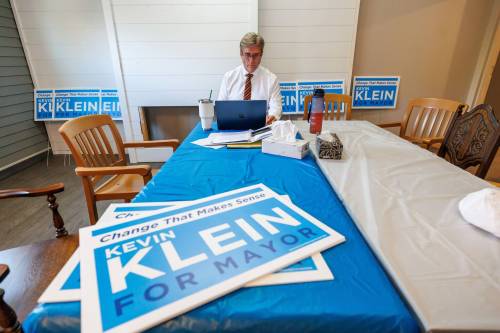
Kevin Klein acknowledges it’s hard to foresee what he’ll wake up to each morning in the final weeks of a mayoral campaign.

But the seasoned politician, who has served as both a city councillor and a provincial cabinet minister, couldn’t have predicted the events — what he describes as “drama” — that unfolded last Sunday. Fellow mayoral candidate Mike Vogiatzakis accused Klein’s campaign team of offering him a job to drop out of the race, while a guest writer’s column in the Winnipeg Sun that questioned the deaths of Indigenous children at residential schools, just days after the National Day for Truth and Reconciliation, sparked condemnation from a prominent Indigenous organization. (Klein is the CEO of the Klein Group, the company that owns the Sun. He has maintained he is not involved in its operations while running for mayor.)

The Free Press had already been scheduled to join Klein on the campaign trail Monday, intending to document a day in the life of the front-running candidate to unseat incumbent Scott Gillingham, before the controversies hit.

The allegations and criticisms were weighing heavily on Klein when the Free Press arrived at his campaign office and he spent much of the day addressing them. He denied Vogiatzakis’s allegations and said his rival’s team had offered him a similar bribe. He vowed the controversial column would never have been published if he was still holding a position at the Sun, placing the responsibility on his wife, Sun editor-in-chief Heather Klein, and later apologizing to the Southern Chiefs’ Organization.

Read
12:00 PM CDT

Longtime voice of the Blue and Gold marks major milestone

David Sanderson 8 minute read Preview

Longtime voice of the Blue and Gold marks major milestone

David Sanderson 8 minute read 12:52 PM CDT

Bob McGregor made his debut as the Winnipeg Blue Bombers’ public-address announcer on June 7, 1997, during a pre-season game at Winnipeg Stadium between the hometown Blue Bombers and their western rivals, the Calgary Stampeders.

McGregor will be behind the microphone again this Saturday, detailing the action on the field in addition to leading a boisterous Princess Auto Stadium crowd through what has become his signature call, “And that is another Winnipeg Blue Bombers first down!”

The Bombers’ final home date of the 2026 regular season will mark a major milestone for McGregor, and the former newscaster feels it’s only fitting the same two teams as 10,717 days ago — the Bombers and Stampeders — will be the ones butting helmets.

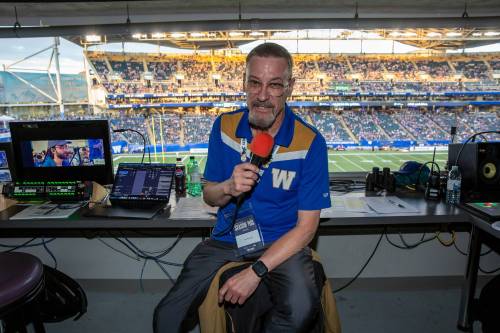
“I knew at the start of the season I was closing in on 300 games as the PA guy, only it wasn’t until I went through the schedule that I realized my 300th would be Winnipeg-Calgary, which struck me as kind of cool,” McGregor says, seated in a St. James breakfast nook, dressed in dark trousers and a blue-and-gold Blue Bombers golf shirt.

Read
12:52 PM CDT

Can’t cut your way to being a better city

Molly McCracken 5 minute read 2:00 AM CDT

The powers that be in Winnipeg have pushed for cheap property taxes for decades. As a result, the city doesn’t have enough money to balance the books, let alone maintain infrastructure, deliver services and respond to challenges like homelessness and the toxic drug crisis.

Winnipeg’s fiscal problem stems from decades of keeping property-tax increases below inflation and relying on inadequate revenues to fund a growing city. The result? Today, Winnipeg spends less money per person on city services than it did in 2001.

A look at the books at city hall is stark. Winnipeg has run a deficit almost every year since the COVID-19 pandemic because of climate-change-driven heavy ice and snowstorms, higher fuel costs and increased policing overtime. During this time, city council tried to cut and freeze public service spending where it could; as a result, community services have been cut to the bone.

Departments responsible for what makes a city a good place to live have been squeezed. Since 1999, community services — responsible for libraries, recreation, swimming lessons and aspects of Winnipeg’s poverty-reduction work — has 149 fewer staff positions, an 18 per cent reduction, even as the city’s population has grown 35 per cent, or by 220,000 people.

Nurses disciplined for botched IV infusion

Nicole Buffie 3 minute read Preview

Nurses disciplined for botched IV infusion

Nicole Buffie 3 minute read Updated: Yesterday at 4:36 PM CDT

Two nurses working at the Grace Hospital have been reprimanded and fined $2,500 each for an IV infusion gone bad and an attempted coverup.

The incident happened on November 23, 2023 when a nurse asked a colleague to set up an IV infusion on him in an unused operating room.

During the attempted IV start, the nurse lost consciousness. The nurse who attempted the IV drip and another who was in the room called for help and several staff responded.

The nurse regained consciousness and vomited, but recovered and continued to work his shift, a March 18 decision by the College of Registered Nurses of Manitoba says.

Read
Updated: Yesterday at 4:36 PM CDT

PCs renew calls for CFS inquiry

Carol Sanders 6 minute read Preview

PCs renew calls for CFS inquiry

Carol Sanders 6 minute read Updated: Yesterday at 7:54 PM CDT

The Progressive Conservatives renewed calls to put Manitoba’s child and welfare system under the microscope Thursday, tabling a motion that urged the province to appoint a commissioner to lead a public inquiry.

Families critic Jodie Byram’s opposition day motion, which was ultimately defeated by the NDP majority, reiterated demands for an inquiry into the systemic failures of Child and Family Services, more than 20 years after the death of Phoenix Sinclair first prompted demands for answers.

“We have seen far too many children die under the care of CFS, and we need to determine where the gaps are in the system in order to make the system a safer place for children,” Byram told reporters before the motion was defeated in the legislature.

Families Minister Nahanni Fontaine said in an interview that her department, CFS agencies and authorities are “doing good work” and won’t call an inquiry.

Read
Updated: Yesterday at 7:54 PM CDT

Canadian author Anne Carson wins literature Nobel for ‘bold and inventive’ works that blend genres

Jill Lawless, Hillel Italie And Kostya Manenkov, The Associated Press 6 minute read Preview

Canadian author Anne Carson wins literature Nobel for ‘bold and inventive’ works that blend genres

Jill Lawless, Hillel Italie And Kostya Manenkov, The Associated Press 6 minute read Updated: Yesterday at 5:05 PM CDT

STOCKHOLM (AP) — Canadian poet, essayist and translator Anne Carson won the Nobel Prize in literature Thursday for “bold and inventive” works that fuse the classical and the modern and blur the boundaries of poetry and prose.

The Toronto-born Carson, 76, has drawn on themes from classical Greek and Roman literature, modern influences and personal experience for genre-blending titles that have ranged from translations of ancient Greek poets to collaborations with dancers and musicians, including Laurie Anderson and Lou Reed.

The Swedish Academy that awards the prize said she won “for her bold and inventive oeuvre that, in playful dialogue with the classical tradition, has created new forms for contemporary literature.”

The permanent secretary of the academy said the author was in Iceland “listening to the wind” when the panel reached her to notify her of the honor.

Read
Updated: Yesterday at 5:05 PM CDT