Get back to the source of cinematic comparison
Advertisement
Read this article for free:
or
Already have an account? Log in here »
To continue reading, please subscribe:

Digital Subscription
One year of digital access for only $205*
- Enjoy unlimited reading on winnipegfreepress.com
- Read the E-Edition, our digital replica newspaper
- Access News Break, our award-winning app
- Play interactive puzzles
*First annual payment billed as $205.00 + GST for one year. This annual subscription will automatically renew at $233.00 + GST every 52 weeks (10% off the regular annual price of $259.35). Offer available to new and qualified returning subscribers only. Cancel any time.
To continue reading, please subscribe:
Add Free Press access to your Brandon Sun subscription for only an additional
$1 for the first 4 weeks*
- Enjoy unlimited reading on winnipegfreepress.com
- Read the E-Edition, our digital replica newspaper
- Access News Break, our award-winning app
- Play interactive puzzles
*Your next Brandon Sun subscription payment will increase by $1.00 and you will be charged $17.95 plus GST for four weeks. After four weeks, your payment will increase to $24.95 plus GST every four weeks.
Read unlimited articles for free today:
or
Already have an account? Log in here »
Hey there, time traveller!
This article was published 05/12/2020 (2124 days ago), so information in it may no longer be current.
David Fincher’s Mank (now on Netflix) explores the creative origins of Citizen Kane, the 1941 drama directed by Orson Welles and co-scripted by the titular character, Herman “Mank” Mankiewicz (Gary Oldman).
If you’re planning on watching Mank and you’ve never seen Citizen Kane, here are a few reasons to make it a double-bill. (Citizen Kane is, unfortunately, not on Netflix but is available to purchase on various streaming services).
● IT’S THE CITIZEN KANE OF CITIZEN KANE MOVIES: The iconic and hugely influential Citizen Kane is regularly used as a marker for other films, as in “Night of the Living Dead is the Citizen Kane of zombie movies,” or “Babe is the Citizen Kane of talking animal movies.”
Sometimes it’s brought in for comic contrast, as in “Sharknado is the Citizen Kane of ‘killer sharks getting swept up in tornadoes and dropped on Los Angeles’ movies.”
Why not get right back to the source of all these cinematic comparisons?
● DON’T WATCH IT BECAUSE IT’S ‘THE GREAT AMERICAN MOVIE’: Citizen Kane’s long-running championship status can make it seem imposing and unapproachable. (It spent five decades in the top slot on the influential Sight & Sound best films list before getting knocked off by Vertigo a few years back.)
Billing Citizen Kane as The Greatest Movie Ever Made is maybe the least useful way to talk about it, and probably the least effective way to get people to watch it.
Forget the massive build-up: The best way to approach Citizen Kane is as a supremely entertaining movie experience.
● IT IS PRETTY GREAT, THOUGH: The film follows Charles Foster Kane (played by Welles) from his beginnings as an ambitious young newspaper magnate to his ending as a reclusive old man, surrounded by luxury but utterly alone.
It’s a cautionary tale about power and wealth — such poor substitutes for love — and a very American story about idealism gone astray. It’s also a character study of one complicated man, with the film presenting him through multiple viewpoints but never presuming to sum him up.
The story sounds simple: Kane’s mysterious dying word (“Rosebud…”) sends a dogged reporter on a hunt for what that might mean. The execution is complex, however, as the narrative circles around itself, moving back and forth through accounts from Kane’s business associates, lovers, friends and enemies. (The Rosebud issue ends up being a spoiler-alert-style twist before that was even a thing.)
Citizen Kane’s look is a film nerd’s wish-list of inventive montages, deep-focus shots, velvety light-dark contrasts, and a roving, moving camera that loves odd angles and impossible vantage points.
Style and substance fuse into a rich, complex tone. Even though the film examines the melancholy themes of time, age and regret, it’s packed with energy and verve and sheer delight in its own cinematic possibilities. And it can be funny, too, with lots of wisecracking, cynical dialogue and clever visual jokes.
● IT’S TOPICAL: It may have been made in 1941, but Citizen Kane still has a lot to say.
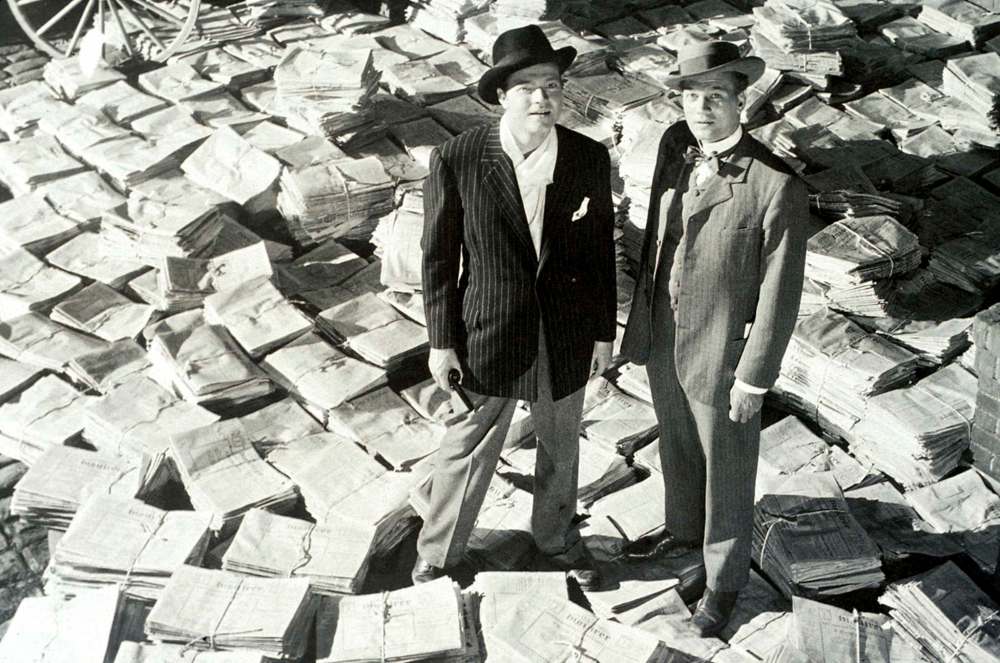
The character of Charles Foster Kane was based on the real-life media mogul William Randolph Hearst, but plenty of public figures with Kane-type qualities have come along since.
Take this suddenly timely sequence: Craving the adoration of crowds, Kane runs for governor of New York as a big-talking populist. On election night, his tame newspapermen make up two possible front pages. The first proclaims “Kane Elected.” But as it becomes clear their boss has lost his election bid, they turn to the second option: “Fraud at Polls!”

Does that sound like anyone we know?
● IT WILL MAKE WATCHING MANK MORE FUN: As a filmmaker, Fincher (Zodiac, The Social Network, Gone Girl, the Netflix series Mindhunter) has often relied on Wellesian touches — the man loves his tracking shots. But in Mank he gets even more specific, referencing the style of Citizen Kane with knowing camera angles and chiaroscuro lighting, all shot in gorgeous, retro black and white.
Citizen Kane is about a larger-than-life legend and the truth that lies behind that image. The film took on its own myths — about genius and hubris and the creative process — and film fans have been disputing the underlying facts ever since. Did Citizen Kane spring full-blown, brilliant and new from the head of 25-year-old wunderkind Welles, or is it the product of a collaborative process, one deeply indebted to the cinema that came before? These questions have been much discussed, feuded and fussed over, and Mank looks to be a controversial addition to the ongoing debate.
Mank is a commentary and an homage and a bridge between Old Hollywood and whatever it is we’ve got going on now. Welles was lured by the RKO studio with the promise of complete creative control, and he made Citizen Kane. Fincher got one of those big Netflix cheques to do a passion project, and he produced Mank.
So, is Mank the Citizen Kane of movies about Citizen Kane? Watch them both and decide.