Photos capture fleeting moments, long love

Advertisement
Read this article for free:
or
Already have an account? Log in here »
To continue reading, please subscribe:
Digital Subscription
One year of digital access for only $1.44 a week*
- Enjoy unlimited reading on winnipegfreepress.com
- Read the E-Edition, our digital replica newspaper
- Access News Break, our award-winning app
- Play interactive puzzles
*Billed as $5.77 plus GST every four weeks. After 52 weeks, price increases to the regular rate of $19.95 plus GST every four weeks. Offer available to new and qualified returning subscribers only. Cancel any time.
To continue reading, please subscribe:
Add Free Press access to your Brandon Sun subscription for only an additional
$1 for the first 4 weeks*
- Enjoy unlimited reading on winnipegfreepress.com
- Read the E-Edition, our digital replica newspaper
- Access News Break, our award-winning app
- Play interactive puzzles
*Your next Brandon Sun subscription payment will increase by $1.00 and you will be charged $17.95 plus GST for four weeks. After four weeks, your payment will increase to $24.95 plus GST every four weeks.
Read unlimited articles for free today:
or
Already have an account? Log in here »
Hey there, time traveller!
This article was published 12/08/2010 (5910 days ago), so information in it may no longer be current.
In this quietly revealing show at the University of Manitoba’s Gallery One One One, curator J.J. Kegan McFadden hits on the smart idea of channelling a wide-ranging retrospective of Larry Glawson’s art — 27 photographs from six distinct bodies of work — through one unifying subject.
Focusing on portraits of the Winnipeg artist’s longtime partner, Doug Melnyk, 27 x Doug becomes a comprehensive exploration of Glawson’s 27-year career, as well as a moving and meaningful photographic record of three decades of shared life.
Domesticity is a rare subject in contemporary art, and the domestic life of a gay couple is even rarer. The 56-year-old Glawson understands the everyday intimacies of potted plants on the mantel, an unfinished paint job on the walls, mussed blankets, old lawn chairs at the lake. A 1986 c-print, which depicts Melnyk wearing his father’s bathrobe, is a simple, powerful distillation of family bonds.
But while many of these scenes look familiar, this isn’t an average family photo album. (There’s that gorilla suit, for one thing, a remnant of a collaboration involving Glawson, Melnyk, and Jack and Sheila Butler.) Glawson has an eye for the small, significant detail, the suspended moment, the unexpected setup that gently nudges the ordinary toward something rich and strange.
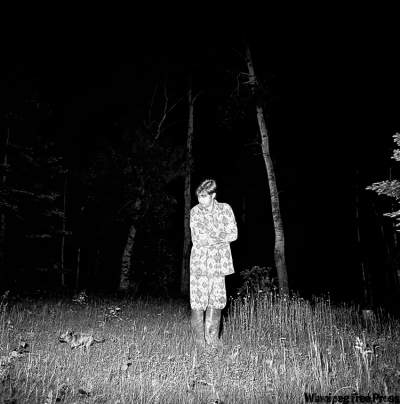
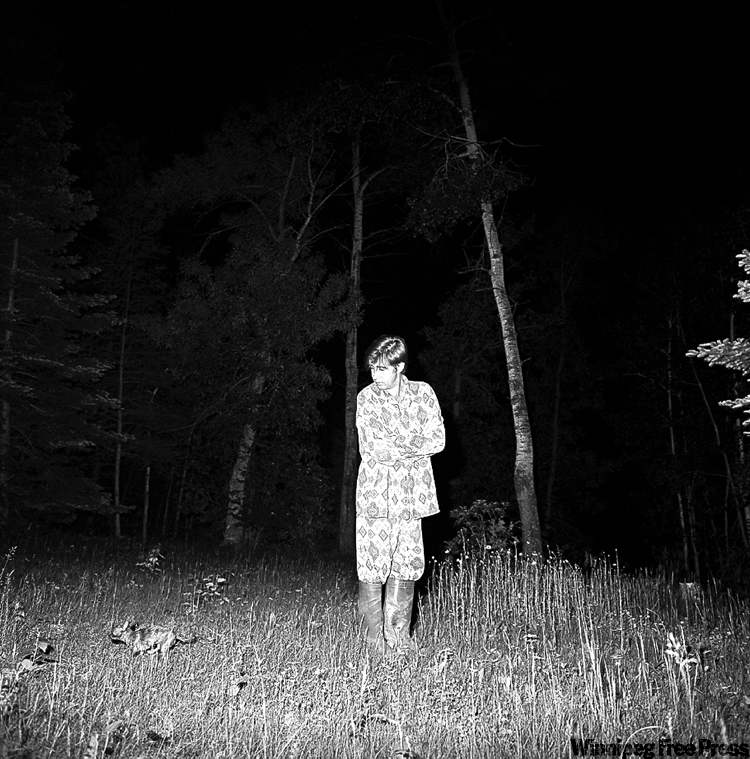
Take a black-and-white shot from 1993. Melnyk’s pyjamas-and-boots combo, a slightly guilty-looking chihuahua and a nocturnal outdoor setting add up to a scene that any dog owner will immediately recognize as a nighttime bathroom break. But something about the spatial relations among the tiny dog, the silvery grass and the looming night transform this mundane chore, giving it an aura that is half comic and half eerie.
November 30 1989, sheet 4#14, sheet 1#17 is a paired portrait of Glawson and Melnyk. They seem to be standing together, but were shot at different times in the same apartment corner, the two photos then joined. The barely perceptible breaks between the images suggest the complex emotional negotiations of a long relationship, as well as the trickiness of photographic representation.
While acting as a personal narrative, the exhibition also offers a condensed history of recent photographic technologies. Glawson shifts from old-school black and white to punchy, large-scale chromogenic prints to digital formats. Untitled (Doug sleeping), from 2002, is composed of video stills; a video projection that moves over the subject, directing and concentrating the viewer’s attention, was added in 2010.
Glawson’s work is marked by a patient and intelligent testing of the limits of photographic information. He parses the line between close observation and voyeurism, and questions the mysterious ways people use photographs to project identities.
Taken together, the 27 images of Melnyk offer a delicate meditation on the way a single photograph arrests the passage of time, while a series of photographs can be a poignant comment on its inexorable passing. We first see Melnyk, an artist and writer, in a casual 1979 snapshot. He’s a heartbreakingly young kid with feathered hair and a hickey. Thirty-one years later, in an extraordinary large-scale work, he stands in his living room, buck-naked in the pose of a Michelangelo nude. It’s a frank portrait of middle age, at once defiant and vulnerable.
— — —
Also on the city’s August arts calendar: At Freud’s Bathhouse and Diner, a group show, I Know What My Weaknesses Are, Probably Better Than You Do, which includes dark drawings of violence from Rhode Island’s William Schaff and drawings, posters, graphic works and zines from Beth Frey, Ryan Trudeau and more; and at Golden City Fine Arts, a beautifully complementary two-person show, Tenten…Kropki…Dots, featuring bright, happy, organic abstractions by Takashi Iwasaki (some painted, some embroidered) and glowing, gorgeous dot paintings by Ewa Tarsia.

alison.gillmor@freepress.mb.ca
ART REVIEW
27 x Doug: Portraits
Larry Glawson
Gallery One One One, until Sept. 17
Studying at the University of Winnipeg and later Toronto’s York University, Alison Gillmor planned to become an art historian. She ended up catching the journalism bug when she started as visual arts reviewer at the Winnipeg Free Press in 1992.
Our newsroom depends on a growing audience of readers to power our journalism. If you are not a paid reader, please consider becoming a subscriber.
Our newsroom depends on its audience of readers to power our journalism. Thank you for your support.
Studying at the University of Winnipeg and later Toronto’s York University, Alison Gillmor planned to become an art historian. She ended up catching the journalism bug when she started as visual arts reviewer at the Winnipeg Free Press in 1992.
Our newsroom depends on a growing audience of readers to power our journalism. If you are not a paid reader, please consider becoming a subscriber.
Our newsroom depends on its audience of readers to power our journalism. Thank you for your support.
Advertisement Advertise With Us
Advertisement Advertise With Us