

Up from the deep
Artifacts salvaged from the wreck of Titanic take viewers on an emotional journey
Advertisement
Read this article for free:
or
Already have an account? Log in here »
To continue reading, please subscribe:
Monthly Digital Subscription
$1 per week for 24 weeks*
- Enjoy unlimited reading on winnipegfreepress.com
- Read the E-Edition, our digital replica newspaper
- Access News Break, our award-winning app
- Play interactive puzzles
*Billed as $4.00 plus GST every four weeks. After 24 weeks, price increases to the regular rate of $19.95 plus GST every four weeks. Offer available to new and qualified returning subscribers only. Cancel any time.
Monthly Digital Subscription
$4.99/week*
- Enjoy unlimited reading on winnipegfreepress.com
- Read the E-Edition, our digital replica newspaper
- Access News Break, our award-winning app
- Play interactive puzzles
*Billed as $19.95 plus GST every four weeks. Cancel any time.
To continue reading, please subscribe:
Add Free Press access to your Brandon Sun subscription for only an additional
$1 for the first 4 weeks*
*Your next subscription payment will increase by $1.00 and you will be charged $16.99 plus GST for four weeks. After four weeks, your payment will increase to $23.99 plus GST every four weeks.
Read unlimited articles for free today:
or
Already have an account? Log in here »
Hey there, time traveller!
This article was published 05/02/2011 (5536 days ago), so information in it may no longer be current.
ON that cold April night 99 years ago when the “unsinkable” Titanic struck an iceberg and began to descend, what would it have been like to be on board?
Would you have shrugged off the threat of a shipwreck, and ultimately jumped overboard in despair? Would you have been first into a lifeboat?
Or would you have shown the calm resignation of tennis player R. Norris Williams and his father? They thought it was too chilly to remain on deck as the ship sank, so they went to the gym to ride the exercise bikes.
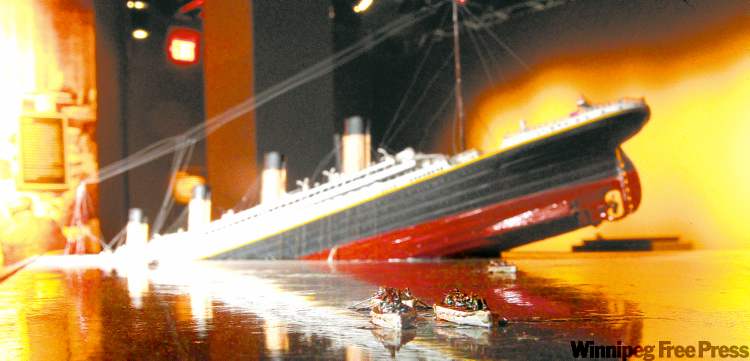
Titanic: The Artifact Exhibition, which opens Friday at the MTS Centre Exhibition Hall (the former A&B Sound building) and runs to June 12, is an “experiential” show that engages visitors’ imaginations by assigning them the identities of actual passengers.
As you enter, you receive a replica boarding pass that gives your name, age, travelling companions, and whether you are a first-, second- or third-class passenger on the 1912 maiden voyage (boarding passes of children who died are not used).
You then pass through seven galleries that use photographs, text panels, video, sound effects, music, historical recreations of first- and third-class cabins (the former luxurious, the latter with bunks) and about 200 salvaged artifacts to trace the haunting stories of Titanic.
The galleries’ themes are construction, departure, life on board, the boiler room (whose massive size is created with mirrors), the iceberg, the rescue, and the modern-day recovery expeditions.
Finally, you reach the memorial gallery, where you learn whether “you” were one of the 705 rescued or the 1,523 who perished. Some visitors find this so moving, they have to sit down on a bench to recover.
“People do get emotional,” says Katherine Seymour, vice-president of public relations for the show producer, RMS Titanic Inc.
The iceberg gallery includes a frozen “iceberg wall” that’s kept at the water temperature the night of the tragedy, -2 C. “We ask people to see how long they can leave their hands on the iceberg,” says Seymour. “Many of the passengers died of hypothermia (in the water). This is a way to relate.”
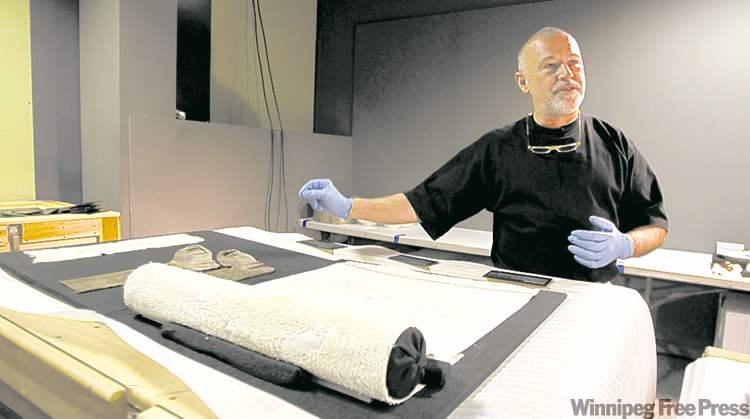
On Friday, textile conservator David Galusha offered a peek at some artifacts as they were prepared for installation. They reflect “every aspect of life on the ship,” he says, from a massive wrench to passengers’ amazingly intact shoes, clothing and toiletry items, dishes, a Champagne bottle still containing liquid, parts of luggage tags, plumbing fixtures and the armrest of an iron deck bench.
Nine recently conserved items are being shown for the first time in Winnipeg. They include paper items — four postcards, currency, a child’s arithmetic book — that were remarkably preserved inside leather satchels.
Winnipeggers will be the first in North America to see some of the clearest video footage yet from the wreck, captured last summer on a research mission.
The Atlanta-based RMS Titanic Inc. has had salvor-in-possession rights to the wreck site in the Atlantic Ocean since 1994. It has conducted eight expeditions and recovered more than 5,500 objects. The company says it removes objects only from the “debris field” on the ocean floor, not the ship itself.
Some scientists, Titanic survivors and ordinary citizens have condemned the salvage operation and the show. They regard the wreck site as a sacred resting place that should not be disturbed or exploited.
“We understand where they’re coming from,” Seymour says about those objections.
But RMS Titanic Inc. honours the victims with a sense of reverence, she says, and if the artifacts are not raised and conserved, they will deteriorate into oblivion. “We’re not going down there… treasure-hunting,” she says.
While large remnants such as parts of the ship are impressive, most visitors find the small artifacts most poignant, she says.
For example, there are tiny bottles found in the case of a travelling perfume salesman. “Not only did the vials stay intact through the sinking, not only did the labels on the vials stay intact, but the perfume stayed intact,” Seymour says. “When you come to the exhibition, the case they appear in has some holes in it, and the perfume is so potent that almost 100 years later, you can still smell it.
“A perfume vial is so small and so precious and so delicate. It’s hard to believe that through all the tragedy that happened that night, it was able to survive.”
alison.mayes@freepress.mb.ca