Shamans and savages
Local artist's new show combines aboriginal imagery with dark subject matter
Advertisement
Read this article for free:
or
Already have an account? Log in here »
To continue reading, please subscribe:

Digital Subscription
One year of digital access for only $205*
- Enjoy unlimited reading on winnipegfreepress.com
- Read the E-Edition, our digital replica newspaper
- Access News Break, our award-winning app
- Play interactive puzzles
*First annual payment billed as $205.00 + GST for one year. This annual subscription will automatically renew at $233.00 + GST every 52 weeks (10% off the regular annual price of $259.35). Offer available to new and qualified returning subscribers only. Cancel any time.
To continue reading, please subscribe:
Add Free Press access to your Brandon Sun subscription for only an additional
$1 for the first 4 weeks*
- Enjoy unlimited reading on winnipegfreepress.com
- Read the E-Edition, our digital replica newspaper
- Access News Break, our award-winning app
- Play interactive puzzles
*Your next Brandon Sun subscription payment will increase by $1.00 and you will be charged $17.95 plus GST for four weeks. After four weeks, your payment will increase to $24.95 plus GST every four weeks.
Read unlimited articles for free today:
or
Already have an account? Log in here »
Hey there, time traveller!
This article was published 15/12/2011 (5349 days ago), so information in it may no longer be current.
When Milos Milidrag was growing up near Sarajevo in the former Yugoslavia, kids weren’t allowed into the local cinema during the school year. Movies were thought to be a bad influence.
But by taking a job cleaning the theatre, the young Milidrag was able to position himself behind the screen. He watched many films that way, including The Savage Innocents, a 1960 picture starring Anthony Quinn as Inuk, an Inuit hunter.
The Winnipeg artist, now 61, was about 10 years old at the time. The adventure filmed in the Canadian Arctic made an indelible impression on him.
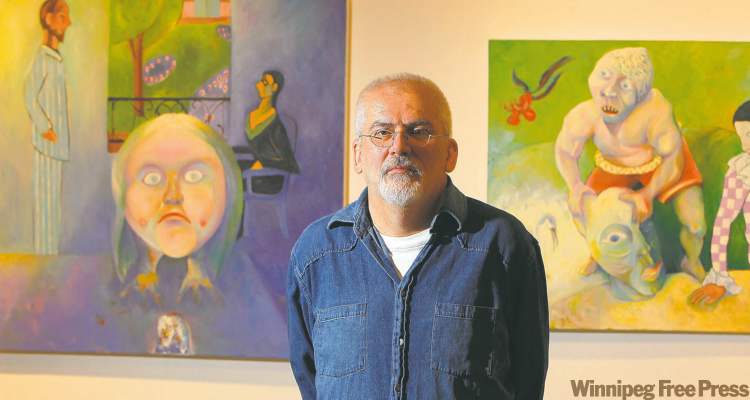
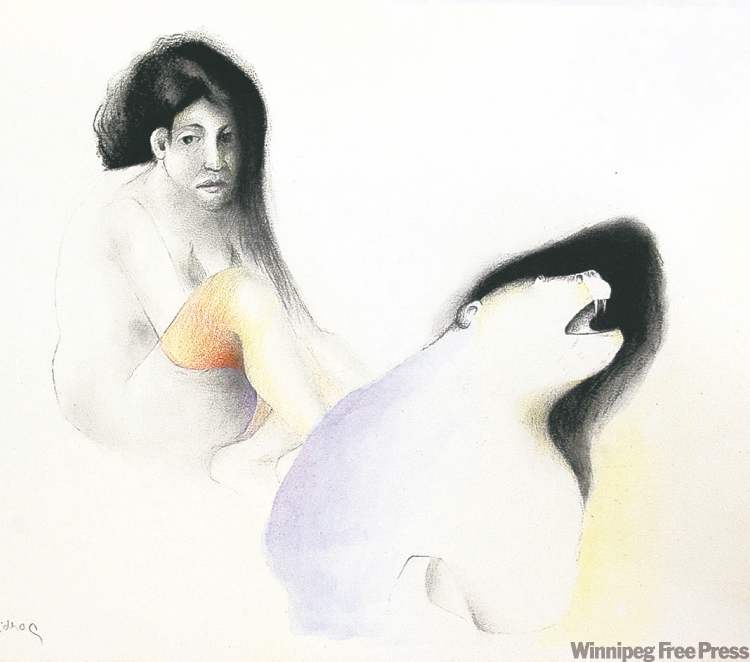
It may sound unlikely, but Lost in a Lost World (I Was Here), Milidrag’s current show at the Gurevich Fine Art gallery in the Exchange District, combines Inuit-style imagery — birds, fish, wolves, polar bears, sharp-toothed shaman figures that are part-animal, part-human — with “quotations” from 20th-century artists such as Picasso, Matisse and Mondrian.
“I’m mixing modern art and Inuit art and adding something of mine,” says the poetic, white-haired painter, who says about himself, “Every day when I look in the mirror, I see that I’m growing to look more like a polar bear.” The implication is that we’re all endangered.
Milidrag, a Serb who had a classical art education, was a respected abstract painter and art professor in Sarajevo. When civil war erupted in the 1990s, he witnessed horrific violence, lost cousins and friends to the conflict and realized that his teenage son would soon be drafted.
Milidrag, his wife and son applied to come to Canada as refugees. Their application in Belgrade happened to be handled by a former Winnipegger who told them the city had a vibrant arts scene. “He told us it will be the best place,” Milidrag recalls.
It wasn’t easy at first. Milidrag didn’t know a word of English when he arrived here in 1997. He toiled for six years as an apartment-building caretaker, haunted by the savagery in his homeland.
“I don’t like to speak about it,” he says. “Every time, the emotion is working hard on me.”
Milidrag had seen Sami (aboriginal) art from northern Norway during the 1984 Olympics in Sarajevo. About five years ago, he went to the Winnipeg Art Gallery seeking Canadian indigenous art. “I wasn’t only satisfied with the Group of Seven,” he says.
Darlene Coward Wight, curator of Inuit art, befriended him and took him into the WAG vaults. “Darlene opened for me a treasure,” he says. “I saw every single piece of Inuit art. She gave me books about Inuit history, legends and stories, and I found some similarities to legends I listened to when I was a child. It appealed to me so much.”
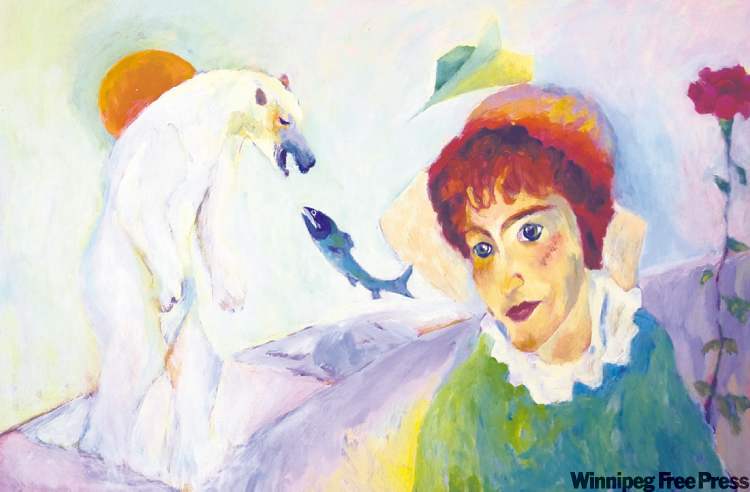
The prolific Milidrag, who has had a dozen Winnipeg solo shows, is now a full-time artist and private teacher with a studio in the Silpit Building. He has come to regard the artist as a kind of contemporary shaman.
For him, it’s a given that art addresses primal themes like “slaughter and sex” (on that note, he mentions his admiration for sex- and violence-prone movie director David Cronenberg).
Milidrag’s work has evolved from minimalism into depictions of the ominous, often disturbing “lost world” of his current show, which consists of drawings and paintings completed in the past two years. It’s a surreal, enigmatic universe of environmental destruction — many of his polar bears are screaming and the sun is often black — and implied suffering, especially for women.
In one painting, a woman drawn from a Picasso work holds a mirror up to a male “killer” carrying a big knife.
“After wartime in my country, I realized that women are stronger than men,” the artist says. “Men just talk about sports and drink. In a crisis, men just give up. But women are fighters…. They fight for life and save their lazy husbands.”
Many works include a downward-pointing paper airplane in the sky. In one, the plane pierces the eye of an aboriginal-style mask. Such planes are often made from newspapers, Milidrag says.
“Every day, (the media) bomb us, usually with bad things. There’s a very small amount of good news…. We think we have paradise, but we will lose it.”

There’s one large mixed-media installation in the show. It’s an abstracted human figure made of gaudily painted wood and found objects, with pieces of a shattered mirror stuck to it and small paintings where you’d expect the head to be.
Milidrag says it’s his version of an inukshuk, a human figure built out of rocks by Inuit people as a marker.
His inukshuk is an “ugly duckling” and if you look between its legs, you’ll see that it appears to have produced an egg.
“This is my sign: I was here,” Milidrag says about the figure. “A new life is gonna be born from that egg — if a predator doesn’t come.”
alison.mayes@freepress.mb.ca