They’re in pursuit of ideal love
But romance a bit off in comic classic
Advertisement
Read this article for free:
or
Already have an account? Log in here »
To continue reading, please subscribe:
Digital Subscription
One year of digital access for only $1.44 a week*
- Enjoy unlimited reading on winnipegfreepress.com
- Read the E-Edition, our digital replica newspaper
- Access News Break, our award-winning app
- Play interactive puzzles
*Billed as $5.77 plus GST every four weeks. After 52 weeks, price increases to the regular rate of $19.95 plus GST every four weeks. Offer available to new and qualified returning subscribers only. Cancel any time.
To continue reading, please subscribe:
Add Free Press access to your Brandon Sun subscription for only an additional
$1 for the first 4 weeks*
- Enjoy unlimited reading on winnipegfreepress.com
- Read the E-Edition, our digital replica newspaper
- Access News Break, our award-winning app
- Play interactive puzzles
*Your next Brandon Sun subscription payment will increase by $1.00 and you will be charged $17.95 plus GST for four weeks. After four weeks, your payment will increase to $24.95 plus GST every four weeks.
Read unlimited articles for free today:
or
Already have an account? Log in here »
Hey there, time traveller!
This article was published 23/01/2012 (5385 days ago), so information in it may no longer be current.
Few people now — and probably not many in 1894 when it was written — are aware George Bernard Shaw borrowed the title of Arms and the Man from the opening line of Virgil’s war-glorifying poem The Aeneid.
“Of arms and the man I sing,” begins the Roman scribe’s praise of military conflict which the pacifist Shaw saw as folly and so attacked England’s romanticizing war and hero worship in his comedic satire. Shaw’s first commercial success and most performed work also takes dead aim of those in blind pursuit of ideal love.
The University of Manitoba’s Black Hole Theatre revives Arms and the Man as part of Shawfest and reveals a playwright who can be as funny as incisive. The student cast, reinforced with graduates, takes a while to find its rhythm, as does the audience with Shaw’s farcical ambitions. All comes together in a satisfying final act where Shaw’s anti-hero, anti-romantic view of the world comes into sharp contrast.
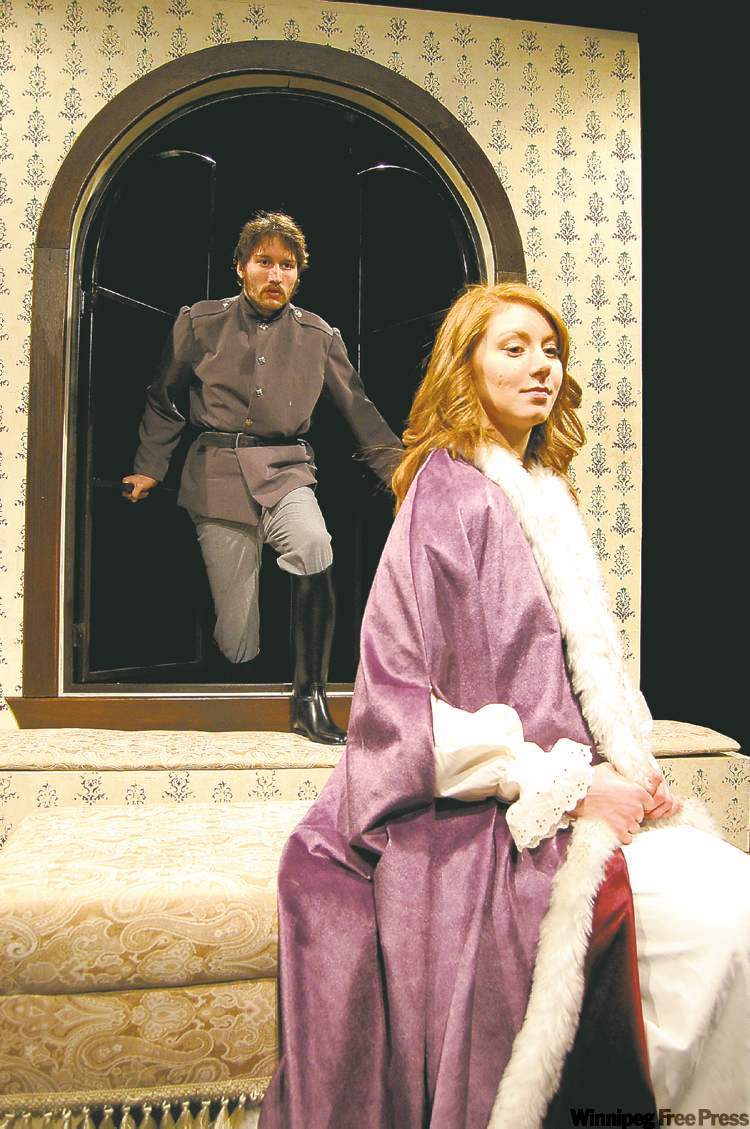
The Irish-born dramatist employs the rarely used setting of Bulgaria at war with Serbia in the mid-1880s to introduce the pretty young rich girl Raina (Kelly Jenken), who is staring out her bedroom window, dreaming about her sweetheart Sergius, who is away fighting. Her servant Louka (Sarah Jane Martin) brings news of Bulgaria’s victory led by the daring cavalry charge of Sergius (Brennan Hakes). Raina is over the moon, declaring it the happiest night of her life as she sighs, “My hero,” at his framed photo.
In through her window slips another picture of war. An enemy soldier on the run has climbed the outside wall and at gunpoint forces Raina to hide him from a Bulgarian officer who doesn’t notice the pistol lying on the ottoman or the fugitive’s legs sticking out the bottom of the curtains. Afterwards the two talk and it becomes obvious the soldier, a Swiss mercenary named Bluntschli (Stephen Currie), is no threat, especially after he lets on he carries chocolates rather than bullets. Raina feeds him sweets and dubs him her “chocolate cream soldier.”
Sergius arrives home to a hero’s welcome but Bluntschli has already told Raina his charge was pointless and mad. He only survived because the Serbs were given the wrong ammunition so they couldn’t shoot him, says Bluntschli. The officer cuts quite a dashing figure in his red serge army jacket and riding boots but internally he doesn’t feel the hero (“Everything I think is mocked by everything I do,” he says).
Raina and Sergius want to believe they are smitten but actually are in love with being in love. In reality, she is falling for the more un-dashing, practical Bluntschli while Sergius has got a thing for headstrong Louka, who is engaged to a servant but yearns to marry who she truly loves. The romantic manoeuvring is the least satisfying of the 105-minute production, directed with an otherwise competent hand by Margaret Groome. There is little chemistry or spark displayed between so-called lovers, so the audience must wait for the next Shavian potshot.
In the cast, Currie stands out in his underdog role, easily earning audience empathy for providing a more accurate portrayal of the futility of war. Hakes stands tall as Sergius, with his heroic posturing and arrogant demeanour. Jenken delivers an appealing earnestness as Raina but there is room for more fun. Among the supporting cast, Kane Makowski has his moments as Raina’s father.
Shaw wins this skirmish with Victorian ideals in Arms and the Man by exposing the artifice that still obscures the unfair realities of love and war today.
kevin.prokosh@freepress.mb.ca

Arms and the Man
Black Hole Theatre Company
To Jan. 29 at Gas Station Arts Centre
Tickets: $15, $12 for seniors/students
Three and a half stars out of five