No sparkle in workmanlike Candida
Advertisement
Read this article for free:
or
Already have an account? Log in here »
To continue reading, please subscribe:

Digital Subscription
One year of digital access for only $205*
- Enjoy unlimited reading on winnipegfreepress.com
- Read the E-Edition, our digital replica newspaper
- Access News Break, our award-winning app
- Play interactive puzzles
*First annual payment billed as $205.00 + GST for one year. This annual subscription will automatically renew at $233.00 + GST every 52 weeks (10% off the regular annual price of $259.35). Offer available to new and qualified returning subscribers only. Cancel any time.
To continue reading, please subscribe:
Add Free Press access to your Brandon Sun subscription for only an additional
$1 for the first 4 weeks*
- Enjoy unlimited reading on winnipegfreepress.com
- Read the E-Edition, our digital replica newspaper
- Access News Break, our award-winning app
- Play interactive puzzles
*Your next Brandon Sun subscription payment will increase by $1.00 and you will be charged $17.95 plus GST for four weeks. After four weeks, your payment will increase to $24.95 plus GST every four weeks.
Read unlimited articles for free today:
or
Already have an account? Log in here »
Hey there, time traveller!
This article was published 24/01/2012 (5365 days ago), so information in it may no longer be current.
Sparkling” is the adjective that’s always used to describe Candida, one of George Bernard Shaw’s early hits and an acknowledged classic.
An amateur company, the Tara Players, has made a valiant effort by mounting the 1894 drawing-room comedy about a threatened marriage.
But the ShawFest production at the Irish Club barely manages to glint with wit, let alone sparkle. At times it’s positively leaden. Still, if you can look past its shortcomings, it’s worth taking in as one of the key works in Shaw’s oeuvre.
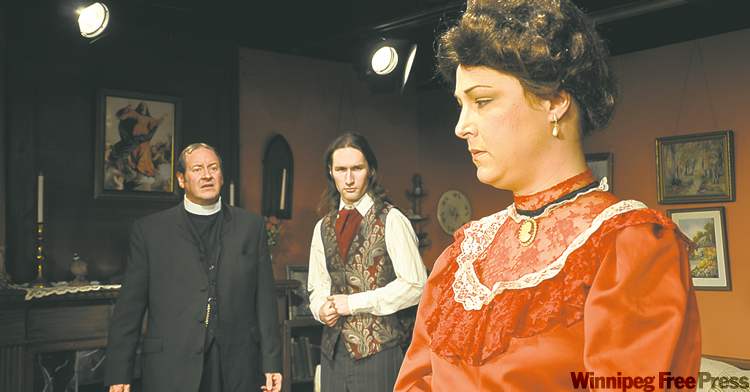
The Irish Club’s cosy 85-seat theatre is one of the festival’s most comfortable. And, as always, Shaw engages the intellect with biting commentary about gender roles, class privilege and religious, social and moral hypocrisy.
Candida, which runs two hours including intermission, makes for an interesting companion piece to Mrs. Warren’s Profession at the RMTC Warehouse. That show also has a six-actor cast and concerns itself with strong Victorian women, but manages to find much more comedy in the supporting characters.
The Irish-born Shaw was inspired to write Candida by Ibsen’s A Doll’s House, a landmark feminist work in which the self-sacrificing wife walks out at the end.
He may also have drawn on his own life. The playwright saw his own parents in a strange romantic triangle involving an artist interloper. His mother, a professional singer, fell for her voice coach and ultimately left his father for him.
The title character in Candida is a beautiful, devoted wife in her early 30s. She lives in a London suburb with James, her popular, workaholic clergyman husband, and their children.
Before the story opens, the 40-ish James has found Eugene Marchbanks, an awkward, moony 18-year-old poet (a role Marlon Brando played on Broadway in his early 20s), living on the riverbank and brought him home.
Candida soon dotes on the naïve aesthete. And the poet worships Candida, idealizing her as an angel and believing that James takes her for granted and doesn’t understand her soul.
When the weakling artist declares to James that he loves his wife, the self-satisfied pastor at first finds it laughable. But the situation escalates to a climax in which the two men — both deluded, ridiculous boys in their own ways — tell Candida she must choose between them.
The glaring weakness here is the casting of Craig Oliphant as the Christian Socialist reverend. James is intended to be a sympathetic character, despite being a preachy windbag. But Oliphant’s horribly stiff, stilted acting becomes an endurance test. He doesn’t even attempt an English accent, while the rest of the cast does.
Eric Rae, on the other hand, is well cast as Eugene and gets better as the show unfolds. Thin and pale, with long flowing hair, Rae has the ideal romantic look. While director Brendan Carruthers could have drawn more physicality and humour out of Rae, he captures the ardent passion of a sensitive boy who “can’t talk about indifferent things” and is infatuated with an older woman.
Eugene is insightful beyond his years. He picks up on truths that others don’t and gives voice to Shaw’s wish that people would be honest about how “we all go about looking for love.” Is he the serpent in the spouses’ Garden of Eden?
The standout in the three smaller roles, and the only actor who gets real laughs, is the delightful Pete Hudson as Candida’s factory-owner father, a mercenary rascal.
As the classy heroine, Cheryl Moore, burdened with a harshly unflattering hairstyle, captures Candida’s quiet wisdom, strength and compassion. The play is a tribute to the wives, mothers and sisters of Shaw’s era, who made their men look good by shielding them, propping them up and never letting them realize it was happening.
Candida’s final, truth-exposing speeches are riveting. “I make him the master here,” she says about her role in her husband’s power. It’s no wonder Victorian actors initially didn’t want to have their egos bruised by playing either the poet or the pastor.
alison.mayes@freepress.mb.ca
Theatre Review

Candida
Tara Players
To Sunday
Tickets $15 at 774-8272
Two and a half stars out of five