Costumes trump comedy in dated plays
Advertisement
Read this article for free:
or
Already have an account? Log in here »
To continue reading, please subscribe:

Digital Subscription
One year of digital access for only $205*
- Enjoy unlimited reading on winnipegfreepress.com
- Read the E-Edition, our digital replica newspaper
- Access News Break, our award-winning app
- Play interactive puzzles
*First annual payment billed as $205.00 + GST for one year. This annual subscription will automatically renew at $233.00 + GST every 52 weeks (10% off the regular annual price of $259.35). Offer available to new and qualified returning subscribers only. Cancel any time.
To continue reading, please subscribe:
Add Free Press access to your Brandon Sun subscription for only an additional
$1 for the first 4 weeks*
- Enjoy unlimited reading on winnipegfreepress.com
- Read the E-Edition, our digital replica newspaper
- Access News Break, our award-winning app
- Play interactive puzzles
*Your next Brandon Sun subscription payment will increase by $1.00 and you will be charged $17.95 plus GST for four weeks. After four weeks, your payment will increase to $24.95 plus GST every four weeks.
Read unlimited articles for free today:
or
Already have an account? Log in here »
Hey there, time traveller!
This article was published 28/01/2012 (5321 days ago), so information in it may no longer be current.
THE troupe’s name suggests an ultra-skimpy budget. But Winnipeg’s amateur Shoestring Players have mounted a Russian-flavoured comedic double bill for ShawFest in extravagantly beautiful period dress.
Set and costume designer Robert Butler, who does this as a hobby, apparently whipped up the opulent gowns and impressive military uniforms himself. The women in the first play, set in the imperial court of St. Petersburg in 1776, also wear stunningly elaborate wigs. The sets are full of rich fabrics and painterly touches.
At the end of the one-hour Great Catherine and the 25-minute Annajanska, the Bolshevik Empress, however, there’s a sense that it was an awful lot of effort for the sake of two obscure Shaw works that mainly come across as time-warped curiosities.
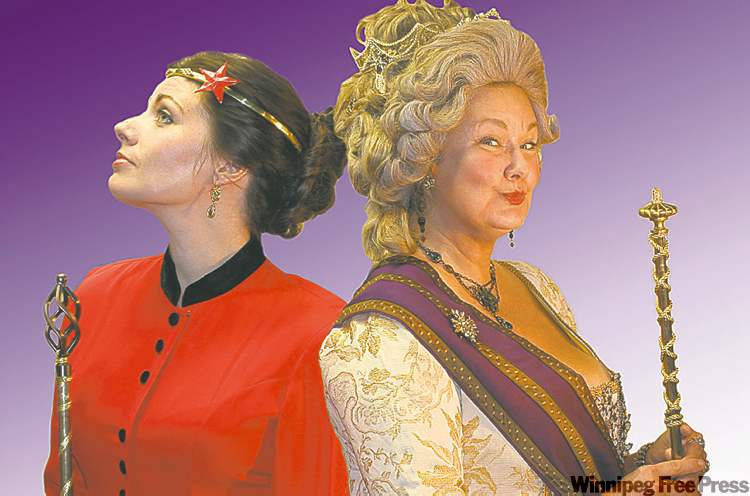
The plays are both silly farces, their tone reminiscent of Gilbert and Sullivan operettas.
The large-cast Great Catherine (1913), directed by Katherine McLennan, is by far the more entertaining of the two. It bases its broad humour in the exaggerated culture clash between the Russians, depicted as lusty near-barbarians, and the British, contrastingly uptight, protocol-obsessed and huffy.
The very proper Capt. Edstaston of the Light Dragoons (the terrific Bernard Boland) seeks an audience with Catherine the Great. But first he has to get past her buffoon adviser, Prince Patiomkin (Joe Stratton), a slovenly drunk. Stratton is the only cast member who lays on a thick Russian accent. His unfunny, boorish antics go on too long, giving the play a painfully slow start.
Thankfully, Rhonda Kennedy Rogers proves an outrageous delight as Empress Catherine II, a big, buxom, German-accented diva. Catherine wants to appear liberal, but routinely orders floggings and dispatches anyone who offends her to Siberia. When the British captain dares to snub her advances, she has him strung up, then tortures him by tickling him with her toes.
One imagines this was jolly hilarious to a 1913 audience. The interplay between the indignant “Just see here!” Boland and saucy Rogers does have delicious moments. But humour is often tied to its era, and the piece is dated to the point of being creaky. References to the writer Voltaire are meaningless to most of today’s viewers.
There’s an even greater gulf between a contemporary audience and Annajanska, the Bolshevik Empress, directed by Maureen Taggart. It’s a 1918 satire that Shaw wrote as a vehicle for a popular actress to take a brief star turn.
We’re in the midst of absurd revolutionary turmoil in 1917 “Beotia.” Gen. Strammfest (Jean-Marc Blanc) complains that he much preferred life under an imperial ruler who was “raised above us as a God,” but for self-preservation he has joined the prevailing Bolsheviks.
The Grand Duchess Annajanska, daughter of the deposed monarch whom the general worshipped so loyally, is delivered as a prisoner to Strammfest and a youthful lieutenant (Ian Scott). Far from wanting to return to her royal gilded cage, it seems the spunky “Comrade” Annajanska has embraced the revolution.

She shoots down all the general’s notions, calling him an idolator. “I was no goddess, but only a girl,” she says. “We royals . . . are mere flesh and blood.”
It’s mildly engaging to hear the socialist Shaw bandy about political ideologies and turn things topsy-turvy. But mostly, one is left wondering why this theatrically flimsy chestnut was pulled from the vaults.
The saving grace is Jennifer Gottwald’s sensational, professional-calibre performance as Annajanska. The petite, wonderfully expressive Gottwald is a firecracker in a gorgeous fur-trimmed green coat.
Butler, the costume wizard, has given her a Russian-style winter hat that just about steals the whole production.
alison.mayes@freepress.mb.ca