Dancer Baryshnikov turns camera on fellow dancers in Miami photography exhibit
Advertisement
Read this article for free:
or
Already have an account? Log in here »
To continue reading, please subscribe:

Digital Subscription
One year of digital access for only $205*
- Enjoy unlimited reading on winnipegfreepress.com
- Read the E-Edition, our digital replica newspaper
- Access News Break, our award-winning app
- Play interactive puzzles
*First annual payment billed as $205.00 + GST for one year. This annual subscription will automatically renew at $233.00 + GST every 52 weeks (10% off the regular annual price of $259.35). Offer available to new and qualified returning subscribers only. Cancel any time.
To continue reading, please subscribe:
Add Free Press access to your Brandon Sun subscription for only an additional
$1 for the first 4 weeks*
- Enjoy unlimited reading on winnipegfreepress.com
- Read the E-Edition, our digital replica newspaper
- Access News Break, our award-winning app
- Play interactive puzzles
*Your next Brandon Sun subscription payment will increase by $1.00 and you will be charged $17.95 plus GST for four weeks. After four weeks, your payment will increase to $24.95 plus GST every four weeks.
Read unlimited articles for free today:
or
Already have an account? Log in here »
Hey there, time traveller!
This article was published 23/02/2012 (5347 days ago), so information in it may no longer be current.
MIAMI – The dancer in the photograph isn’t frozen in time. Her body is the source of light on a darkened stage, and with a blur of muscle, she’s dancing straight at the viewer who has stepped into her moment.
The image is one of roughly two dozen by dancer Mikhail Baryshnikov, himself the subject of many photographs, in a solo exhibition of his photography opening Friday at the Gary Nader Art Centre in Miami. In “Dance This Way,” Baryshnikov turns the camera on ethnic, hip-hop, ballet, modern and popular dances around the world.
The show’s title, Baryshnikov says, is meant to be both commanding and descriptive. He wants the dancers to move toward his camera, and he wants to show what he sees in their dances.
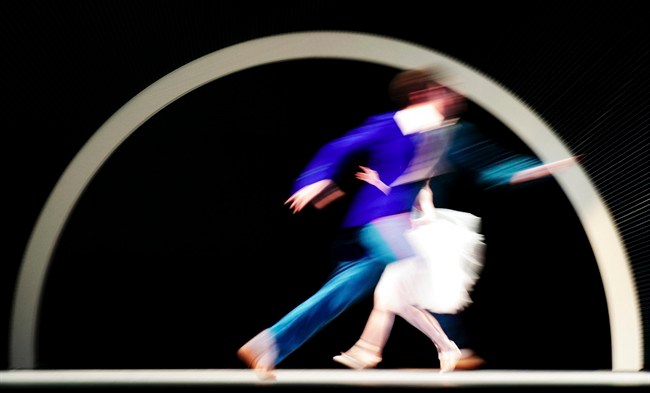
“I’m interested in focusing on body parts, the movements which really one cannot notice in the audience,” says Baryshnikov, 64.
He knows what he’s looking for, after all, and he can get a backstage pass anywhere in the world. The Latvian-born dancer who electrified ballet in the Soviet Union before defecting to dance with major ballet companies worldwide is now artistic director of the Baryshnikov Arts Center in New York.
“This is one of the foremost dancers in the world, and the show itself is about dance,” says gallery owner Gary Nader. “He has what would be some kind of inside information about what’s going on onstage more than any other photographer.”
Baryshnikov has been taking pictures for most of his adult life, and in the past 10 years he’s experimented with digital photography to capture movement. The results are images of figures that are intentionally blurred but still recognizable as dancers in the act of dancing.
“This is not a photography show by a celebrity. This is a photography show by someone who takes great pictures,” Nader says.
Baryshnikov says that by capturing layers of movements in a single frame, instead of stopping the motion in a static image, he’s trying to show something that’s missing from most dance photography.
“You open a section of The New York Times, and there’s a review or a story on a choreographer or a dancer, and there’s an informative, clear image of a dancer,” he says. “This is, in my view, not an interesting photograph.”
Instead of illustrations about dance, Baryshnikov wants his photographs to offer an experience similar to a live performance.
“I want them to entertain as much as good dance entertains people in the audience,” Baryshnikov says.
The effect in the gallery, though, feels less like watching a performance on stage, even from a good seat, and more like standing on a crowded nightclub floor.
Indeed, some of the photographs were taken in cafes or clubs where Baryshnikov noticed regular people dancing. The Miami show includes a handful of images from Baryshnikov’s previous photography collections “Dominican Moves,” shot in cafes in the Dominican Republic, and “Merce My Way,” his collaboration with the challenging American choreographer Merce Cunningham, who died in 2009.
Baryshnikov regards both professional and amateur dancers with the same eye.
Red light fans above a skimpily-dressed woman in a nightclub, reflecting off her metallic miniskirt and adding heat to her sultry gyration. A flamenco dancer’s arm arcs above her head, evoking the classical pose in a painted portrait behind her.
The outstretched arms of Hawaiian hula dancers balance the blur of their grass skirts, highlighting the poise required to make audiences notice the small movements of their hips. Pairs of dancers on stages push and pull at each other, their faces and hands in focus while the rest of their bodies are more impressionistic.
In a stage set that Baryshnikov said reminded him of a Marc Chagall painting, a dancer’s elbow and leg peek through the doorway of a red house, a spot of stillness flanked by whirls of red and blue costumes.
What connects the dancers from different countries and cultures is their vulnerability, Baryshnikov says. “Dance is one of the most revealing art forms,” he says. “I remember the great Martha Graham said, ‘A body cannot lie.'”
“When a body moves, it’s the most revealing thing,” he continues. “Dance for me a minute and I’ll tell you who you are.”
———
If You Go…
DANCE THIS WAY: Photographs by Mikhail Baryshnikov. Gary Nader Art Centre, 62 NE 27th Street, Miami; http://www.garynader.com/. Exhibit opens to the public Feb. 24. Hours: Monday-Saturday, 10 a.m.-6 p.m.