Freaky sculpture raises ethical, moral dilemmas

Advertisement
Read this article for free:
or
Already have an account? Log in here »
To continue reading, please subscribe:

Digital Subscription
One year of digital access for only $205*
- Enjoy unlimited reading on winnipegfreepress.com
- Read the E-Edition, our digital replica newspaper
- Access News Break, our award-winning app
- Play interactive puzzles
*First annual payment billed as $205.00 + GST for one year. This annual subscription will automatically renew at $233.00 + GST every 52 weeks (10% off the regular annual price of $259.35). Offer available to new and qualified returning subscribers only. Cancel any time.
To continue reading, please subscribe:
Add Free Press access to your Brandon Sun subscription for only an additional
$1 for the first 4 weeks*
- Enjoy unlimited reading on winnipegfreepress.com
- Read the E-Edition, our digital replica newspaper
- Access News Break, our award-winning app
- Play interactive puzzles
*Your next Brandon Sun subscription payment will increase by $1.00 and you will be charged $17.95 plus GST for four weeks. After four weeks, your payment will increase to $24.95 plus GST every four weeks.
Read unlimited articles for free today:
or
Already have an account? Log in here »
Hey there, time traveller!
This article was published 14/07/2012 (5154 days ago), so information in it may no longer be current.
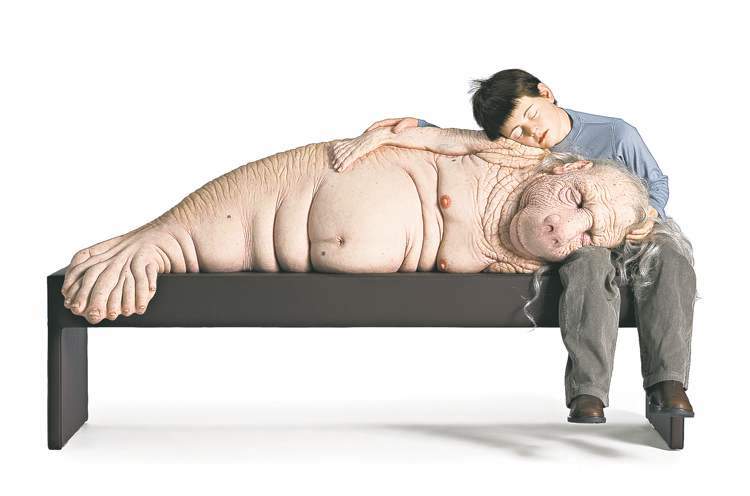
WHAT IT IS: The Long Awaited, by Australian sculptor Patricia Piccinini. Currently on view at the Winnipeg Art Gallery, this hyper-realistic life-size work is part of Fairy Tales, Monsters and the Genetic Imagination, a travelling group show with a fairly high freakout factor.
WHAT IT MEANS: Piccinini depicts a little boy asleep with his “pet.” What should be a cosy scenario is made disturbing by the fact that the companion animal in question is some sort of unidentifiable hybrid creature. Part manatee (maybe) and part elderly lady (perhaps), it is both monstrous and vulnerable, grotesque and touchingly tender. And it challenges our perceptions about the dividing line between the human and the animal.
The Melbourne-based Piccinini is fascinated by the 21st-century collision of science and nature. She creates large-scale works that reference stem-cell research, reproductive technologies, robotics, artificial intelligence and genetically modified organisms.
Her weird personal biosphere — made up of beings that seem to be a mad-scientist mash-up of insect, marsupial and human DNA — could come across as spectacular sci-fi-movie special effects. But her creative scenarios are neither shiny technological paradises nor hellish dystopias. Ambivalent and emotional, her works present the future in terms of new and complicated relationships.
Piccinini often depicts children interacting with strange hybrids that seem to have been created as playthings or even babysitters. Perhaps born into a brave new transgenic world, the kids take the existence of these creatures for granted, approaching them without fear or disgust.
In The Long Awaited, Piccinini uses silicon, fibreglass, human hair and plywood to achieve a level of realistic detail not often seen in contemporary art. She then applies this realism to a fantastically unreal scene, with unnerving results.

The child rests on the kind of bench often seen in art galleries, which could cause a few double-takes. Then there’s the poky, pink fleshiness of the creature and the real hair on the boy, which possess the uncanny, almost-but-not-quite-alive quality seen in waxworks or humanoid robots. There’s even something slightly unsettling about the everyday quality of the clothes, which look like they could have been picked up at Gap Kids.
WHY IT MATTERS: My initial reaction to this work was a sudden, shuddering recoil, but the longer I looked, the more I was drawn into the lovely and loving connection between the child and his friend. What at first seemed aggressively bizarre revealed an unexpected echo of sentimental old paintings of boys and their dogs.
Along with this melancholy emotional tug, the work possesses clear — but never obvious or didactic — moral urgency. The artist may be dealing with speculative futuristic technologies, but she is grappling with questions that artists have been asking since Mary Shelley wrote Frankenstein: Is it dangerous to play God and create life? If we make things that are human-like, where do we draw the line between the human and the monstrous? And if we choose to manufacture living beings to fulfil our needs and desires, what are our ethical obligations toward these creatures?
Art historian Alison Gillmor looks beneath the surface of newsworthy art.
Studying at the University of Winnipeg and later Toronto’s York University, Alison Gillmor planned to become an art historian. She ended up catching the journalism bug when she started as visual arts reviewer at the Winnipeg Free Press in 1992.
Our newsroom depends on a growing audience of readers to power our journalism. If you are not a paid reader, please consider becoming a subscriber.
Our newsroom depends on its audience of readers to power our journalism. Thank you for your support.
Studying at the University of Winnipeg and later Toronto’s York University, Alison Gillmor planned to become an art historian. She ended up catching the journalism bug when she started as visual arts reviewer at the Winnipeg Free Press in 1992.
Our newsroom depends on a growing audience of readers to power our journalism. If you are not a paid reader, please consider becoming a subscriber.
Our newsroom depends on its audience of readers to power our journalism. Thank you for your support.
Advertisement Advertise With Us
Advertisement Advertise With Us