Town’s restored church celebrates 100 years
Advertisement
Read this article for free:
or
Already have an account? Log in here »
To continue reading, please subscribe:

Digital Subscription
One year of digital access for only $205*
- Enjoy unlimited reading on winnipegfreepress.com
- Read the E-Edition, our digital replica newspaper
- Access News Break, our award-winning app
- Play interactive puzzles
*First annual payment billed as $205.00 + GST for one year. This annual subscription will automatically renew at $233.00 + GST every 52 weeks (10% off the regular annual price of $259.35). Offer available to new and qualified returning subscribers only. Cancel any time.
To continue reading, please subscribe:
Add Free Press access to your Brandon Sun subscription for only an additional
$1 for the first 4 weeks*
- Enjoy unlimited reading on winnipegfreepress.com
- Read the E-Edition, our digital replica newspaper
- Access News Break, our award-winning app
- Play interactive puzzles
*Your next Brandon Sun subscription payment will increase by $1.00 and you will be charged $17.95 plus GST for four weeks. After four weeks, your payment will increase to $24.95 plus GST every four weeks.
Read unlimited articles for free today:
or
Already have an account? Log in here »
Hey there, time traveller!
This article was published 06/10/2012 (5104 days ago), so information in it may no longer be current.
Somewhat miraculously, the tiniest of congregations, living in the tiniest of tumbledown villages, once ambitiously described as “une fleur de France,” will celebrate the centennial and recent restoration of its beloved church on Sunday, Oct. 21.
“It’s a small parish and we’re 20 regular parishioners,” says Rachelle Nadeau, renovation/fundraiser co-ordinator for Sacré-Coeur de Jésus Roman Catholic Church in Fannystelle, Man. Nadeau estimates the current population of Fannystelle, a 45-minute drive southwest of Winnipeg along Highway 2, to be about 85 people.
Despite the shrinking congregation, one thing becomes apparent: “This church has a lot of meaning and that became evident when we did our first fundraiser,” says Nadeau.
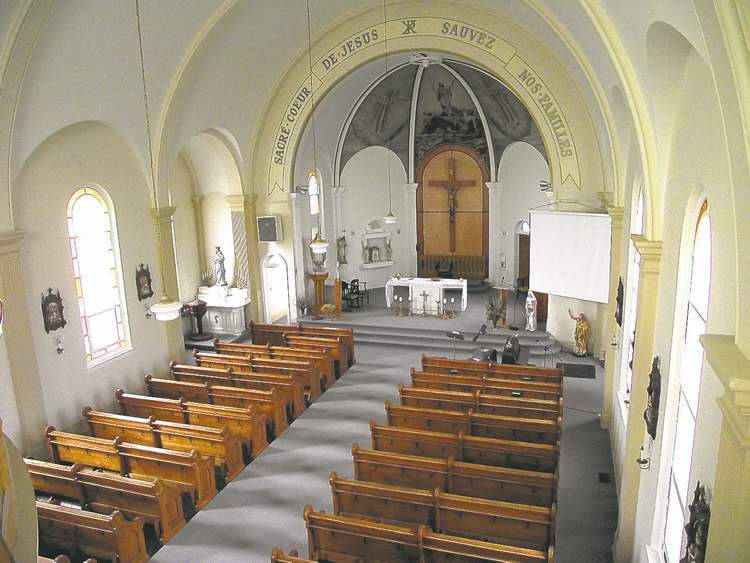
“The church was in really bad shape. The paint was peeling and it would probably have been demolished,” she says.
They asked themselves, “Do we fix it? We’re not a lot of people.”
They decided to give it a try and let the people speak, and the small group held a steak supper. “That night, in one night, we raised $50,000 — so that spoke to what we wanted to do. We had to save the church.
“It is a very important spiritual building for the area — not just for Fannystelle but for Elie, Starbuck, Elm Creek,” says Nadeau. Many people come to the church for different occasions.
The small but devoted group ran a “name a window campaign,” along with the supper, where church windows were sold for $5,000 a piece.
“Eight windows were sold right away,” Nadeau says.
“They’re (the donors) getting a bronze plaque with their name on it, and the unveiling of the plaques will take place on Oct. 21.”
Sacré-Coeur, which was designated a historical site by the province, also received substantial grants from the Sir Thomas Cropo Foundation Inc., the province and the Thomas Sill Foundation.
The congregation hoped to raise $100,000 for repairs.
“We exceeded our goal and were able to restore more parts of the church,” Nadeau says.
The renovations included insulating the basement, painting the entire church, repairing the windows and restoring the bell towers.
Though the community never reached the soaring heights hoped for in the prosperous early 1900s, Fannystelle has an enchanting history.
Founded in 1889 by a Parisian countess, Marthe d’Albuféra, along with Sen. T.A. Bernier, who encouraged the immigration of settlers from Quebec and wealthy families from France, it was named in honour of d’Albuféra’s deceased friend, Fanny Rives.
Rives devoted her life to helping the poor of France, according to the Manitoba Free Press of 1890, and died in 1883. A life-size marble bust of her, described then as “a magnificent specimen of sculpturing,” was shipped from France and can still be seen outside the church in Fannystelle. Fannystelle translates to Fanny’s star or étoile de Fanny.
Bernier’s son, Noël Bernier, wrote a history of Fannystelle in 1934, describing Fannystelle then as “a flower of France blooming in the Manitoba soil.” The first settlers arrived from France, Quebec and later Great Britain and other European countries.
Construction of a small chapel took place in 1889 and when it became too small, a larger church was built in 1911. The church soon burned down.
Parishioners began to build the current church in October 1912 following the plans of the previous one.

Two bell towers of uneven height dominate the front of the church today and surround a huge circular rose window that is considered an increasingly rare architectural sight.
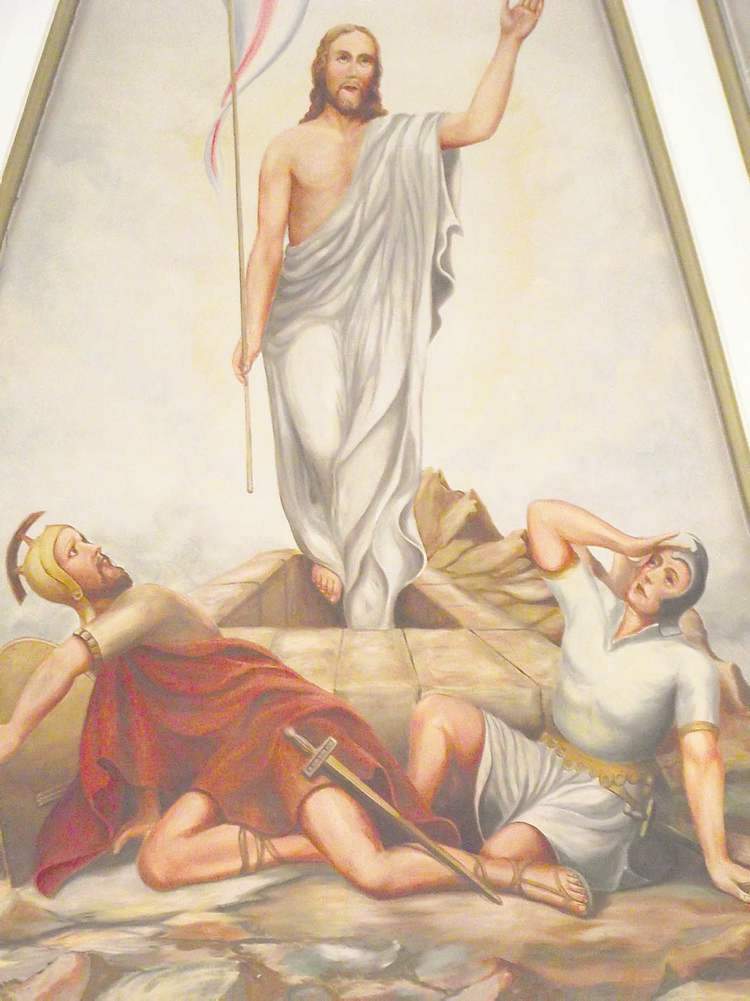
Inside, three huge murals fill the vaulted ceiling of the sanctuary. These scenes from the Resurrection were painted by Arthur Godin in 1935, says former parishioner Irene Painchaud.
Statues were purchased about the same time, says Painchaud, and included the Sacred Heart of Jesus, the Virgin Mary and Saint Joseph, the Infant Jesus, Saint Anne and others, many of which can still be seen in the church. The Stations of the Cross were installed in 1913.
If you’d like to see a place of worship featured here, email girard.cheryl@gmail.com
The Free Press is committed to covering faith in Manitoba through our Religion in the News project. This reporting continues because readers like you step forward to fund it.
Donate now to support our reporting on religion.
Your donation is eligible for a charitable tax receipt.
BECOME A FAITH JOURNALISM SUPPORTER
History
Updated on Saturday, October 6, 2012 1:05 PM CDT: adds fact box
The Free Press acknowledges the financial support it receives from members of the city’s faith community, which makes our coverage of religion possible.