

Mythmaking IN THE MARGINS
WAG exhibition suggests there may be something to the stories Winnipeg tells about itself
Advertisement
Read this article for free:
or
Already have an account? Log in here »
To continue reading, please subscribe:
Digital Subscription
One year of digital access for only $1.44 a week*
- Enjoy unlimited reading on winnipegfreepress.com
- Read the E-Edition, our digital replica newspaper
- Access News Break, our award-winning app
- Play interactive puzzles
*Billed as $5.77 plus GST every four weeks. After 52 weeks, price increases to the regular rate of $19.95 plus GST every four weeks. Offer available to new and qualified returning subscribers only. Cancel any time.
To continue reading, please subscribe:
Add Free Press access to your Brandon Sun subscription for only an additional
$1 for the first 4 weeks*
- Enjoy unlimited reading on winnipegfreepress.com
- Read the E-Edition, our digital replica newspaper
- Access News Break, our award-winning app
- Play interactive puzzles
*Your next Brandon Sun subscription payment will increase by $1.00 and you will be charged $17.95 plus GST for four weeks. After four weeks, your payment will increase to $24.95 plus GST every four weeks.
Read unlimited articles for free today:
or
Already have an account? Log in here »
Hey there, time traveller!
This article was published 01/11/2012 (4960 days ago), so information in it may no longer be current.
Winnipeg is a unique place, and it’s uniquely self-obsessed. While New Yorkers or Torontonians can afford smug short-sightedness, though, Winnipeggers are keenly aware of their insignificance in the grand scheme. To compensate, we seize on dubious distinctions (consuming the most Slurpees, committing the most knife crime) and engage in self-mythology, broadcasting an image of the city as an undiscovered oasis of cutting-edge cultural production.
Few have promoted that image as tirelessly as Border Crossings founder Robert Enright and editor-in-chief Meeka Walsh, figures who’ve profoundly shaped what “Winnipeg art” means to national audiences. For Winnipeg Now, the survey exhibition currently at the WAG, the pair brings together 11 noted artists with ties to the city, and the results suggest that Winnipeg’s hype, if largely self-generated, is also mostly justified.
While the curators let the works speak for themselves, some recurring themes emerge, with “mythology” chief among them. Some of the fables here are familiar, as in photographer and multimedia artist Sarah Anne Johnson’s romantically realized dreamscapes of the High Arctic or Marcel Dzama’s macabre, chess-themed ballet. Some, like those of Michael Dudeck’s made-up space religion (don’t ask), are wholly fabricated.
Other artists find mythic potential in familial and cultural trauma. In Only Dream Things, Guy Maddin recreates his childhood bedroom, inherited after his older brother’s suicide, as a freestanding film set accompanied by sinister projections and wrenching tableaux of personal effects. Though it wears its artifice openly, the scene feels as haunted by actual ghosts as it does by upsetting memories.
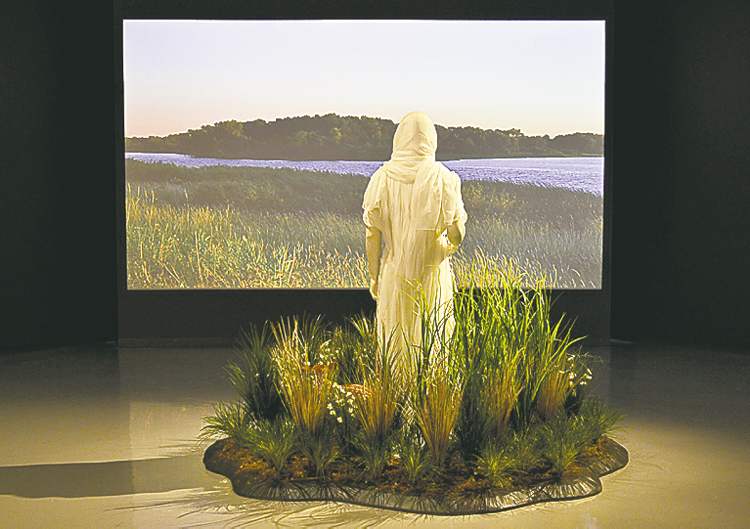
Here, as in all his best work, Kent Monkman walks a razor’s edge between sneering camp and mournful beauty, all the while bristling with scarcely disguised rage. Lot’s Wife reimagines the tragic biblical figure as a glistening white life-cast of Monkman’s drag alter-ego, Miss Chief. With a partial erection visible through her gauzy white dress, she looks back toward a serene landscape — a site near the experimental Manitoba reserve that Monkman’s great-grandmother was first forced onto and later forced to leave.
“Marginality” resurfaces often as both a formal and a psychological concern. Paul Butler’s monumental volume of daily to-do lists, ephemera that he’s collected obsessively since 1997, seems to have prophesied what social media would later prove about the over-examined life, while Dominique Rey adopts various approaches, ranging from video to gardening, to document and preserve the experiences of a vanishing order of Catholic nuns.
It’s the artists who extract transcendent results from debased materials and equipment, though, who best illustrate Winnipeg’s indomitable “make-do” ethos, distilling it into a unique esthetic sensibility. Along these lines, Jennifer Stillwell combines house paint, epoxy resin, and (with characteristic weirdness) rainbow sprinkles to concoct imposing, abstracted aerial landscapes. Daniel Barrow’s show-stealing Thief of Mirrors employs a disorderly array of current, obsolete and lo-fi equipment and assorted hack-jobs to bring his ghoulish illustrations shudderingly to life. Equally opulent and grotesque, the work presents a kaleidoscopic nightmare scenario of failing youth, beauty, and wealth.
While Winnipeg Now might seem like an odd title for a show where about half of the artists currently live elsewhere (this has been a source of some grumbling, locally), the exhibition more than capably reflects the image of art in Winnipeg has that exists on the national and international stage. Whether that image is rooted in myth or reality is for you to decide, as is how much that distinction matters in the first place.
Steven Leyden Cochrane is a Winnipeg-based emerging artist, writer and educator from Tampa, Fla.
Winnipeg Now

óè Curated by Robert Enright
and Meeka Walsh
óè Winnipeg Art Gallery
óè Sept. 29 to Dec. 30