The opposite of Instagram

Winnipeg's Pinhole Artist Collective goes back to basics to recapture some of photography's unruly charm

Advertisement

Advertise with us

I'll admit that I have a sentimental attachment to "traditional" (analog, film-based) photography, but I can't pretend the transition to digital hasn't been a positive one -- for the most part.

Read this article for free:


or

Already have an account? Log in here »

To continue reading, please subscribe:

Subscribe and receive a limited-edition Free Press branded hat or tote.

Digital Subscription

One year of digital access for only $205*

  • Enjoy unlimited reading on winnipegfreepress.com
  • Read the E-Edition, our digital replica newspaper
  • Access News Break, our award-winning app
  • Play interactive puzzles

*First annual payment billed as $205.00 + GST for one year. This annual subscription will automatically renew at $233.00 + GST every 52 weeks (10% off the regular annual price of $259.35). Offer available to new and qualified returning subscribers only. Cancel any time.

To continue reading, please subscribe:

Add Free Press access to your Brandon Sun subscription for only an additional

$1 for the first 4 weeks*

  • Enjoy unlimited reading on winnipegfreepress.com
  • Read the E-Edition, our digital replica newspaper
  • Access News Break, our award-winning app
  • Play interactive puzzles
Start now

*Your next Brandon Sun subscription payment will increase by $1.00 and you will be charged $17.95 plus GST for four weeks. After four weeks, your payment will increase to $24.95 plus GST every four weeks.

Opinion

Hey there, time traveller!
This article was published 24/01/2013 (4969 days ago), so information in it may no longer be current.

I’ll admit that I have a sentimental attachment to “traditional” (analog, film-based) photography, but I can’t pretend the transition to digital hasn’t been a positive one — for the most part.

My grandmother had a black-and-white darkroom in the attic of her house in upstate New York that we’d visit most summers, accessible by way of a three-metre ladder. I did my own black-and-white processing and printing through high school. I miss skulking around under the red and amber safelights, watching images materialize as if by magic in shallow, smelly chemical baths. I miss the post-vacation ritual of picking up the drugstore prints, tearing open the envelope in the back seat, uncertain and excited to see what turned out.

I think I last had film developed 10 years ago.

Submitted
Winnipeg’s Pinhole Artist Collective goes back to basics to recapture some of photography’s unruly charm. Pictured: Open, by Lori Fontaine.
Submitted Winnipeg’s Pinhole Artist Collective goes back to basics to recapture some of photography’s unruly charm. Pictured: Open, by Lori Fontaine.

Digital is cheap, immediate, leaves comparably little to either skill or chance, and perfectly suits the way most of us actually use photographs on a daily basis, and if you’re feeling nostalgic, there are apps and filters to add back in the scratches, light-leaks, and wonky colouring that digital SLRs and cellphone cams erased.

I can acknowledge the benefits of leaving film behind, but some things did get lost in the transition that Instagram can’t quite replace. In hopes of recovering them, the Pinhole Artists Collective — a rotating crew of notable Winnipeg photographers whose current exhibition at Platform Centre, be.still, coincides with the launch of their book, Collecting Light — return to some of photography’s earliest, most basic forms.

Any light-proof box with a hole on one side to serve a rudimentary lens can be a camera, whether it’s an oatmeal canister or a spare bedroom (I’ve done it with both because I make my own fun.) Light passes through the “lens” and lands on the opposite wall as a perfect, projected image of whatever’s outside. Put a piece of light-sensitive film or paper in its path, and you’ve made a photograph. It’s basic physics; it’s bonkers, and its simplicity and directness are what lend analog photography its unique, almost “magical” aura of authenticity.

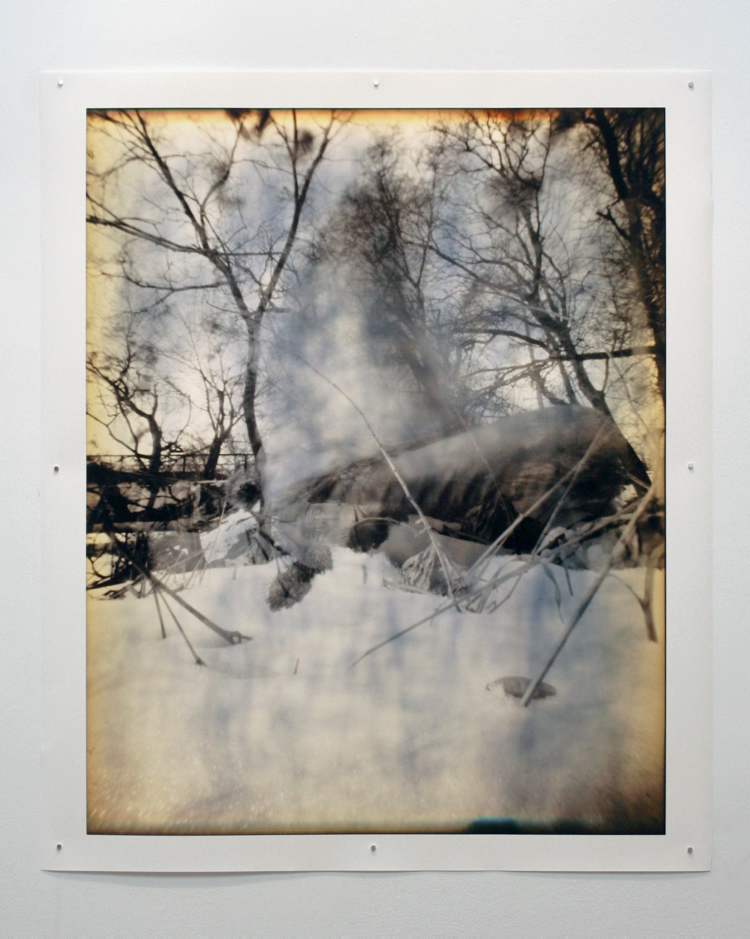
Members of the collective use self-made “pinhole cameras” based on these principles to create lasting documents of the world around them. The images featured in the show are everyday scenes of buildings, plants and landscapes, but the idiosyncrasies of the crude devices used to make them yield surprising results. Buckles in the film result in funhouse-mirror distortions and reflections, while stray beams of light create streaks and haloes of vivid colour. Long exposure times and imperfect optics make for dreamlike blurring effects and stuttering double-exposures, and, for the most part, this is all well beyond the photographer’s control.

The exhibition is, in essence, a collection of happy and genuinely satisfying accidents, but the book features images that are even more surprising. “Solargraphs,” made with pinhole cameras wedged among tree branches or duct-taped to eavestroughs, “capture light” for weeks or even months. The exposures are so long that you see not just the trail of the sun as it passes, but an array of arcing bands that show its changing height in the sky across whole seasons.

Submitted
Winter, by William Eakin
Submitted Winter, by William Eakin

If all this just seems needlessly antiquated (to say nothing of inefficient), that’s fair enough. For the rest of us nerds, there’s a workshop to make our own solargraph cameras on Feb. 2 — and again in September to see how the pictures turn out.


Steven Leyden Cochrane is an Winnipeg-based artist, writer, and educator from Tampa, Fla.
Submitted
Omand's Creek, by Sarah Crawley
Submitted Omand's Creek, by Sarah Crawley
Submitted
Ruins, by Jen Loewen
Submitted Ruins, by Jen Loewen
History

Updated on Friday, January 25, 2013 11:18 AM CST: Adds colour photographs.

Report Error Submit a Tip

More Stories

Dynacare strike could lead to lab test logjam

Carol Sanders 4 minute read Preview

Dynacare strike could lead to lab test logjam

Carol Sanders 4 minute read Yesterday at 2:00 AM CDT

DOCTORS and health-care advocates are raising concerns about patient care if a Sept. 8 strike goes ahead at the private company that provides nearly all medical lab services in Manitoba.

There is no essential services agreement in place with Dynacare, so if its lab techs are off the job, patients who need blood tests and urinalysis will be directed to hospitals and public clinics for those services.

“There’s only so many of those workers and I’m sure that the public folks are bracing for big crunch of additional patients if the strike really goes ahead,” Noah Schulz of the Manitoba Health Coalition said Monday.

Dynacare serves 1.2 million Manitoba patients a year at 23 community lab locations.

Read
Yesterday at 2:00 AM CDT

Mayoral rematch between Gillingham, Klein gets ugly on Day 1

Joyanne Pursaga 6 minute read Preview

Mayoral rematch between Gillingham, Klein gets ugly on Day 1

Joyanne Pursaga 6 minute read Updated: Yesterday at 6:25 PM CDT

Former city councillor and provincial cabinet minister Kevin Klein says he will soon enter the race to become Winnipeg’s next mayor — prompting an immediate war of words with incumbent Scott Gillingham.

Gillingham quickly responded to the announcement by calling Klein “toxic” and a “fixer” for Peter Nygard.

Klein said Tuesday he had decided not to enter the mayoral race weeks ago due to an unspecified health scare that required surgery. After recovering, he decided to run.

“The future of the city means a lot to me. I believe that we have so much untapped potential that I felt I should do something about it,” said Klein, noting he felt compelled to run because key city issues, such as perceptions of public safety in the downtown, have grown worse over the past four years.

Read
Updated: Yesterday at 6:25 PM CDT

Filtering the worst of our behaviour

Gwynne Dyer 5 minute read 2:00 AM CDT

On Sunday, Aug. 30, a Falcon Heavy rocket delivered the Nancy Grace Roman space telescope onto a direct transfer trajectory to its permanent home at the Lagrange Two Point (L2), 1.5-million km from Earth. In 100 days it will reach its station, power up, and start observing the universe.

Astronomers will use it to try to understand the nature of dark matter, which makes up most of the mass in the universe (but some say may not even exist).

It is expected to find up to 100,000 new exoplanets circling other stars, and may be able to spot ones even smaller than Mars. Current methods can only see much bigger ones.

It will test a new technology called a coronagraph, which may one day be able to detect life on some of those planets by analyzing the light reflected from them. It would be nice to have a better answer to scientist Enrico Fermi’s famous question: “Where is everybody?”

Port of Churchill celebrates first grain shipment in six years

Aaron Epp 6 minute read Preview

Port of Churchill celebrates first grain shipment in six years

Aaron Epp 6 minute read Monday, Aug. 31, 2026

Approximately 30,000 tonnes of Canadian durum wheat from Saskatchewan-based AGT Foods is being loaded at the northern Manitoba port and will be shipped to customers in Europe.

Read
Monday, Aug. 31, 2026

Renewed spirit and life: Indigenous treatment centre expands with $21-M revamp

Scott Billeck 5 minute read Preview

Renewed spirit and life: Indigenous treatment centre expands with $21-M revamp

Scott Billeck 5 minute read Yesterday at 3:44 PM CDT

Don Robinson knows first-hand that many people don’t get sober by themselves.

In late June 1984, Robinson downed his last drink. His recovery began at Pritchard House in Winnipeg’s North End, a 22-bed treatment facility run by the Native Addictions Council of Manitoba.

“I didn’t get sober by myself,” said Robinson, a member of Bunibonibee Cree Nation who now works in grief and trauma counselling and traditional knowledge as an elder at Ka Ni Kanichihk Inc.

More than four decades later, Robinson was back at the council on Monday, crowded into a room at its newly renovated treatment centre at 160 Salter St. — a place he once turned to for help and where he helps others now.

Read
Yesterday at 3:44 PM CDT

Rare and tough to notice, sarcomas may lurk in the body

Jen Zoratti 12 minute read Preview

Rare and tough to notice, sarcomas may lurk in the body

Jen Zoratti 12 minute read Monday, Aug. 31, 2026

Last summer, Michelle Finley was going about a normal day.

She had just dropped her car off at a garage and was walking back to her office building downtown when, suddenly, she was stopped in her tracks by a searing cramp on the bottom of her right foot.

“It was so painful it took my breath away,” says Finley, now 52. “I stopped and held on to the side of a building for a second — like, it was bringing tears to my eyes.”

Finley thought she had a really bad case of plantar fasciitis. Nine months later she would lose her foot to sarcoma.

Read
Monday, Aug. 31, 2026