Touring production of Les Mis a visual treat, but emotionally lacking
Advertisement
Read this article for free:
or
Already have an account? Log in here »
To continue reading, please subscribe:

Digital Subscription
One year of digital access for only $205*
- Enjoy unlimited reading on winnipegfreepress.com
- Read the E-Edition, our digital replica newspaper
- Access News Break, our award-winning app
- Play interactive puzzles
*First annual payment billed as $205.00 + GST for one year. This annual subscription will automatically renew at $233.00 + GST every 52 weeks (10% off the regular annual price of $259.35). Offer available to new and qualified returning subscribers only. Cancel any time.
To continue reading, please subscribe:
Add Free Press access to your Brandon Sun subscription for only an additional
$1 for the first 4 weeks*
- Enjoy unlimited reading on winnipegfreepress.com
- Read the E-Edition, our digital replica newspaper
- Access News Break, our award-winning app
- Play interactive puzzles
*Your next Brandon Sun subscription payment will increase by $1.00 and you will be charged $17.95 plus GST for four weeks. After four weeks, your payment will increase to $24.95 plus GST every four weeks.
Read unlimited articles for free today:
or
Already have an account? Log in here »
Hey there, time traveller!
This article was published 25/07/2013 (4748 days ago), so information in it may no longer be current.
The pressing question that envelopes the 25th anniversary production of Les Misérables — before, during and after — is whether it is truly better than the original, which stands alone in its dramatic and emotional achievements.
Not only is the Alain Boublil and Claude-Michel Schonberg world-conquering musical justly beloved, but it has been seen by 60 million people, so you mess with it at your peril.
The Broadway Across Canada touring production that stopped at the Centennial Concert Hall for the first of eight performances July 23 is certainly different, but not as satisfying as the groundbreaking Trevor Nunn and John Caird production that first came to Winnipeg in 1991.
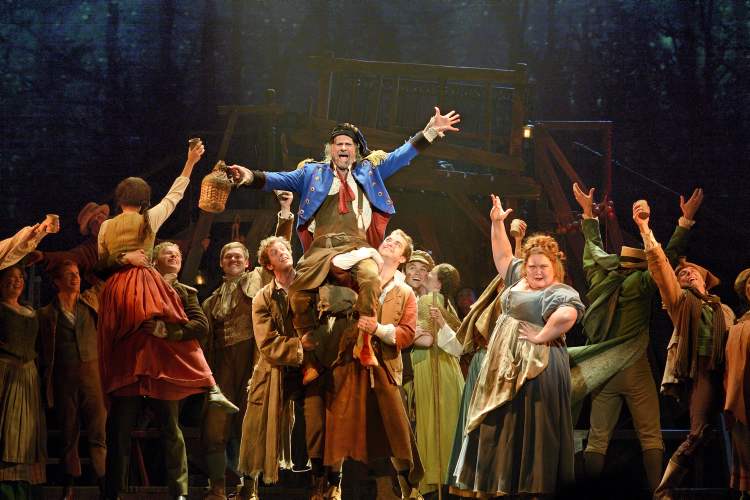
Certainly, the dark and moody revitalization by the Laurence Connor and James Powell provides much to gush about in its just under three-hour running time. With all the tweaking, re-tooling and streamlining, there has been a lessening of the emotional impact earned by the lush emotionalism of Schonberg’s score and Victor’s Hugo 1862 tale of redemption, first love and doomed revolution. The tempo of the songs is occasionally too fast to catch all the words, but most of all, the production fails to allow enough time for the audience to luxuriate in the passions of the melodrama.
The first big tune, Fantine’s anguished I Dreamed I Dream, seemed hurried, was hardly affecting and immediately brought to mind better versions by Britain’s Got Talent find Susan Boyle and Oscar winner Anne Hathaway. It stands in contrast to the showstoppers in the second act that were given sufficient room to be soul-stirring.
The most obvious alteration to Les Misérables is visually, as Hugo’s atmospheric ink drawings of the darkened city streets of Paris and heavily clouded landscapes become the evocative backdrops to the story of tormented Jean Valjean’s lifelong quest for atonement in 19th-century France. The new opening scene, which features crashing waves from a ship, is just a taste of the technical wizardry that is to come and which reaches its zenith in Javert’s death scene and Valjean’s escape into the sewers after the aborted student revolution.
The look is also augmented by the vivid lighting of British designer Paule Constable — the winner of the 2011 Tony Award for her work on War Horse — who emphasizes the message about heroic sacrifices though luminous transitions. However, her method of focusing an ultra-bright shaft of light on all the noble characters as they die is gag-worthy.
Connor and Powell tinker with the presentation to mostly positive effect. The decision to have the street urchin Gavroche die unseen but then have Javert see his dead body piled in a cart made the remorseless police officer’s subsequent acts more plausible. The use of candles to represent the dead students in Empty Chairs at Empty Tables was a nice touch, although injecting a balcony scene to suggest heartthrob Marius and his sweetheart Cosette are Romeo and Juliet is a dubious addition.
The soaring anthems that underpin this sung-through pop opera hold up effectively and are well-matched with a mostly American cast flush with great voices. Standing out among the performers is Peter Lockyer, as Valjean, who embodies this sinner-turned saint with appealing gravitas. His singing was beautiful, although he strained with his falsetto to hit the heights of his wartime prayer Bring Him Home.
Valjean’s single-minded nemesis Javert was played by Andrew Varela, who was not always easy to understand, although he made musical high points of his two arias Stars and Soliloquy. Briana Carlson-Goodman’s Eponine rips off a more angry On My Own, her unrequited love for Marius expressed like a pop song performed by an aggrieved Taylor Swift.
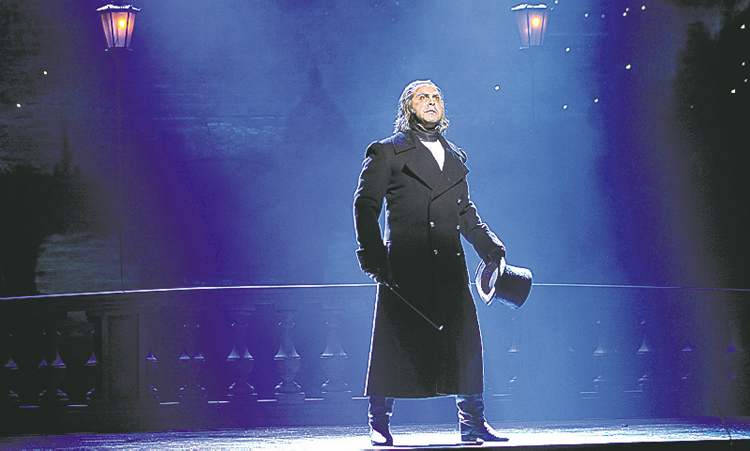
Much, if not all, the humour in Les Misérables is supplied by the villainous innkeepers, the Thernardiers. The creepy Timothy Gulan and the bosomy Shawna A. Hamic are in fine form, exhibiting a comic abandon in a rousing Master of the House and Beggars at the Feast. Devin Ilaw as Marius wrung plenty of regret from Empty Chairs at Empty Tables.
The show’s signature song, Do You Hear the People Sing (re-titled as The People’s Song), remains one of the musical canon’s great sendoff songs and still gets audiences up on their feet cheering, no matter what unnecessary fiddling has gone on to Hugo’s epic tearjerker.
kevin.prokosh@frepress.mb.ca
History
Updated on Thursday, July 25, 2013 1:18 PM CDT: replaces photo, changes headline, corrects spelling of Misérables